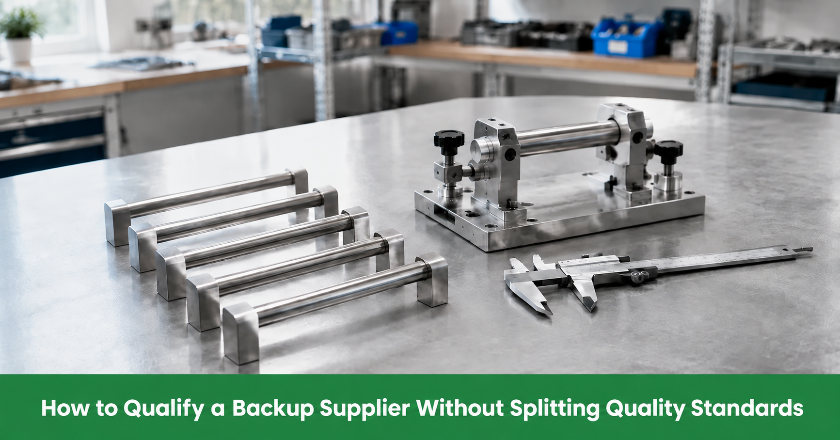
A backup factory can make a convincing sample and still need a different tolerance, material or inspection method to produce it economically. Accepting those differences informally creates two versions of the product under one purchasing description. The customer discovers the difference when replacement parts do not fit, finishes vary or repeat orders behave differently.
Qualify the new production source against the requirements already approved for the product. Allow different manufacturing methods where they deliver equivalent results, but require evidence before treating either the method or the output as acceptable. The useful distinction is between changing how a product is made and changing what the buyer has agreed to buy.
Keep One Standard Across Both Factories
A backup supplier becomes qualified against the same baseline, not against an easier acceptance rule. The quality baseline is the approved product requirements and test methods used by both factories. Keep acceptance fixed while checking whether the new production source can repeatedly satisfy it, then approve only the product and production conditions that the evidence actually covers.
- Agree before sampling: issue one current specification, reference sample and test-method set.
- Make results comparable: settle conflicting measurements before negotiating a tolerance change.
- Test repeat production: obtain pilot evidence from the intended equipment, materials and setup conditions.
- Limit approval: record the site, revision, restrictions and changes that require another review.
Freeze the Product Standard Before Sampling
Approve one product baseline before asking the backup factory to make qualification samples. Give the primary and backup factories the same acceptance requirements, and name the person authorized to resolve gaps or approve changes. Otherwise, each factory can reasonably interpret an incomplete brief differently, leaving the buyer to negotiate quality after tooling, materials and delivery dates have already been committed.
A written plan turns expectations into something testable: ASQ's quality-plan guidance covers standards, practices, resources and specifications for a particular product or activity. For backup qualification, use that principle to connect each important characteristic to an acceptance limit, a test method and a current document revision.
The following checklist separates common product requirements from factory-specific working methods. It is a planning aid, not a substitute for the technical requirements of the product or destination market.
| Control area | Keep common | What may differ | Evidence to request |
|---|---|---|---|
| Material and components | Approved grade, construction and functional requirements | Purchasing route, where permitted | Material identification and relevant test results |
| Dimensions and fit | Drawing revision, tolerances and mating requirements | Equipment or tooling design after validation | Measurements tied to parts and the agreed method |
| Appearance | Approved finish and acceptable defect boundaries | Process settings that achieve the same result | Retained samples and controlled viewing conditions |
| Function and durability | Required performance and test conditions | Internal production controls | Results from representative production units |
| Packing and identification | Protection, quantities, markings and traceability needs | Packing-station arrangement | Packed-unit checks against the approved requirement |
Do not treat the incumbent's recent output as the only standard. An existing factory may itself be drifting. If its goods conflict with the approved drawing, settle the discrepancy with the technical owner before qualification starts; copying an existing defect does not establish equivalence. Identify reference samples by revision and date, and define which written requirement governs when the sample cannot show a property clearly.
For a hardware buyer adding equivalent products from China, mounting fit and finish consistency affect returns and repeat sales. NewBuyingAgent's local industrial-cluster resources support product sourcing from China against defined purchasing needs. Provide the approved product version and acceptable variation with the sourcing request, so price and delivery are considered alongside the required product outcome.
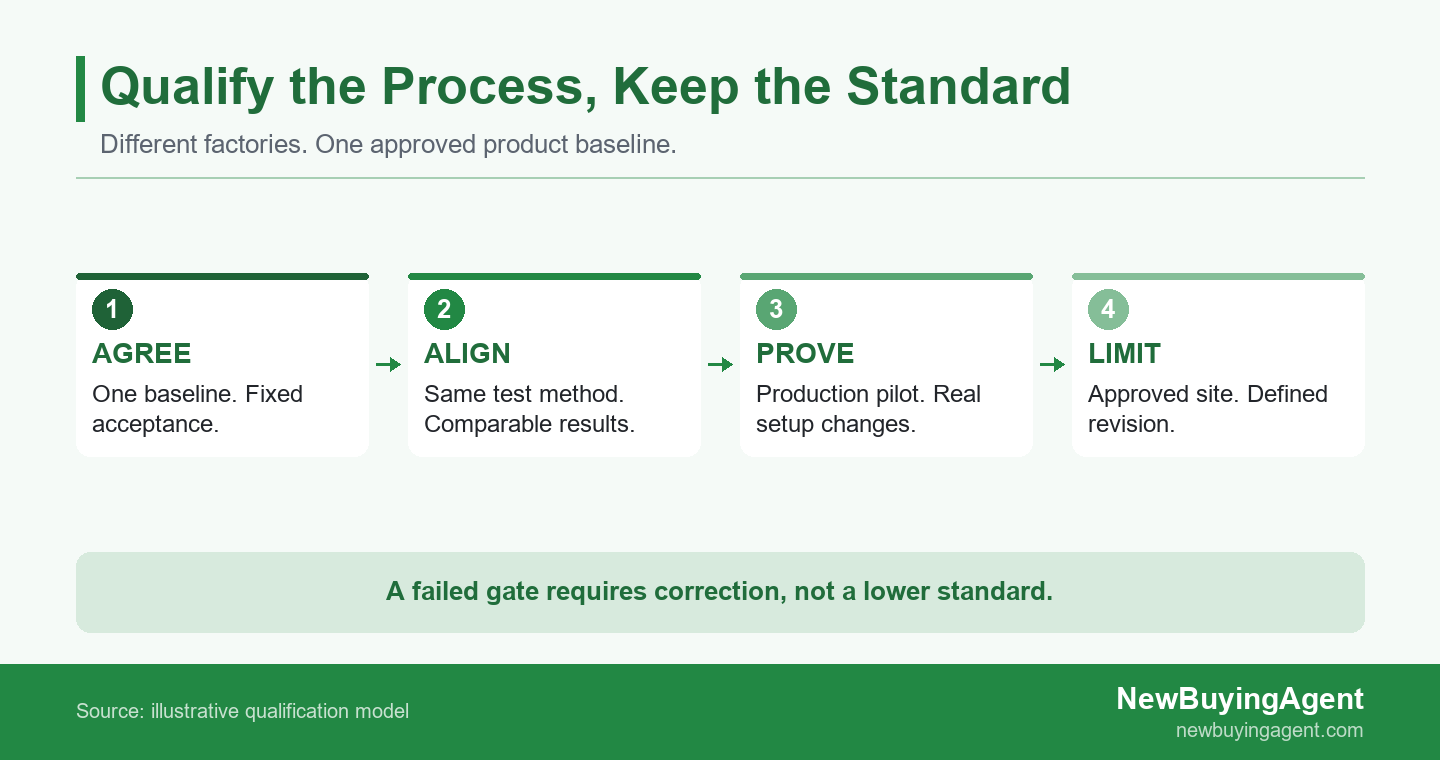
Four qualification gates keep the same product standard from baseline agreement to scoped approval
Make Both Teams Reach the Same Test Verdict
Resolve measurement disagreement before treating conflicting pass and fail reports as a production problem. A buyer and factory can inspect the same part but obtain different results because they use different reference points, fixtures or conditions. Establish agreement on the method first; otherwise, additional samples may only reproduce the disagreement, and widening the tolerance may conceal rather than solve it.
Compare the Same Parts Under the Same Conditions
Use the same retained parts and written method to separate measurement variation from product variation. Mark each part, preserve its identity and have both teams record results independently. For a mounting dimension, specify the reference points, fixture, instrument resolution and rounding rule; for appearance, agree on lighting, viewing distance and the reference finish. Agree in advance how borderline readings will be resolved.
The NIST guidance on gauge studies examines errors affecting production measurements, including repeatability and reproducibility. That distinction matters when one inspector repeats a reading consistently but another obtains a different result. Ask the quality specialist to assess the measurement system for the required tolerance; a calibration label alone does not resolve differences in how the part is positioned and measured.
Check the Actual Site Behind the Sample
Audit evidence and prototype results answer different questions about production readiness. Establish where the sample was made, which process produced it and whether the proposed commercial site will use the same route. A hand-finished sample from a development workshop does not demonstrate the output of the planned production line. Ask which critical operations are subcontracted and how their materials and process changes are controlled.
ASQ's supplier-quality guidance includes quality-system assessment and prototype or sample testing among evaluation methods. Use them as complementary evidence: system records show how work is controlled, while product tests show what the submitted units achieved. Neither should silently replace a trial of the intended production conditions.
Verify certification with the issuing body and check the listed site and scope. ISO explains that external certification bodies issue certificates; ISO does not perform certification itself. A certificate is therefore a document to verify, not a reason to skip the product-specific qualification evidence.
Run a Pilot That Tests Repeat Production
A qualification pilot should expose the planned production conditions, not merely reproduce the best sample. Specify the intended materials, equipment, tooling and important setup changes before the run, then keep results traceable to those conditions. The quantity and coverage should follow the product's risks and test needs, rather than a convenient round number chosen after the factory has already made the parts.
Separate first-article checks from repeat-production evidence. The first pieces can reveal a wrong drawing or tool setting, but later pieces may expose drift, wear or a weak restart procedure. Where relevant, include different cavities, production runs or a controlled changeover. Record why those conditions were selected. A deliberately varied qualification pilot is not automatically a statistically representative sample of a future shipment.
Before starting, agree who witnesses the run, how units are selected, which tests are destructive and what findings stop qualification. Preserve failures rather than allowing the factory to replace them with better pieces. For a serious fit or safety concern, do not average the failure away with acceptable cosmetic results. Have a competent technical owner set the applicable acceptance decision and determine whether specialist laboratory testing is necessary.
Illustrative Scenario: A 90-Piece Hardware Pilot
A hardware buyer has accepted an attractive cabinet-pull prototype. In this illustrative scenario, six failures in a 90-piece pilot prevent approval for a planned 1,800-piece order. The buyer-defined mounting centres are 96.0 mm, with a tolerance of plus or minus 0.2 mm; these are example requirements, not an industry-wide specification. The pilot contains 30 pieces from each of three production runs, identified separately rather than mixed into one sample box, with all 6 failed pieces retained.
All six failures occur after the third-run setup reset. Two inspectors agree on measurements using the same method: the buyer's inspector and the factory inspector measure the same retained pieces and reach the same verdict. Pooling results would hide a setup-dependent defect. The pattern points to the drill-jig reset for investigation; it does not justify changing the mounting tolerance to accept the failed parts.
The buyer holds qualification. The factory investigates the reset, corrects the jig-positioning method and adds a documented setup check before production restarts. It then produces a new 90-piece pilot that includes the same reset condition. The buyer does not accept only the replacement pieces that look best: the agreed qualification checks apply to the new run, with measurements and setup records retained together.
If the repeat pilot passes all agreed checks, the technical owner may conditionally approve that product revision at that site with the corrected setup method, while keeping additional checks on the first commercial order. If it fails, qualification remains on hold. Both pilots are development quantities outside the planned 1,800 commercial pieces; their disposition is recorded separately. This example demonstrates diagnosis and approval discipline, not a prescribed pilot size, a guarantee of future performance or a NewBuyingAgent client result.
Record Exactly What the Approval Covers
Limit qualification to the product revision, production site and process conditions actually demonstrated. The approval record should tell the next purchasing or quality colleague what can be ordered, what remains restricted and which changes require another decision. A supplier-level green status without those boundaries can accidentally authorize an untested finish, a relocated line or a larger production requirement than the pilot supported.
Use distinct outcomes. Approved means the defined qualification requirements have been met within the recorded scope. Conditionally approved requires explicit operating restrictions, remaining actions, a responsible owner and a completion date. On hold means the missing or failed evidence prevents the intended release. Conditional approval must not become a quiet waiver of an unresolved safety or mandatory market requirement.
Keep the decision record compact but usable: product and specification revision; factory and site; materials and critical process route; approved reference samples; test methods and results; pilot run identifiers; unresolved actions; permitted order scope; first-order inspection requirements; approver; and review triggers. Record any authorized deviation separately with its exact quantity or time limit. An expired exception must not become the backup factory's permanent standard.
NIST distinguishes lot acceptance from longer-term quality control. A shipment inspection answers whether that immediate lot meets the applicable acceptance decision; it does not by itself establish that every future run will remain consistent. Keep the supplier's qualification record and each commercial lot's release decision separate, while using findings from both to update the production controls.
For buyers already working with China factories, NewBuyingAgent's product-development and QC capability supports management of existing China factories. The relevant purchasing problem is consistent finished goods across repeat orders. Carry the approved product version and first-order restrictions into that relationship, so local quality follow-up supports dependable product supply rather than a disconnected inspection report.
Keep the Baseline Current After Qualification
Changes to the product or production conditions require a documented review before relying on earlier qualification. Keep one controlled product baseline, but retain separate factory records showing how each site meets it. This lets the buyer update a shared requirement without losing the ability to identify which site's material, tooling or process change caused a later difference in output.
Require notification before changes to critical materials, subcontracted operations, tooling, production location or agreed test methods. The technical owner should decide which evidence must be repeated and whether approval remains valid during the change. A new packaging layout might need different checks from a new load-bearing material. Neither an automatic full restart nor automatic acceptance is a sensible rule for every change.
For recurring measurements, ASQ describes control charts as time-ordered views of process behaviour. Where the data and production pattern support them, such records can help reveal change that isolated pass/fail reports conceal. Keep the applicable product limits distinct from statistical control limits, and ask a qualified specialist to select the analysis rather than drawing limits around a handful of convenient measurements.
Before activating an idle backup, confirm the current revision, tooling condition, critical input availability and proposed production slot. An old successful pilot is useful history, not proof that nothing has changed. Set the refresh interval according to the product and process risks, and document the reason; a calendar reminder is only useful if somebody owns the resulting check.
Prepare a Backup-Production Request That Can Be Quoted
Include qualification constraints in the purchasing requirement so the offered product meets the same approved standard. State which product must remain interchangeable, which variations are acceptable and when verified output is needed. This gives a sourcing partner a realistic commercial problem to solve, rather than a request for a cheap sample followed by unpriced testing, tooling and correction work.
Bring the approved specification and reference version, quantity, target price, destination and delivery timing. Add known fit or finish problems, critical tests, any restrictions on process or material changes, and the evidence still missing from backup production. Only share drawings, designs and tooling information that you are authorized to provide; unresolved ownership or permission questions should be settled before transfer.
NewBuyingAgent is a one-stop China sourcing agent service provider for global buyers. Its local factory resources and product/QC capability can connect the quality requirement to a China-sourced product offer with a workable price and delivery path. When equivalent backup production is part of the purchasing need, state those constraints upfront and send the purchasing requirement to NewBuyingAgent.
Frequently Asked Questions
Can one approved sample replace a written specification?
No. A sample helps communicate appearance and feel, but it cannot define every material, dimension, function or test condition. Use it alongside the written requirements, with a revision identifier and an agreed way to resolve conflicts. Replace or reapprove samples when their condition changes; a scratched, faded or damaged reference can create a new disagreement instead of preventing one.
How many units should a backup qualification pilot contain?
There is no universal pilot quantity; choose coverage from product risk, process variation and the tests needed to support approval. Consider production runs, tooling positions, setup changes and destructive testing. Agree the rationale and acceptance decision before manufacture. A small, deliberately varied pilot and a random shipment sample serve different purposes, so do not borrow one quantity without checking the intended decision.
Can a different material be accepted if the finished item looks identical?
Only after the proposed material change has been reviewed and explicitly approved for the intended product and market. Appearance alone does not establish equivalent strength, ageing behaviour or suitability for use. Keep the original requirement active until the technical owner approves the change and its supporting tests. If accepted, issue the revised baseline to all affected production sources and identify any transition stock.
Does backup qualification automatically reserve production capacity?
No. Quality qualification and a committed production slot are separate conditions. Confirm the available volume, critical materials, lead time and booking arrangements before relying on the backup for a delivery promise. If the proposed run is materially different from the conditions already demonstrated, assess whether further production evidence is needed as well as a new commercial commitment.
NewBuyingAgent
Related Resources

Get Started Today
Let's Turn Your Sourcing Goals into RealityWeChat:+86 15157124615
WhatsApp:+86 15157124615
Address:Building 10 #39 Xiangyuan Road, Hangzhou, China