Origin port choice is the selection of the shipment gateway connecting a factory’s loading location to the booked ocean service. A workable choice includes the inland movement, equipment arrangements, port handoff and departure the goods can actually reach.
Start with the exact loading address and cargo-ready date, then compare feasible routes to the same receiving destination. A lower ocean rate can be offset by a longer container movement, extra origin work or a missed cutoff. Select the route using its complete cost and useful receipt date.
Choose the complete factory-to-market route
Factory location helps define possible gateways, while the actual inland service and available sailing determine which option can work. Quote equipment movement, loading and origin charges before judging an ocean discount. Align the delivery responsibilities and final receiving point across the offers. Recheck the result when the factory address, order readiness or booking changes.
- How it works. Build each route from the actual loading site.
- Cost comparison. Include inland, origin, ocean and destination work on the same basis.
- Timeline. Confirm the sailing’s separate gate-in and document deadlines.
- Decision. Choose the feasible route that serves the buying requirement.
Use the loading address to define feasible gateways
Use the factory’s actual loading address, cargo details and ready date to ask providers for feasible gateway routes. A city name leaves open the travel, equipment and access conditions that affect collection. Compare the available inland connections and ocean services for that shipment. The useful shortlist consists of routes that can collect, load and deliver the goods under the buyer’s actual requirements.
Ask which site will load the goods. The sales office, registered address and production facility can be different places. Confirm the district, full address, loading contact and operating hours. Add vehicle access restrictions, container-loading capability and the time needed to load and secure the shipment. If the goods will first move to another warehouse, include that location and the extra handling in the route.
Maersk's China inland-service listing includes truck, rail, barge and depot connections, with different modes shown for individual locations. For example, its Taicang listing in Suzhou identifies barge and truck connections, while other listed locations have different combinations. Use such information to form questions for the provider. Obtain current availability and the actual pickup-to-terminal arrangement for the order.
When sourcing products from China through NewBuyingAgent, factors such as factory location, product specifications, packing requirements and production timelines are considered as part of the overall purchasing process. Having a clearer picture of these order details helps buyers and their logistics providers assess practical collection arrangements, inland transportation costs and suitable origin ports. This ensures that port selection reflects the actual sourcing and shipment requirements, rather than relying on factory location alone.
Turn factory facts into a route shortlist
Use the questions below when requesting origin options. Give each provider the same facts and ask it to identify the actual depot, terminal and service it proposes. Keep an unavailable address, unconfirmed loading condition or missing charge visibly open. Resolve the point with the factory or transport provider before accepting the route as executable.
| Factory fact | Route question | Answer to retain |
|---|---|---|
| Loading address | Where does the journey start? | Actual site and contact |
| Cargo and pack | What vehicle and equipment fit? | Packed units and limits |
| Loading access | Can the proposed truck enter and wait? | Access and loading plan |
| Ready date | Which connection can the goods catch? | Available collection and sailing |
| Other factories | Where will the goods meet? | Consolidation site and deadline |
Compare the loading site, inland scope, available sailing and complete result as connected parts of the same route. Retain the assumptions that make each proposed gateway workable.
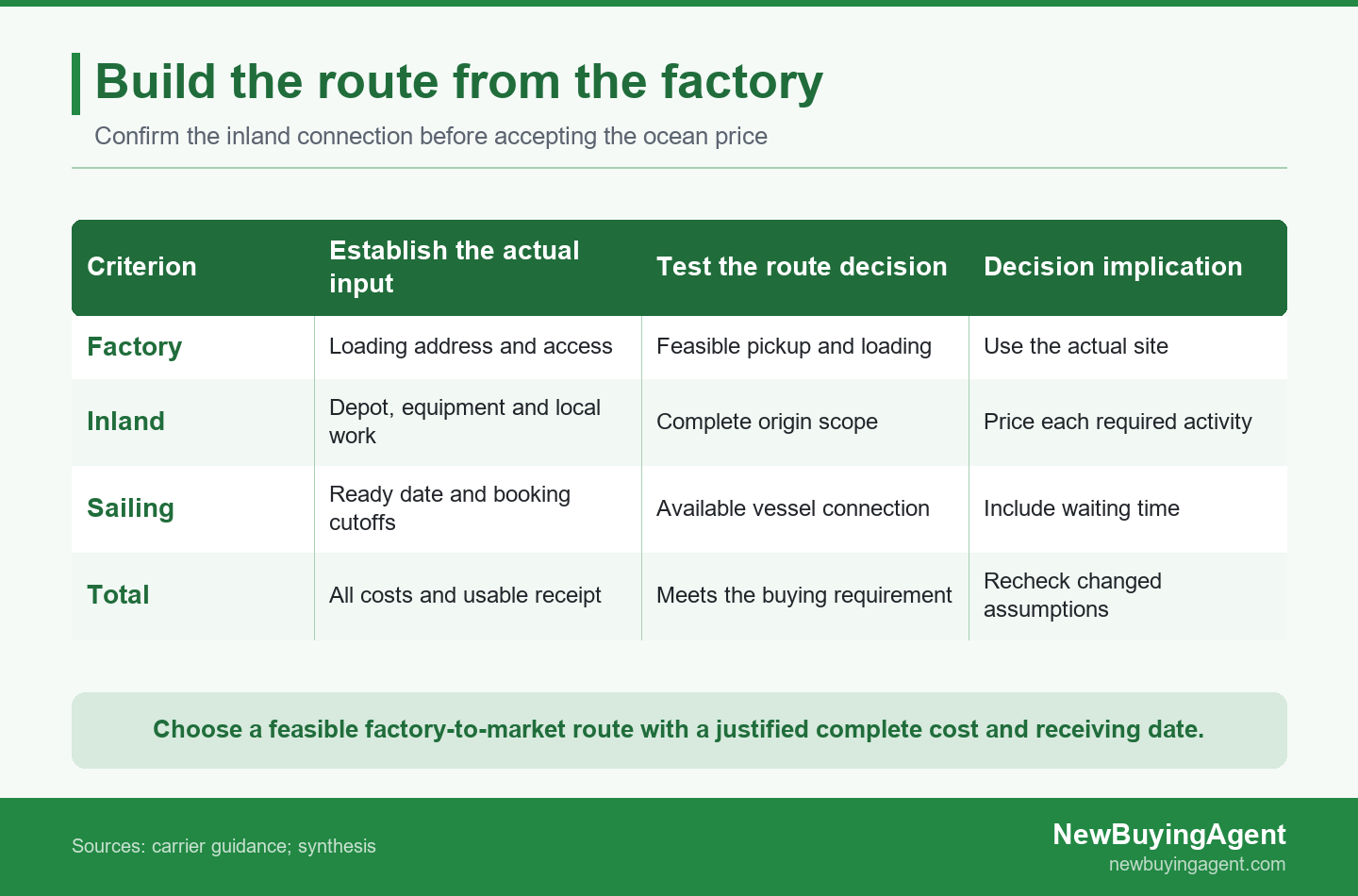
Confirm factory access, inland scope, the available sailing and complete cost before choosing an origin port.
Price the actual inland movement and port handoff
Price the inland operation using the actual equipment collection point, factory-loading arrangement and terminal handoff. Include the required origin activities, identifying the charge unit and responsible payer. The sale contract and transport offer can divide those costs differently. Reconcile the two records so the same activity is covered once in the complete route total.
Include empty pickup, loading and return conditions
For a full container, ask where the empty will be released and how it reaches the factory. Confirm container type, equipment availability, collection reference, loading time allowance and the required laden-container terminal. Include any agreed waiting, additional stops, chassis or special handling. A road-distance estimate from factory to port can omit the empty leg and conditions attached to the equipment.
Hapag-Lloyd’s local-charge table separates country and port location, import or export direction, charge description, currency, amount and unit. Those fields show why an amount needs its applicable place and charging basis. Ask the provider to identify current origin charges in the actual offer and show which are included in its quoted total. A per-container amount and a per-document amount need different quantity inputs.
If the route uses a rail or barge connection, locate the transfer and its terminal work. Confirm how the cargo reaches that connection, how equipment is handled and what happens if it arrives late. Obtain the relevant receiving and departure requirements with the price. A lower inland line item becomes useful when the full connection can be completed.
Align the sale term and the transport quotation
Record the agreed sale term, its named place or port and the product-price inclusions. Then mark which party is arranging each transport activity. A supplier may have included part of the origin movement in the product offer. Compare the combined purchasing and transport position so an origin expense is neither omitted nor added twice.
An ICC Academy explanation of FCA and FOB describes FCA delivery at an agreed place and FOB delivery on board the vessel at the named shipment port. Those different handoffs affect how the parties allocate responsibilities. Confirm the actual agreed rule and named location before asking for a changed gateway. Obtain the supplier’s and provider’s revised scopes where the change affects their work.
Keep the commercial agreement separate from the provider’s operational estimate. A quoted trucking price does not amend the sales contract by itself. If the buyer requests a different port, document the accepted additional work, payer and revised timing with the relevant parties. Preserve the agreed product, quality and export requirements while changing the route.
Check the sailing that the goods can actually catch
Choose a sailing using the packed-ready date and all deadlines needed for the cargo to be accepted. Inland collection, loading, terminal receipt and document submission must fit that booking. Include any feeder or transfer connection in the plan. A port’s available ocean service has value when this shipment can reach it and still meet the buyer’s receiving requirement.
Work backward from gate-in, documents and verified weight
Ask for the actual vessel or service reference, terminal and booking deadlines. Work backward through factory loading, empty collection and inland travel. Identify who supplies the product and shipping data, who submits the documents and who confirms acceptance. Use the provider’s stated date and time basis, including any local operating calendar. An early vessel departure is irrelevant to goods that cannot meet its required handoffs.
Maersk’s cutoff guidance identifies container gate-in, shipping instructions and VGM among the separate deadlines shown with vessel options. Retain each applicable deadline for the actual booking. Confirm the inland connection’s own requirements as well, particularly when cargo first enters a barge terminal or rail facility. A single date labeled “closing” can leave the earlier document or connection requirement unclear.
The IMO packed-container guidance explains that, under the applicable SOLAS rules, the shipper provides verified gross mass sufficiently early for the stowage plan and VGM is a condition for vessel loading. Assign the actual weighing, information and submission tasks. Keep the packed-container weight evidence connected to the shipment. Confirm with the provider how those tasks fit the relevant terminal and vessel deadlines.
Compare the complete receiving calendar
Compare routes from the same ready event through the same useful receiving point. Include inland transit, origin work, waiting for departure, ocean movement and destination release and delivery. Ask whether the quoted ocean transit involves transshipment and what connection is assumed. A shorter published sea leg can accompany a later factory-to-warehouse result when departure waiting or origin work increases.
The World Bank’s Container Port Performance Index measures container-ship time in port. That gives context for port efficiency, with a different scope from a specific factory’s delivery calendar. Use the actual shipment plan to establish collection, departure and receipt. Keep the booking’s available service and current conditions alongside any broad performance information used to screen a gateway.
Test the ocean discount against inland cost and time
Test an ocean discount against the complete route total and the date the goods become useful at destination. Hold the cargo, equipment, ready event and receiving scope constant across the options. Include each route’s inland and origin work before comparing the difference. Treat an unconfirmed charge, departure or handoff as an unresolved input to the decision.
A practical comparison can keep separate lines for inland movement, origin work, ocean transport and destination work. Record currency, validity and the basis for any conversion. Distinguish included services from charges still payable elsewhere. When the scope is aligned, the buyer can see whether the proposed ocean saving compensates for the changed origin arrangement.
Calculate the same-container alternatives
Consider a hypothetical dry-container order collected from one factory and delivered to the same overseas warehouse. Assume the cargo, container, service inclusions and destination requirements are identical. Route A costs USD 480 for the inland movement, USD 350 for origin work, USD 2,200 for ocean transport and USD 600 for destination handling and delivery, totaling USD 3,630. Route B costs USD 950 inland, USD 300 at origin, USD 1,900 for ocean transport and the same USD 600 at destination, totaling USD 3,750. Route B’s ocean price is USD 300 lower, while its complete transport total is USD 120 higher. Its extra inland cost is USD 470, partly offset by USD 50 less origin cost. Assume all required transport services and fees are included in these amounts, with duties and taxes assessed separately on an equivalent basis. These are explicit teaching assumptions to replace with actual current quotations.
Assume both routes begin at the same packed-ready event on day 0. Route A needs 2 days for inland and origin work, 3 days waiting for departure, 25 days at sea and 4 days for destination receipt, totaling 34 elapsed days. Route B needs 4 days inland and at origin, 5 days waiting, 23 days at sea and 4 days at destination, totaling 36 days. Against a day 35 warehouse deadline, Route A fits and Route B misses. Route B has a shorter sea leg but a later complete receipt under these assumptions. Obtain the actual available sailing and cutoffs before applying the result to an order.
Replace the teaching amounts and dates with complete current offers before selecting a route. If a revised inland arrangement reduces the total, recalculate the full price. If an earlier departure becomes available, rebuild the calendar from the factory’s current ready date. The preferred gateway can change when those operational facts change, so retain the basis of the accepted comparison.
Recalculate when several factories share a shipment
For several factories, compare the combined inland routes, consolidation location and common loading deadline. A gateway that works well for one factory may add travel, waiting or handling for the others. Confirm which goods will be ready together and where they can be combined. Price the complete consolidated movement alongside any credible split plan using the same destination requirement.
Locate the consolidation work and its deadline
List each factory’s loading address, packed quantity and ready date. Ask who collects each portion and where the goods meet. Confirm unloading, storage, loading and identification requirements at the consolidation point. Include the consequence of a late supplier, such as holding the other goods or quoting a separate movement. Keep any additional costs explicit until the arrangement is agreed.
A study by Jost and coauthors on LCL hinterland planning models transport cost as depending jointly on origin-port selection, routing and consolidation. Its LCL network setting supports examining those decisions together. Apply that relationship to the buyer’s actual collection pattern, while obtaining current route prices and services separately. The paper supplies a planning relationship rather than a live saving for the order.
For retained suppliers, NewBuyingAgent’s agreed existing-factory management can support supplier communication, production and quality follow-up, with logistics coordination in the agreed scope. Accurate readiness information helps the buyer evaluate whether the orders can share a departure. Confirm the actual consolidation provider, location and responsibilities separately when defining the shipment arrangement.
Use the actual warehouse gateway for LCL
For less-than-container-load cargo, start with the receiving warehouse and its cargo deadline. Identify the onward loading port, the consolidation plan and the destination handoff in the quote. Confirm measurement, minimum charges and any local handling that applies to the consignment. The factory-to-warehouse leg must match the service that carries the cargo onward.
DHL describes LCL service as combining smaller consignments into a container, with warehouse handling and different transport combinations. That structure makes the consolidation gateway part of the origin decision. Ask for the actual cargo-receiving address, cutoff and onward service. Compare that complete arrangement with any full-container alternative using the same packed goods and receiving requirement.
When a quotation changes from one warehouse gateway to another, obtain the revised local charges and collection instructions. Give the factory the accepted address and cargo reference so it delivers to the correct location. Keep the service provider’s confirmed onward port and schedule in the order record, especially if the warehouse and ocean loading port are in different places.
Set the gateway requirement in the next purchasing brief
Keep factory location, packing, readiness and the required receiving date together in the purchasing brief. Ask for a feasible origin arrangement using those inputs, with clear price inclusions and booking responsibilities. Retain the accepted route assumptions with the order. Revisit the comparison when product volume, supplier location or the planned departure changes.
For repeat purchasing, save the actual loading site and contact, packed dimensions and weights, loading conditions and any agreed consolidation arrangement. Record the supplier’s current ready date alongside the buyer’s needed receipt. A previous route can provide a starting point for the next inquiry, while current charges, equipment and sailings still need confirmation. These records help explain why a gateway was selected and what would justify changing it.
For recurring China purchasing, share the purchasing requirements with NewBuyingAgent, including product specifications, quantity, target cost, destination, timing and current sourcing situation. Add available factory addresses, packing data and readiness information. Its local factory resources and product/QC capability support a scoped discussion of complete China product supply or agreed existing-factory management around the order’s product, quality and delivery requirements.
Frequently Asked Questions
Can the loading port change after the booking is confirmed?
Changing a confirmed loading port requires the carrier and relevant shipment parties to confirm a revised feasible booking, costs, deadlines and document requirements. Ask what happens to equipment already released or cargo already moved. Obtain the accepted new instructions before redirecting a truck or warehouse delivery. Keep the supplier and receiver informed of the revised route and receiving expectation.
Should the buyer always use the port closest to the factory?
The closest port is a useful candidate when its actual inland service and available sailing fit the shipment’s receiving requirement. Compare the empty movement, loading conditions, local charges and departure waiting as well as the road leg. Another gateway may offer a better complete result. Use current equal-scope quotations and a realistic calendar to decide between the feasible candidates.
Who pays when the buyer requests a different origin port?
Responsibility for extra origin costs follows the agreed sale terms, transport arrangements and any accepted change to the order. Identify which activities were included in the supplier’s price and which were contracted separately. Ask the parties to confirm the revised payer and amount before the change proceeds. Keep that agreement with the booking and purchasing records.
Does an LCL warehouse address identify the ocean loading port?
An LCL receiving warehouse identifies the cargo handover location, while the onward ocean loading port must be confirmed in the service plan. Ask the provider to show the warehouse, gateway port and sailing together. Give the factory the actual accepted receiving instructions. If a gateway changes after quotation, confirm the revised collection, charges and cutoff before dispatching the goods.
NewBuyingAgent
Related Resources
Get Started Today
Let's Turn Your Sourcing Goals into RealityWeChat:+86 15157124615
WhatsApp:+86 15157124615
Address:Building 10 #39 Xiangyuan Road, Hangzhou, China