
A customs hold is a restriction on clearing or moving identified imported goods while the responsible authority completes a check or resolves an outstanding requirement. The next action depends on the authority, affected goods and actual notice.
Obtain the original hold message, identify the requested action and assign an authorized response owner. Match the supporting documents to the specific shipment and product, record the submission result, and escalate any unresolved task before its deadline. Arrange collection after the applicable government, carrier and terminal conditions have been confirmed.
Turn the hold notice into a specific next action
Start with the notice and the decision it requires. A tracking page may show only a broad clearance delay, leaving the actual request with the broker or importer. Obtain that request before asking the factory for another certificate. Keep the response deadline, goods location and next update visible in one case record.
- How it works. Identify the authority, entry and affected product lines.
- Standard. Answer the actual request with shipment-specific records.
- Decision. Separate the authorized submitter from the people supplying facts.
- Bottom line. Verify the release decision and collection readiness separately.
Identify who placed the hold and what it covers
Ask the broker or forwarder for the original message, entry reference, issuing authority and affected lines. Establish whether the next step is a document response, physical examination, product review or a commercial release task. Record the applicable deadline and time zone. This identifies who can resolve the blocker and prevents an unrelated payment or document upload from being mistaken for clearance.
Write down the exact request in plain language. For example, “provide the actual manufacturer for the affected line” gives purchasing a task it can assign. “Customs needs paperwork” leaves everyone guessing. If the reason is unavailable, the first task is to obtain the message and confirm the contact handling the case. Record the missing information explicitly and set a follow-up time with the broker.
For a UK declaration selected for checking, HMRC sets out a designated process for sending supporting documents to the National Clearance Hub. The response therefore needs the correct declaration and current submission route. A generic email to the shipping agent may leave the requested evidence outside the official review process. Other destinations use their own systems and contacts, which the importer or representative should confirm.
Identify whether the restriction covers the entire entry, named product lines or particular packages. Ask where the goods are physically held and who controls access. Keep government review, carrier document release and terminal collection restrictions as separate entries in the record when more than one applies. Each can require a different action and confirmation.
Use four checks throughout the response: identify the actual hold, prepare the requested evidence, confirm receipt of the submission and verify all conditions for release and pickup.
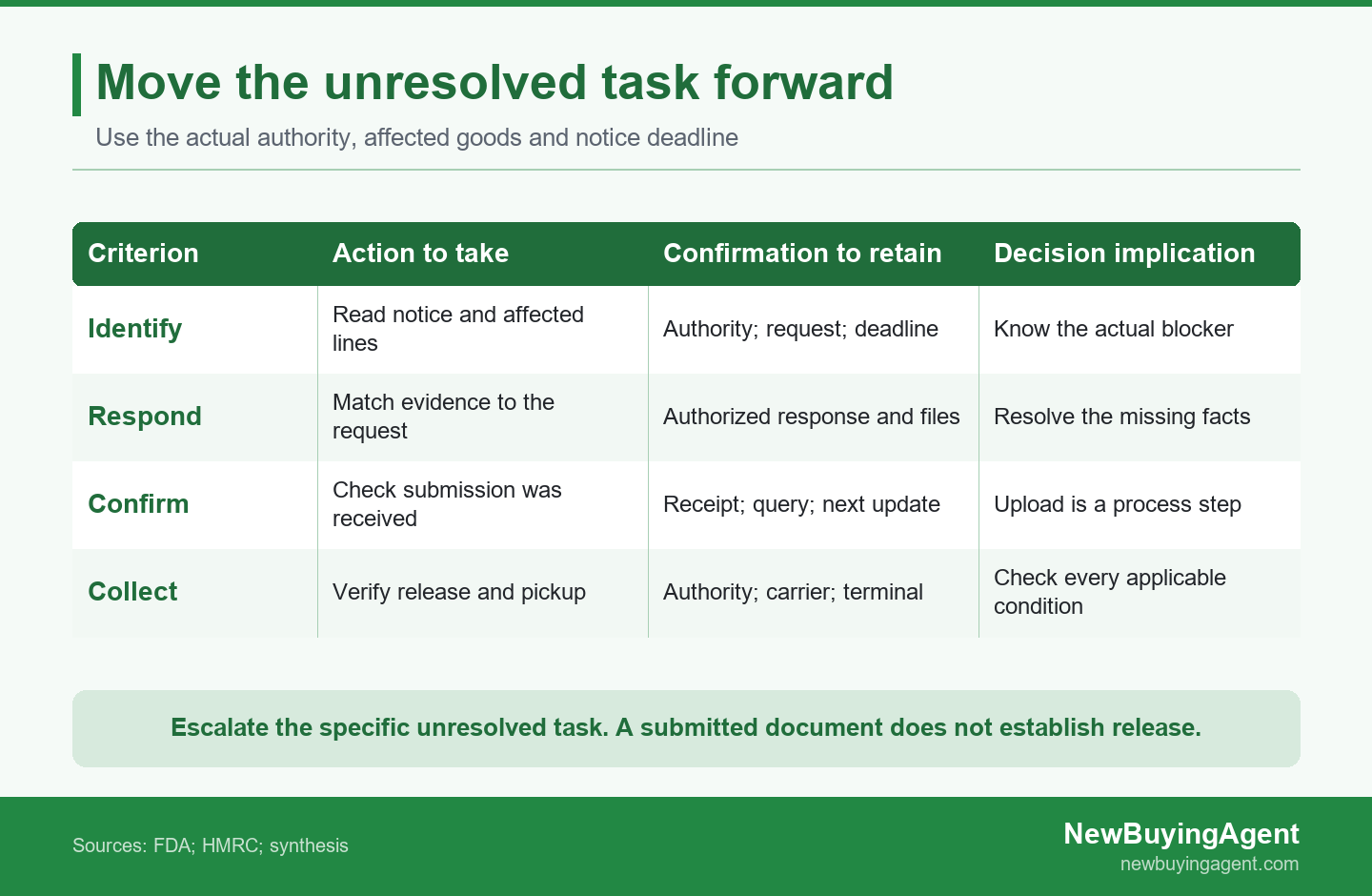
Identify the hold, prepare the requested evidence, confirm receipt and verify all release conditions.
Build the response file around the actual request
Use one case reference and a short response index that maps each question to its answer, attachment and contributor. Start with the original notice and shipment references, then add the records needed for that request. Preserve earlier versions when correcting an error. The receiving reviewer should be able to identify the relevant product and understand the correction without reconstructing a long email chain.
Copy the following record into the case email or working document and replace each field with the actual detail. Enter “awaiting confirmation” for a genuinely unknown fact, with a named contributor and next follow-up. Keep that uncertainty visible until the factual answer arrives.
| Record item | Fill in actual detail | Confirmation needed |
|---|---|---|
| Case identity | Entry; transport reference; notice date | Same shipment across all files |
| Affected goods | Line; model; quantity; package marks | Actual scope of restriction |
| Authority request | Question; deadline; time zone; contact | Original notice retained |
| Evidence response | Answer; attachment; revision; contributor | Product and request match |
| Submission | Authorized sender; channel; receipt; time | Submission received for this case |
| Outstanding action | Missing fact; owner; next update | Observable next result |
| Release and pickup | Authority status; carrier; terminal | All applicable conditions checked |
Match commercial and transport records to the goods
Compare the invoice, packing list, transport document and filed entry details against the affected goods. Check buyer and seller names, product descriptions, model references, quantities and units. A shipment with 120 cartons and 2,400 pieces needs a documented pack conversion before those figures can be compared. Keep package identifiers attached to the product lines so the examination site can locate the requested goods.
The International Trade Administration’s common export document guidance explains the different purposes of the commercial invoice and packing list. The invoice states the goods sold and amount payable. The packing list gives package and cargo details, including quantities, weights and marks. Compare both records because an internally consistent packing list alone cannot answer a question about transaction value.
If a figure is wrong, have the responsible party establish the correct fact and explain the change. Keep the original, revised document, revision date and reason together. Ask the broker how the correction should enter the destination filing process. Merely replacing an attachment in the purchasing folder leaves the submitted declaration and the authority’s working file unresolved.
Check the exact product and manufacturer evidence
Build the product answer around the held model and actual production source. Compare the order specification, manufacturer identity, product photographs, labels and relevant report scope. A similar-looking model may have a different material, electrical rating or intended use. Where a document does not clearly identify the held goods, explain the connection using factual records or obtain the correct document from its issuer.
FDA’s documents-required guidance lists evidence that may be requested for FDA-reviewed entries. Depending on the product, this can include labeling, actual-manufacturer information, intended use and commodity-specific records alongside entry documents. Confirm the requested evidence with the office handling the entry. A certificate chosen because it is available may leave the reviewer’s actual question unanswered.
When a China supplier has used several model names for the same order, NewBuyingAgent’s product development and quality-control capability is relevant to establishing the correct specification and origin records. Local factory resources can help connect the commercial description to the product actually made within the sourcing relationship. The destination response still needs the evidence applicable to that product and request.
Assign one response owner and named contributors
Choose one person to maintain the case record and coordinate the response with the authorized destination representative. Give each factual question to the party able to answer it. Purchasing can obtain origin records, the factory can confirm manufacturing facts, and the logistics party can arrange access or movement. Record who submits the answer and who confirms the resulting status, since those responsibilities can sit with different people.
The owner should keep a short list of open questions with contributor, due time and evidence required. Request a named backup when a time-zone gap or factory closure threatens the response. Avoid making the broker infer a product fact from inconsistent supplier emails. Provide a reviewed factual answer and identify any point that remains uncertain.
In FDA examination cases, the Notice of FDA Action and examination guidance identify the entry status, requested action and contact. The goods and their location also matter when an examination or sample is required. A response owner should coordinate that physical availability with the party controlling the cargo, alongside the document work.
| Task | Contributor to confirm | Escalate when |
|---|---|---|
| Explain notice and response route | Importer / authorized representative | Request or authority remains unclear |
| Confirm model and manufacturer | Purchasing / factory contact | Records conflict or arrive too late |
| Submit and track response | Authorized destination submitter | Receipt fails or a query remains |
| Arrange access and collection | Forwarder / facility / carrier | Movement permission or pickup is unclear |
For buyers retaining Chinese suppliers, NewBuyingAgent’s existing-factory management can support supplier communication, product and quality follow-up, and logistics coordination within the agreed scope. That can help obtain the factory’s missing records and prepare future orders more consistently. Keep the authorized destination representative responsible for the submission route and procedural advice.
Escalate the unresolved task before its deadline
Escalate when a specific task cannot be completed in time, the submitted response has not reached the reviewer, or a new question changes the required evidence. State the case reference, unresolved point, decision needed and remaining time. Direct the request to someone able to act on that issue. A useful escalation produces a document, authorization, confirmed receipt or agreed next update.
Set internal follow-ups early enough to review the evidence and resolve discrepancies before the official deadline. The interval should reflect the actual notice, factory availability and cargo situation. When the remaining time becomes inadequate, flag that fact promptly to the authorized representative instead of quietly moving the internal due date.
For FDA detention, the detention and hearing procedure provides a notice-specific respond-by date and allows eligible parties or a properly authorized representative to submit evidence. A request for extra time needs to be made within the specified timeframe and approved. Retain the resulting written confirmation. Apply that procedure only to the relevant FDA case and confirm other authorities’ rules separately.
Confirm submission, receipt and the next decision
Before submitting, check that the case reference, response index and attachment names match. Ask the authorized sender to retain the submission receipt and time. Record whether the system accepted the transmission, whether the reviewer requested anything further and when the case will next be checked. If transmission fails, resolve the route promptly and preserve evidence of the failure.
FDA’s Import Trade Auxiliary Communication System supports entry and line status checks, document submission and information on goods availability for examinations. Use the current status and any subsequent notice to determine the next action. An uploaded file establishes a submission step. The authority still needs to review the relevant evidence and make its decision.
When a query arrives, attach it to the same case and update the response index. Point directly to the document or new fact answering that query. Resending the entire folder without explaining the answer increases the chance of another clarification request. Give purchasing and the logistics team a short update identifying what changed and what remains open.
Track storage and movement alongside the response
Ask the forwarder or facility for the actual storage arrangement, applicable free-time end, current charges and next cost trigger. Keep confirmed charges separate from estimates. Identify who can authorize examination handling or a permitted transfer and which costs that action would create. These commercial facts help the buyer make timely decisions while the regulatory review continues.
HMRC’s temporary-storage guidance requires goods under that UK procedure to remain identifiable and within the approved area, with handling limited by the procedure. Confirm any proposed opening, examination or movement with the responsible parties. A purchasing instruction to unpack or transfer cargo does not itself establish permission to do so.
Maintain two open items when both apply, one for the authority response and another for storage or carrier action. Resolving a billing issue can remove a collection obstacle once release is available. It leaves any outstanding government decision to be confirmed through its own channel. Track the consequence of each action against the corresponding record.
Walk through a held shipment with incomplete evidence
Consider a hypothetical importer receiving 800 household appliances in 40 cartons from China. The destination representative forwards a product-document request identifying model K2. The factory has sent a report for K1, while the commercial invoice describes both simply as kitchen appliances. The buyer needs to establish the actual model and manufacturer before the representative can assess whether the response answers the request.
The case owner records the affected entry line, carton marks, response deadline and goods location. Purchasing asks the factory for the order specification, K2 label photographs, manufacturer details and the document covering the supplied model. The existing K1 report stays in the file with an explanation of why its applicability is uncertain. The team keeps the cargo status open while those facts are checked.
The factory confirms that K2 is a different model and cannot immediately provide the requested supporting document. Purchasing records that gap and the earliest confirmed availability. The authorized representative reviews the notice, advises on the available response options and, where the procedure permits, seeks additional time before the deadline. The owner records any approval and revised date. A pending request for an extension leaves the original deadline in view until approval is confirmed.
If the correct evidence subsequently arrives, the representative checks its relevance, submits the response and retains receipt. The owner then watches for a query or decision. An authority confirmation covering the affected goods allows the team to check the remaining carrier and facility conditions. Collection is arranged once those applicable conditions are satisfied. The visible results are the relevant response, receipt, decision and pickup confirmation, each attached to the same case.
This example assumes a document gap and demonstrates a coordination method. The actual product may instead require further examination or face an unfavorable admissibility decision. The working record keeps that outcome separate from the factory’s delivery promise, enabling the buyer to act on confirmed information as the case develops.
Confirm every release condition before arranging pickup
Close the hold after the responsible representative confirms the decision for the affected entry and goods, and the logistics parties verify the remaining collection conditions. Match the status to the actual lines and packages. A broad tracking update may leave another restriction unresolved. Retain the relevant notices, carrier release, terminal availability and collection instruction so the buyer can trace why pickup was authorized.
Use the same product and package references established during triage. Check whether a decision covers every held line and whether any continuing condition affects movement or use. Ask the forwarder to confirm collection readiness with the facility before dispatching a truck. After collection, retain the handover record and reconcile authorized charges with the original estimate.
UK border controls for non-food products illustrate why product-safety review needs its own confirmation. Market surveillance authorities can be involved in assessing imported goods and their documents. For a shipment within that procedure, check the applicable product-safety outcome alongside customs status. Use the equivalent responsible authorities for the actual destination and product.
Record the confirmed cause and any remaining dispute separately from cargo release. A successful pickup does not resolve every question about document accuracy, extra cost allocation or future purchasing controls. Keep those commercial follow-ups assigned until the relevant agreement or correction has been recorded.
Carry the cause into the next sourcing order
Convert the confirmed gap into a specific purchasing requirement. If manufacturer identity was unclear, agree how the actual production source will be recorded. If models were confused, align order descriptions, labels and applicable product documents before dispatch. Have the destination representative confirm which evidence will be needed for the product and market, then include that requirement in the next order review.
For recurring China purchases, share your purchasing requirements with NewBuyingAgent, including product specifications, quantity, target price, destination, timing and current sourcing situation. Add the model, labeling or manufacturer-record issue revealed by the shipment. That supports a scoped discussion of China product supply or agreed existing-factory management, using local factory resources and product/QC capability to prepare the next order around the buyer’s actual needs.
Frequently Asked Questions
Can paying the storage bill release a customs hold?
Paying a storage invoice resolves only that commercial charge, while the authority still needs to confirm the relevant release decision. Ask the forwarder which invoice or balance affects collection and have the authorized representative confirm the government status. Keep both confirmations attached to the shipment record. If another carrier or facility condition remains, assign that task before arranging pickup.
Can the factory contact customs directly for the importer?
A factory can provide factual product records, but authority to submit or represent the importer depends on the destination procedure and authorization. Route manufacturer statements, specifications and relevant documents through the agreed response owner. Have the authorized representative confirm whether direct factory communication would help. Keep the final response and submission record visible to the importer so conflicting answers can be resolved.
Does a request for documents mean the goods are refused?
A request for additional documents means the reviewer needs more information, while a refusal is a separate decision under the relevant procedure. Read the current notice and status carefully, then provide the requested evidence through the applicable route. If the notice alleges a violation or gives a response deadline, obtain advice from the authorized representative on that specific case and preserve the deadline.
Can unaffected product lines leave while another line remains held?
Partial release requires confirmation from the responsible authority and logistics parties for the identified lines, packages and any shared movement restrictions. Ask which goods the decision covers and whether those goods can be physically separated at the current location. Keep package references and collection instructions aligned. Avoid arranging a split pickup based solely on an assumption that an unmentioned product is available.
NewBuyingAgent
Related Resources


Get Started Today
Let's Turn Your Sourcing Goals into RealityWeChat:+86 15157124615
WhatsApp:+86 15157124615
Address:Building 10 #39 Xiangyuan Road, Hangzhou, China