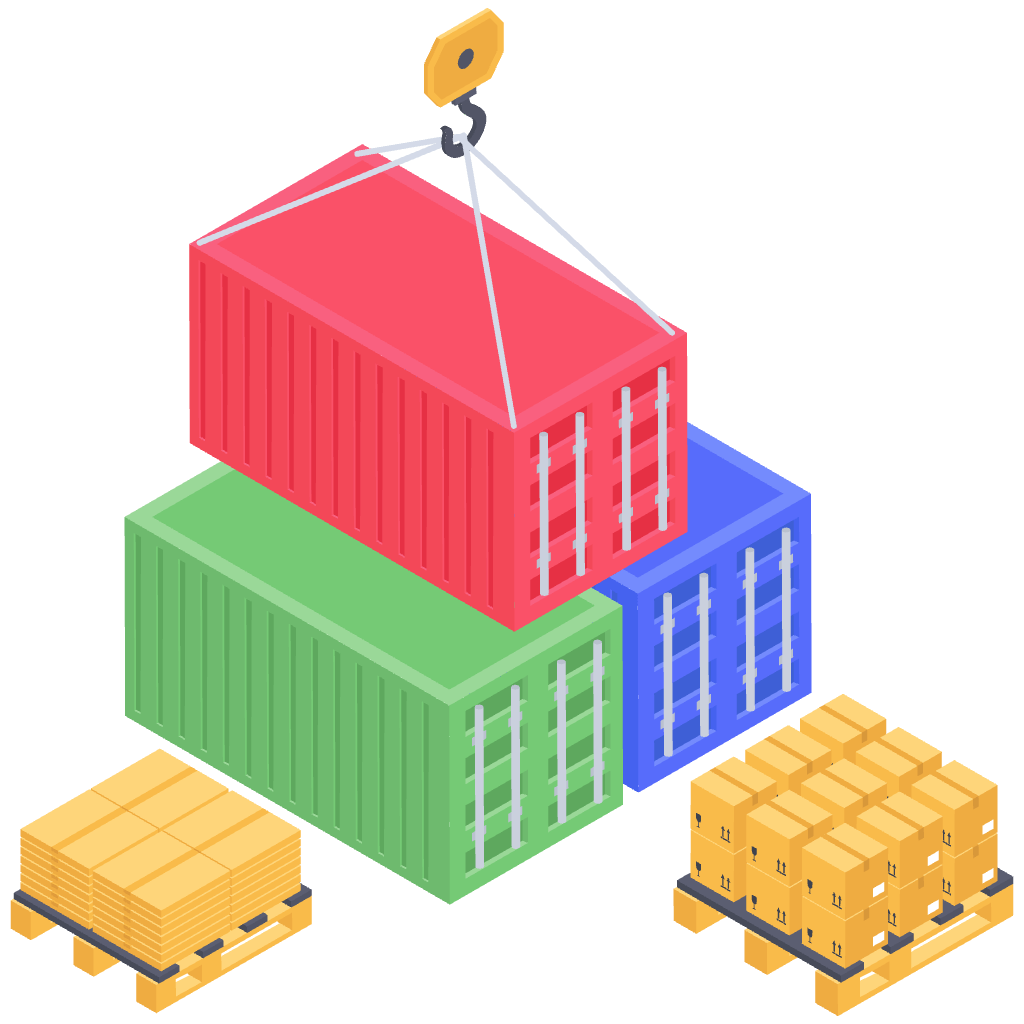
Economic Order Quantity
Economic Order Quantity (EOQ) is an inventory-management model used to determine an order quantity that balances the costs of ordering inventory with the costs of holding inventory.
The basic idea is straightforward: ordering very small quantities may require more frequent orders, while ordering very large quantities may increase the amount of inventory that must be stored and financed. EOQ provides a theoretical order quantity that balances these two cost categories under a defined set of assumptions.[1]
The standard EOQ model considers three primary variables:
- Annual demand
- Ordering cost per order
- Annual holding cost per unit
The model is designed to answer:
“How much should be ordered each time when demand and inventory costs are relatively predictable?”
EOQ is a planning model rather than a universal purchasing rule. Actual purchasing decisions may also be constrained by supplier MOQ, production capacity, lead time, price breaks, storage capacity, and other commercial requirements.
EOQ Formula
The standard EOQ formula is:
EOQ = √(2DS ÷ H)
Where:
- D = Annual demand in units
- S = Ordering cost per order
- H = Annual holding cost per unit
For example, suppose a buyer has:
- Annual demand: 20,000 units
- Ordering cost: $50 per order
- Annual holding cost: $2 per unit
The calculation is:
EOQ = √(2 × 20,000 × $50 ÷ $2)
EOQ = √1,000,000
EOQ = 1,000 units
Under the assumptions of the basic model, an order quantity of approximately 1,000 units balances the modeled ordering and holding costs.
Why Does EOQ Matter?
EOQ illustrates the trade-off between order frequency and inventory quantity.
If a buyer orders very small quantities, the business may need to place orders more frequently. This can increase ordering and administrative costs.
If the buyer orders very large quantities, fewer orders may be required, but average inventory can increase. Higher inventory can result in greater holding costs and more capital tied up in stock.
EOQ identifies the theoretical point where these two cost effects are balanced within the model.
This does not mean that the EOQ quantity will always produce the lowest total real-world purchasing cost. The model only considers the variables included in its assumptions.
EOQ and Ordering Cost
Ordering cost represents the costs associated with placing and processing an order.
Depending on the business, this may include purchasing administration, order processing, receiving, inspection, and other costs that occur when an order is placed.
If ordering costs increase while other variables remain unchanged, the EOQ model produces a larger optimal order quantity.
The reason is that placing orders becomes relatively more expensive, making fewer and larger orders more economical under the model.
EOQ and Holding Cost
Holding cost represents the cost of maintaining inventory over time.
It can include expenses such as storage, insurance, handling, inventory financing, deterioration, obsolescence, and other inventory-related costs.[1]
If holding costs increase, the EOQ model generally produces a smaller order quantity.
The logic is that when inventory becomes more expensive to hold, purchasing large batches becomes less attractive.
EOQ and Demand
Annual demand is another key input.
If annual demand increases while ordering cost and holding cost remain unchanged, EOQ generally increases because the business needs to replenish more inventory during the year.
However, EOQ does not directly forecast demand. The model assumes that the demand input is already known or estimated.
If the demand forecast is inaccurate, the resulting EOQ may also be inappropriate.
EOQ Example
Consider a buyer with annual demand of 12,000 units.
The buyer estimates:
- Ordering cost: $40 per order
- Annual holding cost: $2 per unit
Using the EOQ formula:
EOQ = √(2 × 12,000 × 40 ÷ 2)
EOQ = √480,000
EOQ ≈ 693 units
The theoretical EOQ is therefore approximately 693 units per order.
The buyer would then need to consider whether this quantity is commercially practical.
For example, if the supplier's MOQ is 1,000 units, the buyer cannot simply place an order for 693 units under that supplier's current terms.
This is where EOQ and MOQ need to be considered together.
EOQ vs. MOQ
EOQ and MOQ are not the same thing.
EOQ is a calculated inventory-planning quantity based on demand and selected cost assumptions.
MOQ is a supplier-defined minimum purchasing quantity.
For example:
- Calculated EOQ: 800 units
- Supplier MOQ: 2,000 units
The buyer's theoretical EOQ is below the supplier's minimum order quantity. The buyer may therefore need to order at least 2,000 units or negotiate different purchasing terms.
Conversely, a supplier's MOQ may be lower than the buyer's EOQ.
This distinction is important because EOQ describes what the model suggests, while MOQ describes what the supplier requires.
EOQ vs. Cycle Stock
EOQ and cycle stock are closely related but represent different concepts.
EOQ determines a theoretical replenishment quantity.
Cycle stock is the inventory associated with normal replenishment cycles.
Under the simple EOQ model, if a buyer orders the EOQ quantity each time and demand is relatively stable, average cycle stock can be approximated as:
Average Cycle Stock = EOQ ÷ 2
For example, if EOQ is 1,000 units:
1,000 ÷ 2 = 500 units
The buyer would therefore have approximately 500 units of average cycle stock under the simplified assumptions.
EOQ and Inventory Turnover
EOQ can influence inventory turnover because order quantity affects average inventory.
If a buyer consistently orders substantially larger quantities, average cycle stock may increase. If sales remain unchanged, inventory turnover may decrease.
However, inventory turnover is a performance ratio, while EOQ is a planning model.
A buyer should not attempt to maximize inventory turnover simply by reducing order quantities without considering ordering costs, supplier requirements, and stockout risk.
EOQ and Safety Stock
EOQ and safety stock serve different purposes.
EOQ determines the quantity ordered under a cost-balancing model.
Safety stock provides additional inventory protection against uncertainty in demand or supply.
A simplified inventory plan may therefore contain both:
EOQ / Order Quantity → Normal Replenishment
Safety Stock → Protection Against Uncertainty
EOQ itself does not determine how much safety stock a business should maintain.
EOQ and Reorder Point
EOQ answers:
“How much should be ordered?”
The Reorder Point (ROP) answers:
“When should replenishment be initiated?”
These are different decisions.
For example, a buyer may determine that an order quantity of 1,000 units is appropriate under its planning model, while the reorder point is 1,200 units.
When available inventory reaches the reorder point, the buyer places an order for the planned quantity.
The actual ROP calculation may also include safety stock and variations in demand or lead time.
EOQ and Lead Time
EOQ does not directly determine manufacturing or supplier lead time.
Lead time affects when an order needs to be placed, while EOQ primarily addresses how much to order.
For example, a buyer may have an EOQ of 2,000 units but a supplier lead time of 60 days. If the buyer waits until inventory is nearly exhausted before placing the order, the next shipment may arrive too late.
The buyer therefore needs to use EOQ together with reorder-point and lead-time planning.
EOQ and Price Discounts
The basic EOQ model assumes a constant unit purchase price.
In real purchasing, suppliers may offer lower unit prices for larger quantities.
For example:
| Order Quantity | Unit Price |
|---|---|
| 1–999 | $10.00 |
| 1,000–4,999 | $9.50 |
| 5,000+ | $9.00 |
In this situation, the lowest unit price does not automatically mean the lowest total cost.
A larger order may reduce purchase price but increase inventory holding costs and potentially increase the risk of excess inventory.
When quantity discounts are significant, a buyer may need a quantity-discount analysis rather than relying solely on the basic EOQ formula.
EOQ and Manufacturing
EOQ is primarily associated with replenishment and purchasing decisions, but the same economic logic can be applied to production quantities.
Manufacturers may need to balance setup costs against inventory holding costs when determining production batch sizes.
For example, producing very small batches may require frequent machine setups, while producing very large batches may create more finished-goods or work-in-progress inventory.
The exact production model may use a different formulation, such as an Economic Production Quantity (EPQ) model, rather than the basic EOQ formula.
Assumptions of the Basic EOQ Model
The traditional EOQ model is based on simplifying assumptions. Common assumptions include relatively stable demand, a known or predictable ordering cost, a known holding cost, and replenishment that can be treated as sufficiently predictable for the model.
The basic model also does not automatically account for many real-world purchasing constraints, such as supplier MOQ, quantity discounts, uncertain demand, variable lead time, limited storage capacity, production constraints, or supply disruptions.
This is why EOQ is best viewed as a starting point for order-quantity analysis, rather than an automatic purchasing recommendation.
Limitations of EOQ
The usefulness of EOQ depends on the quality of its inputs and assumptions.
If demand changes rapidly, holding costs are difficult to estimate, or supplier lead times vary significantly, a static EOQ may not accurately represent the buyer's current situation.
The model can also produce a mathematically valid quantity that is commercially impractical.
For example, EOQ may produce 650 units while a supplier requires an MOQ of 2,000 units. The buyer still needs to address the supplier constraint.
Similarly, a calculated EOQ may exceed available storage capacity or create excessive inventory for products with short lifecycles.
Therefore, EOQ should generally be evaluated together with actual purchasing conditions.
Frequently Asked Questions
What does EOQ stand for?
EOQ stands for Economic Order Quantity.
What is the EOQ formula?
The standard formula is:
EOQ = √(2DS ÷ H)
where D is annual demand, S is ordering cost per order, and H is annual holding cost per unit.
What does EOQ calculate?
EOQ calculates a theoretical order quantity that balances ordering costs and inventory holding costs under the assumptions of the basic model.
Is EOQ the same as MOQ?
No. EOQ is calculated using inventory and cost variables, while MOQ is the minimum quantity a supplier requires a buyer to order.
Is EOQ the same as reorder point?
No. EOQ determines how much to order, while reorder point determines when to place the order.
Does EOQ include safety stock?
No. Safety stock is a separate inventory component used to protect against demand and supply uncertainty.
Can EOQ be used when demand changes frequently?
It can provide a reference point, but a static EOQ may be less suitable when demand is highly variable. The buyer may need a more dynamic inventory-planning approach.
Does EOQ always minimize total purchasing cost?
No. The basic EOQ model balances ordering and holding costs under defined assumptions. It does not automatically account for every real-world cost, such as quantity discounts, stockout costs, supplier constraints, or changing demand.
How NewBuyingAgent Can Support Order Quantity Planning
For buyers purchasing manufactured products, the theoretical order quantity needs to be considered alongside actual supplier conditions.
NewBuyingAgent works with manufacturing sources across product categories and can coordinate buyer requirements such as product quantities, purchasing schedules, and manufacturing requirements with factories.
When evaluating an order quantity, buyers may need to consider MOQ, expected demand, manufacturing lead time, inventory holding requirements, production batch sizes, and price breaks rather than relying on unit price or a theoretical EOQ alone.
Key Takeaway
Economic Order Quantity (EOQ) is an inventory-planning model that calculates a theoretical order quantity by balancing ordering costs and inventory holding costs.
The standard formula is:
EOQ = √(2DS ÷ H)
EOQ is different from MOQ, reorder point, safety stock, and cycle stock. It answers the question of how much to order under a specific set of assumptions, while actual purchasing decisions must also consider supplier requirements, lead time, demand variability, storage capacity, and commercial pricing.
For buyers, EOQ is therefore most useful as a planning reference for evaluating order quantities, rather than as a fixed quantity that should always be purchased.
Partial Sources
[1] U.S. National Institute of Standards and Technology (NIST), Inventory Management and Supply Chain Resources. NIST — Supply Chain Resources
[2] IBM, What is Inventory Management? IBM — Inventory Management
[3] Corporate Finance Institute, Economic Order Quantity (EOQ). CFI — Economic Order Quantity
Related Knowledge Base
Sourcing Practices & Insights: Economic Order Quantity
Latest Sourcing Guides


Get Started Today
Let's Turn Your Sourcing Goals into RealityWeChat:+86 15157124615
WhatsApp:+86 15157124615
Address:Building 10 #39 Xiangyuan Road, Hangzhou, China