

Customer reviews tell a product team what disappointed buyers. They rarely tell a China factory exactly what to manufacture differently. Forwarding a translated complaint such as “the shoes do not fit” leaves the supplier to guess whether the problem is usable space, the opening, the size description or the intended customer.
A review-derived factory specification converts customer feedback into approved product requirements, with defined use conditions, measurable acceptance criteria and a method for checking the finished product.
The useful translation is from a customer’s experience to a testable decision, not simply from English into Chinese.
Turn Customer Complaints into Testable Product Decisions
A review signals a customer need; a factory requirement also needs a measurable condition, a verification method and an accountable approver. Start by identifying which product and use situation produced the feedback, then establish what a satisfactory result would look like. Ask the factory to confirm feasibility against that result before treating an improved sample as ready for production.
- Keep the evidence: Retain the original feedback, product version and use context.
- Test the interpretation: A complaint is not proof of a particular technical cause.
- Approve the measurement: Agree on conditions, limits and the checking method together.
- Control changes: Recheck affected requirements when a component or drawing changes.
Translate the Need, Not Just the Customer’s Words
Preserve the outcome the customer wanted, while keeping the observed complaint separate from an unproven cause or proposed design solution. A buyer reporting a difficult lid might need comfortable opening, but the cause could involve grip, seal friction or assembly variation. Requiring thinner plastic before investigating those possibilities could change the product without solving the original problem.
The underlying approach has an established name: ASQ describes quality function deployment, or QFD, as a method for translating customer requirements into technical requirements. For a consumer-product brief, the practical starting point can be a simple traceable record rather than a large matrix.
Consider illustrative feedback that a storage box “feels too small.” Keep that wording in the evidence record. Interpret the need as storing the intended objects with the door closed, then investigate the actual usable space and access opening. External length alone may be the wrong measurement because walls, hinges and door geometry occupy space inside the box.
Assign the product manager to confirm the intended objects and customer group. Ask engineering and the factory to propose a measurable fit check. The buyer then approves the acceptance condition after trying the proposed design in use. If the complaint instead reflects an inaccurate size description, the corrective action may include changing the listing rather than increasing the box dimensions.
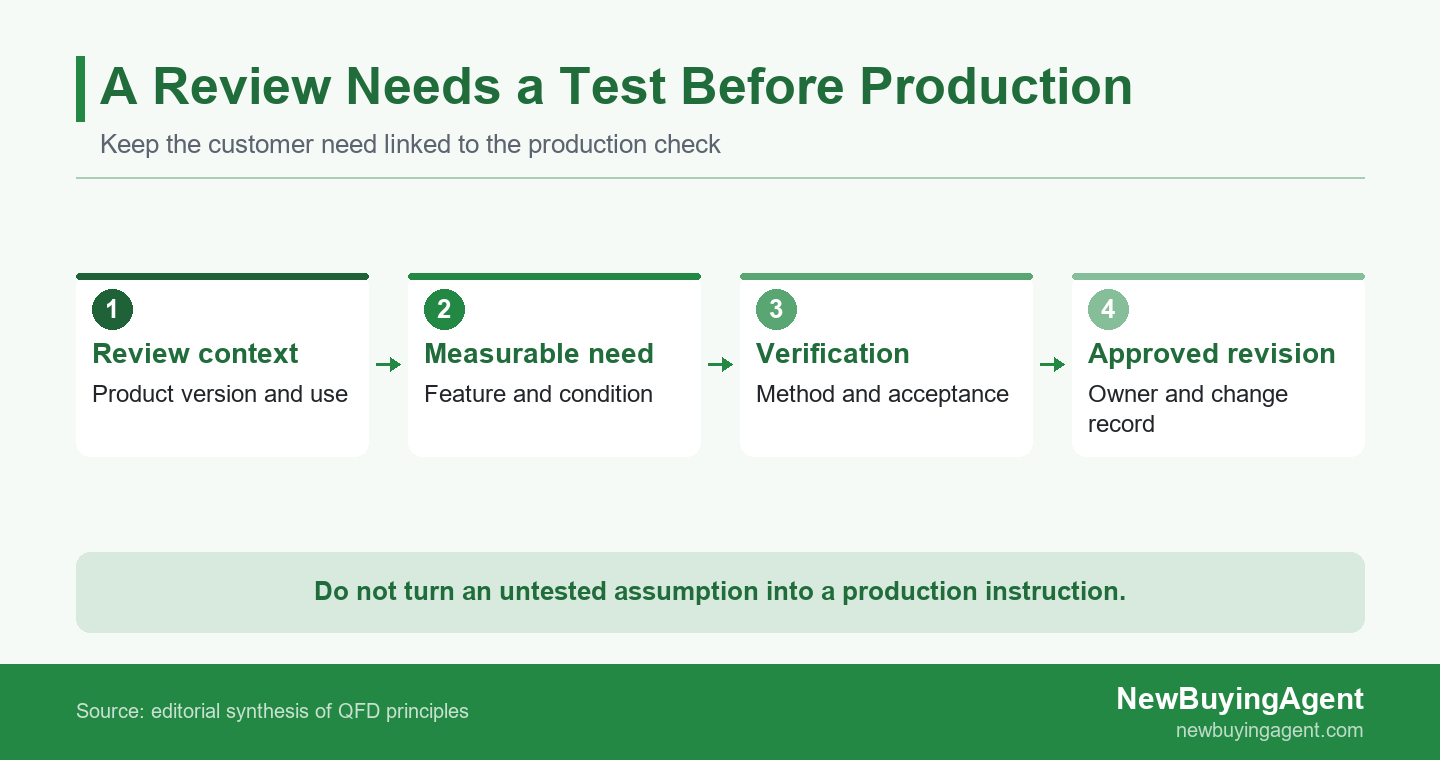
Customer review moves through use context, measurable requirement, verification method and approved factory revision
Build a Review Set You Can Trace to the Right Product
Group feedback by product version and use context, remove duplicates and preserve uncertainty instead of treating review counts as defect rates. A complaint about an earlier hinge design should not automatically become a requirement for its replacement. Keep unclear reports available for investigation, but distinguish them from feedback supported by a matching product, photograph or returned sample.
Record the source, date, variant, reported use, symptom and supporting detail. Retain a link or an authorized copy so another person can check the interpretation. When several websites reproduce the same comment, count it as one observation in the working set. Remove personal details that the factory does not need.
Source quality matters: the FTC cautions that online reviews can be fake, deceptive or manipulated. That caution does not justify discarding inconvenient feedback. Instead, compare reports with returns, support tickets, photographs and direct product checks, and mark what remains unconfirmed.
Separate recurring themes from their commercial importance. A minor color preference mentioned often and a less frequent loss of essential function need different responses. Reviewers are not a random sample of all purchasers; the share mentioning a problem cannot establish the product’s population defect rate. If reporting theme counts internally, state the reviewed set and exclusions.
Include positive feedback as a constraint on redesign. If buyers value compact storage, enlarging the box to resolve fit complaints may sacrifice an existing advantage. The requirement brief should preserve that trade-off for a deliberate decision.
Write Requirements the Factory Can Measure and Quote
Define the product feature, operating condition, acceptance limit, checking method and applicable revision before asking the factory to commit. A useful requirement lets the buyer and supplier reach the same result when they examine the same product. Where a target still needs testing, label it as provisional and resolve it before approval rather than disguising it as a settled production instruction.
Separate the Customer Need from the Measurement
Translate the complaint into the intended outcome first, then select a measurable characteristic and a method that represent that outcome. “Better quality” does neither. Even “increase opening force” is incomplete if the customer actually wanted easier opening. Record the direction of improvement and the conditions under which the result matters.
The following examples show what needs defining; they are illustrative feedback, not customer data or ready-to-use test standards.
| Illustrative feedback | Customer need to confirm | Requirement and check to develop |
|---|---|---|
| “My shoes do not fit.” | Store the intended shoe range with the door closed. | Define the usable envelope, insertion path and closure check on the assembled box. |
| “The lid is too hard to open.” | Open the product comfortably without unintended release. | Agree on grip position, opening-force range and retention conditions. |
| “It is difficult to clean.” | Remove expected residue using the stated cleaning method. | Define residue, cleaning procedure and acceptable remaining marks or damage. |
| “The hinge does not last.” | Maintain the required function over the intended use. | Establish load, motion, test duration and failure criteria through product-specific evaluation. |
NASA’s guidance on writing requirements favors verifiable statements and warns against vague, unverifiable terms. The relevant principle here is clarity, not aerospace compliance. A specification should explain how the buyer will recognize acceptance, not merely express a preference.
For example, an approved shoe-fit requirement could identify the buyer’s reference shoe envelope, require insertion without forced deformation, and require the assembled door to close and latch. The record must identify the envelope drawing and method revision. Numerical limits come from the intended product range and validated trials; they should not be guessed from a complaint or borrowed from another product.
When those requirements are ready for a new China-sourced product, NewBuyingAgent’s product-supply service connects the brief with local factory resources and product-development capability. This gives the buyer a basis for discussing a supplied product against quality, price and delivery needs, rather than comparing loosely described samples from unrelated factory offers.
Resolve Conflicting Needs Before Tightening Tolerances
Prioritize the target use case and check design trade-offs and process capability before tightening a tolerance or adding cost. Easy opening and secure closure can pull a design in opposite directions. Instead of averaging contradictory feedback into an arbitrary target, identify who uses the product, how it is carried and which failure would make it unsuitable.
Classify proposed changes as essential functions, preferences or questions needing investigation. Keep applicable safety and market requirements in their own qualified review; a popularity count cannot override them. For preferences, compare the benefit with effects on tooling, material, assembly time, packaging and delivery. Ask the supplier to price meaningful alternatives against the same conditions.
A tolerance is the permitted variation around a requirement. NIST describes process capability as comparing output from a stable process with specification limits. A single attractive sample therefore cannot establish that regular production will maintain a tighter dimensional range.
Ask what production measurements support the proposal and whether the measurement method is consistent. If the factory cannot yet support the desired range, decide between a design change, process development or a different sourcing option. Do not widen the limit merely to obtain agreement if that would defeat the customer need. Equally, avoid paying for precision that adds no useful performance.
Check Both Customer Use and Conformance to the Specification
Checking conformance to a specification and checking whether the product satisfies the intended customer need are different tasks. Both are necessary when feedback drives a redesign: a precisely manufactured box can still be awkward to use if the chosen requirement is wrong. Confirm the proposed solution in representative use, then define how production units will be checked against the approved design.
NASA distinguishes verification against specified requirements from validation for intended use. Applied here, verification asks whether the assembled box meets the agreed fit check. Validation asks whether the intended customers can actually store and retrieve their shoes as expected.
Before sample approval, have the product owner review the use trial and its limitations. The factory should confirm the build configuration; quality personnel should confirm the inspection method and equipment. Where specialist performance testing is needed, agree on the laboratory, applicable method and acceptance criteria before booking it. A photograph of a successful demonstration does not replace a defined test result.
Make the sample reference unambiguous. Record the drawing revision, materials and changed components alongside test results. Approving appearance alone should not be interpreted as approval of fit, durability or every other requirement. Specify which checks occur during development and which belong in production inspection.
For buyers retaining an existing factory, NewBuyingAgent’s existing-factory management service brings production follow-up and quality-control execution into the broader sourcing relationship. This helps connect approved requirements to the goods being produced and delivered; the buyer’s product team still owns the intended-use decision and acceptance of design trade-offs.
Keep Late Product Changes Inside the Same Requirement Record
A late component or tooling change must reopen affected requirements and verification instead of inheriting approval from an unrelated sample. Ask which functions, dimensions and test results the change could affect, then identify the corresponding product variants and orders. The point is to prevent an earlier approval from being used as evidence for a configuration that nobody has checked.
Illustrative Scenario: A Door Change Reduces Usable Shoe-Box Length
In an illustrative 4,000-box order, a late door change affects the 2,000 large boxes and requires the usable-length requirement to be checked again. The home-storage brand offers 2 sizes and had used shoe-fit complaints to define an internal-space requirement. Its original sample was approved, but the revised large-box door has not yet been checked against that requirement.
The external dimensions are unchanged, while the revised door projects farther inward. The factory points to the unchanged outside-length result as evidence that size remains acceptable. That observation does not establish usable space: the approved requirement concerns the shoe envelope inside the closed assembly. The new geometry could consume clearance even though the outside of the box measures exactly as before.
The buyer keeps the changed large-box scope pending recheck and assesses the unchanged size under its own approved controls. The factory must connect the new door revision to the drawing and fit requirement, identify affected units and prevent old and new configurations from being mixed without identification. If the revised assembly cannot meet the agreed fit requirement, the team must resolve the design rather than quietly redefine acceptance around the failed sample.
Before approving the change, check the buyer-approved shoe envelope and closure method on revised assembled boxes, recording the tested configuration and result. That establishes evidence for the fit decision only; it does not prove that every durability or safety requirement is satisfied. This is an illustrative decision sequence, not a NewBuyingAgent client case. Its lesson is specific: changing a component can invalidate a customer-derived requirement even when a familiar inspection dimension still passes.
Send the Factory an Approved Specification Package
Send the agreed product revision, measurable requirements, verification plan and change controls together with the purchasing brief. The factory should be able to identify what it is quoting, what it must demonstrate and who can approve a deviation. Keep unresolved development questions separate from approved production requirements so a quotation does not silently turn assumptions into commitments.
ASQ explains that an operating quality plan connects customer requirements with actions, responsibilities and methods. Use that connection when handing over the specification, rather than treating the document as a detached list of dimensions.
- Product identity: Variant, drawing, material and component revisions.
- Acceptance: Requirement IDs, conditions, limits and approved checking methods.
- Evidence: Sample references, relevant use trials and verification results.
- Responsibility: Factory contact, buyer approver and rules for proposed changes.
- Order context: Quantity, target price, packing, destination and required delivery timing.
If customer feedback is shaping your next product order, prepare that specification package and identify the concerns that matter most to your buyers. As a one-stop China sourcing agent, NewBuyingAgent can use local factory resources to quote and supply products around the brief, with production follow-up, quality control and logistics coordination supporting execution. To discuss a product quotation aligned with your quality and delivery requirements, request a product quote from NewBuyingAgent.
Questions About Review-Based Product Specifications
Can AI turn customer reviews into a finished specification?
AI can help organize feedback, but it should not approve technical limits or factory commitments. Use it to suggest themes or draft a translation, then check those outputs against the original comments. A product owner and qualified technical reviewers must resolve the intended use, feasibility and acceptance method. Do not upload personal or confidential material into a tool without appropriate permission and data controls.
What if the product has very few reviews?
Use reviews as a starting point and fill the gaps with other product evidence. Returns, support conversations, customer interviews and observed use trials can help identify needs that a small review set misses. Record which conclusions remain tentative. A new product does not need a large review count before development can begin, but uncertainty should guide further testing rather than become an unsupported claim about market demand.
Should competitor reviews go into our specification?
They can reveal needs to investigate, but they do not prove your product has the same cause or solution. Keep competitor observations distinct from evidence about your own design, and compare the intended use and product version before drawing conclusions. Investigate the underlying customer need without copying protected designs or proprietary material. Any resulting requirement still needs validation against your own product and target buyers.
Does the factory need a Chinese version of the specification?
Use the working language needed for reliable execution, with one controlled meaning across versions. Bilingual text can help when the buyer, engineering team and production staff use different languages. Keep requirement IDs, units, drawings and revision references identical, and agree on how discrepancies will be resolved. Ask the factory to explain the checking method back to you; a fluent translation alone does not establish shared technical understanding.
NewBuyingAgent
Related Resources



Get Started Today
Let's Turn Your Sourcing Goals into RealityWeChat:+86 15157124615
WhatsApp:+86 15157124615
Address:Building 10 #39 Xiangyuan Road, Hangzhou, China