

Supplier OTIF means on-time in-full delivery: the share of due orders that meet both the agreed delivery window and the agreed product quantity. For China orders, its usefulness depends on naming the delivery event, counting basis and reporting period before measuring performance.
A factory can finish production on schedule while your warehouse receives an incomplete order late. Neither “production complete” nor a favorable shipment dashboard resolves that difference. A useful OTIF review shows which promise was missed, whether the products were actually available, and what the responsible team should change before the next order.
Measure the Delivery Promise Before Judging the Supplier
OTIF needs a fixed delivery promise, a stable counting unit and a clear reporting period before the percentage can support a supplier decision. For order-level on-time in-full reporting, count orders passing both conditions against all orders due in that period. Separate punctuality and quantity rates can conceal different failures, so agree these rules before using the result to allocate more business.
- Definition: A pass means the specified products arrive complete within the chosen window, not merely that some cartons were dispatched.
- How it works: Keep the numerator and denominator tied to the same due-order population, including known overdue deliveries.
- Common mistake: Revising a promise after a miss or dropping open orders can improve the report without improving supply.
- Decision: Investigate the cause separately from the service outcome, then test a specific correction on upcoming orders.
Calculate OTIF from Orders That Pass Both Tests
Order-level OTIF counts orders that are both on time and in full, not the average or product of two separate pass rates. Start with every order due under the agreed reporting rules, mark each order against both tests, and count only the joint passes. This preserves the relationship between punctuality and completeness instead of assuming the two conditions occur independently.
APQC defines this OTIF measure as the percentage of orders delivered complete within the agreed time frame. That supports an order-level measure; it does not establish a universal target for every China sourcing route.
OTIF (%) = orders passing both tests ÷ all orders due in the period × 100. The joint-pass count is the numerator; the due-order count is the denominator. Decide the due-period and reporting cutoff before running the calculation.
Consider an illustrative month with 20 due orders: 16 pass both tests, two arrive on time but short, one arrives late but full, and one remains undelivered after its deadline. The last order fails both tests at the reporting cutoff. The late full order has arrived by that cutoff; its eventual completeness does not erase its lateness.
The on-time rate is 18 ÷ 20 = 90%, and the in-full rate is 17 ÷ 20 = 85%. Observed OTIF is 16 ÷ 20 = 80%. Multiplying 90% by 85% gives 76.5%, which is not the observed joint result. Keep the two component rates as diagnostic information, not substitutes for counting the actual overlap.
This example uses whole-order pass or fail, without quantity tolerances or cancellations. A different agreed method may award partial quantity credit, but it must be labeled differently and applied consistently. The useful question is how many purchasing promises were met, not which calculation produces the more attractive percentage.
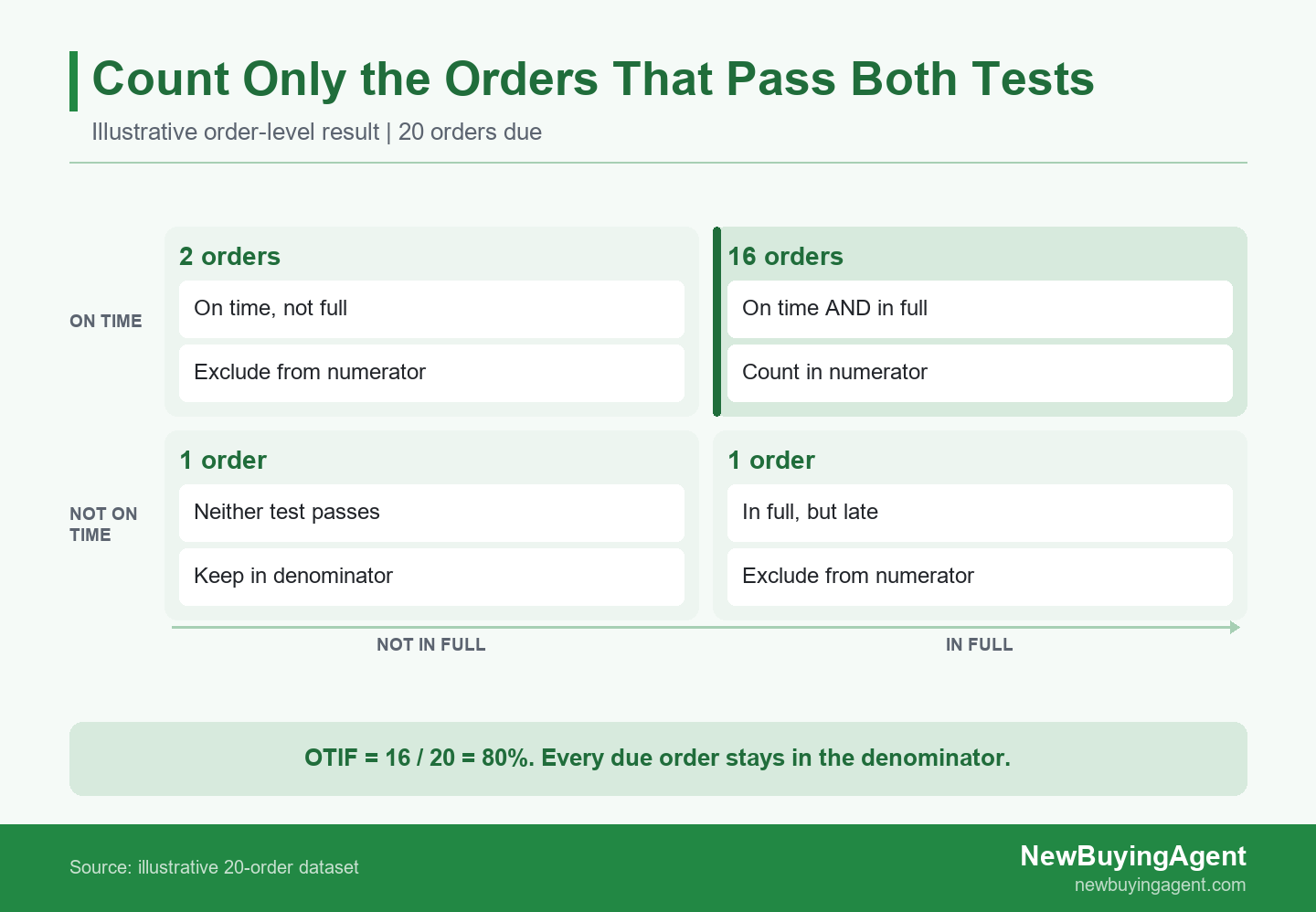
Only orders that are both on time and in full enter the OTIF numerator
Write the Measurement Rules into the Order Record
A supplier score requires an agreed milestone, date window, counting unit and quantity rule, with due orders retained even when they remain undelivered. Put these definitions beside the purchase order or supplier scorecard before the reporting period starts. Otherwise, a buyer and factory can use the same OTIF label while scoring different events, making their disagreement impossible to resolve from the percentage alone.
Keep the customer's original requested date and the supplier's accepted commitment separately. A requested-date measure shows whether sourcing meets the business need; a committed-date measure tests reliability against an accepted promise. A late commitment can satisfy the second while failing the first.
Choose the Delivery Event and Date Window
Factory readiness, carrier handover, vessel loading and warehouse receipt are different events; the OTIF record must name the one being measured. “Ready Friday” cannot prove arrival at the destination warehouse on Friday. If you need both views, maintain a supplier-milestone score and a destination-receipt score rather than silently switching between them.
The distinction also matters when reading trade terms: ICC explains that FCA delivery occurs before goods are loaded on board a vessel. FCA means Free Carrier. A warehouse-arrival target is therefore not interchangeable with that contractual delivery event; the score alone cannot assign responsibility for the intervening journey.
Name the location, date window and local time zone. State whether an early arrival is acceptable or fails a booked receiving window. Keep forecasts separate from actual timestamps. When an approved product change moves the schedule, preserve the original commitment, revised date, reason and approver instead of overwriting the historical promise.
For a new lunchbox range, the arrival requirement should influence product and packing choices before an order is placed. NewBuyingAgent’s product-supply service uses local factory resources and product-development capability within one-stop China sourcing. That connects a buyer's required date and specifications to a product quotation and feasible supply assumptions, rather than leaving delivery planning until cartons are ready.
Keep the Due-Order Population and Quantity Basis Stable
Count each agreed order or scheduled delivery unit once, and retain overdue undelivered units in the due-period population. If a purchase order has separately agreed monthly releases, specify whether each release is the counting unit. Do not divide a failed order into smaller records afterward to create extra passes.
McKinsey’s consumer-sector research distinguishes order, line and case-based approaches to OTIF. Its discussion illustrates why two reported percentages may not be comparable: an entire order can fail while many individual cases meet the requirement. Choose the basis your receiving operation needs, then keep it visible beside the result.
Define “full” by the agreed product identifiers, units and tolerances. Extra blue lunchboxes cannot offset missing red ones; containers without their specified lids are not complete kits. For an order-level pass, all required quantities must meet the rule. Quality acceptance remains a separate control unless the agreed definition expressly incorporates it: OTIF is not a complete product-quality or compliance score.
If split deliveries are permitted, their combined quantities can satisfy the order only when the required total meets the agreed window. A late balance restores inventory but does not retrospectively turn the earlier miss into a pass. Log cancellations and buyer-authorized scope changes with dates and reasons; publish any adjusted view alongside the unadjusted result rather than quietly removing inconvenient records.
Build a Record That Explains Each Miss
A useful OTIF row links the original promise, actual delivery event, matched product quantity and supporting records; a status label alone cannot establish completion. Both teams should be able to reconstruct the pass or fail from that row without relying on someone's memory. Keep the scoring evidence separate from the reason for a miss so that a disputed cause does not hide a known delivery failure.
A practical record needs the purchase-order or release identifier, version, product code, ordered quantity and unit, due window, actual event location and time, received quantity, and evidence reference. Add separate on-time, in-full and joint-result fields. Then record the cause, responsible owner and any approved change history.
GS1’s EPCIS standard separates event time, record time and event time-zone offset. That distinction is useful even in a spreadsheet: the time a warehouse received goods is not necessarily the time someone uploaded its receipt. You do not need to deploy the standard's software model to preserve those separate facts.
Missing evidence is not an automatic pass. Distinguish a confirmed overdue non-delivery from an unconfirmed receipt. Keep unresolved records visible, mark the result provisional and assign a reconciliation deadline. When evidence arrives, retain a revision trail so teams can explain why a previously reported figure changed.
For buyers retaining an existing factory, NewBuyingAgent’s factory-management service connects local production follow-up and quality-control capability to the products being ordered. For lunchboxes, attention to matching lids and packing readiness can support complete product delivery before dispatch. That is an operational supply-chain role, not a promise that a better spreadsheet alone will prevent shortages.
Use a Missed-Order Review to Choose the Correction
An OTIF review becomes useful when a confirmed miss leads to a specific cause, owner and corrective action. Separate manufacturing lateness, incomplete packing, transport delay and receiving problems before choosing what to change. The same low score can come from different failures, and asking every supplier to “improve delivery” does not tell any team which process needs attention or what evidence will establish recovery.
ASQ explains that Pareto charts rank categories by frequency or cost to highlight significant problems. Use that ordering to focus investigation, not to claim that the most frequent label proves the cause. A single missed seasonal launch may deserve more attention than several minor replenishment delays.
Illustrative Scenario: Twenty Lunchbox Orders Due This Month
An importer has 20 China lunchbox orders due this month, each for 600 complete lunchboxes: 12,000 units in total. This hypothetical scenario uses the warehouse-receipt calculation above. At month end, its dashboard contains 19 delivered orders, while an overdue order remains open outside the report. The team initially reviews only that completed-delivery list.
The dashboard excludes one overdue undelivered order. Two on-time orders are short of the specified lids. Receipt checks confirm 16 joint passes. The 4 misses comprise 2 on-time shortages, 1 late full delivery and 1 overdue non-delivery. These observations do not yet prove whether the lid shortage began at packing or during transport.
Sixteen passing orders divided by twenty due orders gives 80% OTIF; excluding one undelivered order incorrectly raises the result to about 84.2%. The higher figure reflects a missing denominator entry, not better service. Correcting it establishes the baseline from which the importer can judge a real operational change.
The buyer restores the open order to the report and asks the factory to reconcile packing quantities against receiving evidence. If that investigation confirms missing lids before carton closure, the factory's packing lead tests a complete-kit count before sealing cartons on upcoming orders. If the evidence instead points to transit loss, the corrective action belongs at that stage; the repeated symptom alone is insufficient.
The buyer checks matched lids before release, then verifies actual warehouse quantities on the next due orders using unchanged promise dates. Shipment release still requires the agreed product-quality checks. This is an illustrative decision process, not a NewBuyingAgent client result or a market benchmark, and no future improvement is assumed. Recovering the missing products cannot rewrite the previous month's performance.
Turn the Baseline into an Improvement Plan
An OTIF improvement plan should name a verified cause, a responsible owner, a test on upcoming orders and a later check using unchanged measurement rules. Begin with the failure that most threatens product availability, then set a correction deadline before the relevant production or packing step. Treat the next deliveries as evidence of whether the change worked, not merely as dates for another status meeting.
ASQ’s improvement cycle calls for testing a change, checking the result and acting on what is learned. Applied to supplier OTIF, that means a limited operational trial followed by a delivery check, rather than immediately declaring a new procedure successful.
| Stage | Owner and action | Evidence to check |
|---|---|---|
| Establish baseline | Buyer reconciles all due orders | Promises, receipts and open orders |
| Confirm cause | Relevant operations lead traces the miss | Packing counts, handovers and receipt differences |
| Test correction | Packing lead trials complete-kit counting if packing caused the shortage | Matched product and lid quantities before sealing |
| Verify outcome | Buyer checks the next due deliveries | Actual receipt result under unchanged rules |
Give the owner a deadline tied to the next affected order, not a vague month-end commitment. Define how many upcoming deliveries will be reviewed and retain each result. A successful packing check is an early sign; the receiving outcome establishes whether the buyer obtained complete products on time.
If the same shortage recurs, reopen the cause analysis rather than repeatedly issuing training reminders. If completeness improves but lateness worsens, examine whether the new check has become a production bottleneck. Do not waive quality checks or rely on emergency airfreight to make the percentage look better without recording the resulting cost.
Set Targets That Protect Product Availability
An OTIF target is meaningful only when its counting basis and delivery promise match the products, route and buyer service need. Set the target against a reconciled baseline and the consequences of missing supply, rather than importing an unexplained percentage from another business. Review the rate alongside the number of orders, stockout exposure and recovery cost so that a better score represents a better purchasing outcome.
A repeat stock item, a seasonal range and a first production run have different planning conditions; avoid imposing an unexplained common target on all three. Group comparable orders for diagnosis, while keeping the overall service result visible. Small groups also need their actual pass and due counts: one order can move the percentage sharply.
When a factory meets its handover commitment but destination receipts remain late, investigate the transport and receiving stages before changing factories. When the factory repeatedly misses an unchanged, feasible production commitment, ask for capacity or process evidence before increasing order volume. Buyer-caused changes should remain visible with their reasons; distinguish responsibility without deleting the service impact.
For an upcoming replenishment order, prepare the product specifications, quantity, target price, destination, required arrival date and packing or release constraints. To obtain a China-sourced product quotation with delivery assumptions, send the purchasing brief to NewBuyingAgent. A clear product requirement makes the next delivery promise easier to evaluate before purchasing, when there is still time to change the plan.
Frequently Asked Questions
What if no orders are due in the reporting period?
Report OTIF as not applicable when the agreed denominator is zero. Calling it a perfect score suggests delivery performance that was never tested. Keep the period in the reporting calendar, show zero due orders and explain why no percentage appears. If you combine several periods, calculate the combined rate from their passing and due-order counts rather than treating the empty period as a pass.
Can OTIF be measured for samples and new product launches?
Yes, but report samples and launches separately from repeat replenishment. Define the deliverable and acceptance point carefully: receiving a development sample is different from receiving an approved production quantity. Keep design approval and tooling milestones visible as leading indicators. Otherwise, a mixed score may suggest stable replenishment performance while concealing unresolved development work, or unfairly compare a changing prototype requirement with an unchanged repeat order.
Should OTIF be averaged across suppliers?
Combine passing and due-order counts when reporting a pooled order-level rate. A simple average gives a low-volume supplier the same influence as a high-volume supplier, which answers a different question. Pool only compatible definitions and reporting periods, and label the result's basis. Keep individual supplier results alongside it so a large supplier's good performance does not conceal a smaller supplier's repeated misses on a critical product.
Does a poor OTIF score automatically justify a penalty?
A poor score does not by itself establish a right to charge a penalty. Check the applicable agreement, defined delivery obligation, accepted changes and evidence of the miss before taking commercial action. Responsibility and remedies need their own review; a destination-receipt failure may involve several parties. Use the score to identify the problem, then have the appropriate commercial or legal adviser assess any disputed charge.
NewBuyingAgent
Related Resources



Get Started Today
Let's Turn Your Sourcing Goals into RealityWeChat:+86 15157124615
WhatsApp:+86 15157124615
Address:Building 10 #39 Xiangyuan Road, Hangzhou, China