
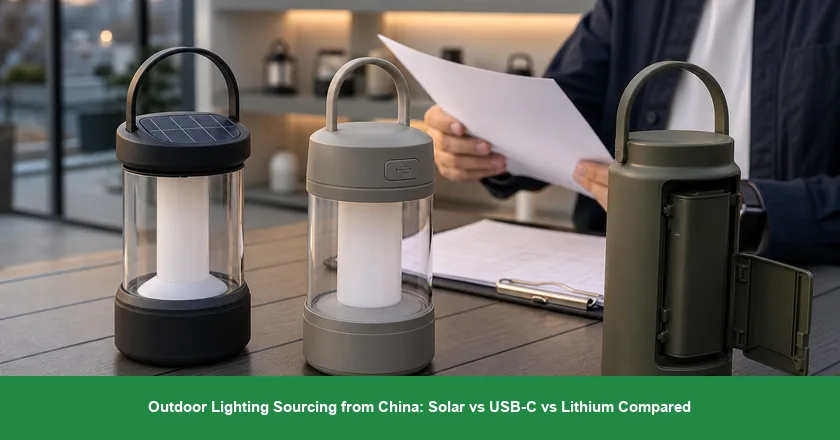
For outdoor lights, solar and USB-C describe charging inputs, while lithium describes stored energy and transport evidence; treating them as one three-way choice hides the architecture a buyer must verify. A portable lantern can combine solar top-up, a USB-C charging port, and a lithium-ion pack in one SKU. The useful sourcing question is therefore not which label wins. It is whether the intended lighting duty, recharge route, battery identity, enclosure claim, carton statement, and shipment records all describe the same finished configuration.
The Outdoor-Light Choice Has Three Layers
The practical comparison is three-layered: choose the lighting duty, select the charging route, and verify the battery, enclosure, and market evidence as separate but connected decisions. That framing keeps a product brief from treating a connector, a photovoltaic panel, and a battery chemistry as substitutes.
- Layer 1 — lighting duty: Define where the light is used, when it must work, the required illumination pattern, mounting, and realistic access to recharge.
- Layer 2 — recharge route: Solar is exposure-dependent; USB-C uses a controlled external connection whose actual rating and protocol still need specification.
- Layer 3 — stored energy and proof: The lithium pack, finished enclosure, packaging, and transport documents must be tied to the released SKU.
There is no universal winner. Solar can fit a placement with real daily exposure. USB-C can fit a product that returns to a known recharge point. A hybrid can fit a use case that needs both. In each case, the buyer should release the product only after the evidence matches the chosen architecture.
Start With the Lighting Duty, Not the Charging Label
A recharge route cannot answer a lighting-duty question by itself. Start with the use window: occasional garden ambience, a portable camp lantern, a pathway marker, or a decorative patio light. Then state the expected recharge opportunity. Is the solar panel exposed in the final installed position? Can the user reliably recharge through a protected port between uses? Is a hybrid arrangement part of the approved product rather than an optional catalog feature?
A charging input is the route through which the product receives energy, such as solar or a USB-C connection. The lithium pack stores that energy for later use. Keeping the terms separate makes a China quotation easier to compare because the supplier must identify a specific product architecture, not merely tick three feature boxes.
| Layer to compare | Solar input | USB-C input | Lithium pack |
|---|---|---|---|
| What it describes | Exposure-based energy input | External connector and specified charging behavior | Stored energy, product identity, and transport layer |
| Best question | Will final placement provide enough usable exposure? | What input rating, protocol, cover, and charger behavior are approved? | Which battery model and watt-hour record belong to this SKU? |
| Evidence to request | Panel specification, placement assumption, and relevant performance test | Input specification, charging test, port treatment, and label | Battery identification, test summary, packout, and product association |
| Common mistake | Assuming a panel guarantees the required nightly duty | Assuming the port shape proves fast charging or weather protection | Treating the battery document as proof of the whole finished light |
For a new China request, buyers can use NewBuyingAgent's product-supply service for an evidence-led outdoor-light brief. The useful output is an agreed input specification and sample check, not an untested assumption that a product label answers the whole architecture question.
Solar Input Fits Exposure-Available Recharging
Solar charging is exposure-dependent because photovoltaic output changes with available sunlight and conditions such as clouds, shade, dust, rain, snow, and dirt; a battery shifts that energy to a later use period but does not eliminate the input variability. The U.S. Department of Energy describes those variability factors and the role of storage.
For sourcing, ask the supplier to separate what is measured from what is assumed. A product brief can specify panel position, typical exposure window, lighting mode, and the test condition behind a stated recharge or operating result. Avoid turning a prototype result into a generic promise for a shaded balcony, a dirty panel, or a different season. The battery is useful because it makes energy available later; it does not make the upstream solar input constant.
USB-C Input Fits Controlled Recharging Access
A USB-C receptacle identifies a connector interface, not by itself the charging power, power-delivery protocol, battery capacity, or weather protection of an outdoor light. USB-IF's Type-C specification separates the connector ecosystem from product-specific implementation.
USB Power Delivery is a separate protocol layer from the USB-C connector, so a buyer should verify the product's stated input rating and supported charging behavior instead of inferring them from the port shape. USB-IF explains USB Power Delivery as a distinct power-delivery protocol.
The request should name the approved charger class, input rating, cable condition if relevant, charge indicator behavior, and the closed-port condition for outdoor use. The useful output is an agreed input specification and sample check, not an untested assumption that every USB-C port behaves the same way.
Treat the Lithium Pack as a Separate Product Layer
Lithium is the stored-energy and transport layer: a rechargeable light may use a lithium-ion pack whether its energy arrives through solar, USB-C, or both. That is why a “solar vs lithium” comparison is incomplete. The buyer still needs the pack identity, rated energy, integration method, and the exact relationship between the pack record and the finished product model.
For EU-bound product planning, battery access and replacement should be assessed against the product's design and intended water exposure rather than assumed from a sealed housing alone. Regulation (EU) 2023/1542 includes removability and replaceability requirements as well as a limited water-exposure derogation.
That is a planning boundary, not a claim that one enclosure is compliant. In the product brief, identify whether the pack is removable, accessible for service, fixed inside the housing, or supplied as a separate component. Then ask which design version and intended-market route the supplier's evidence actually covers. A sealed light, a different battery door, and a revised port cover may be materially different finished configurations even if the external shape looks similar.
Match Weather Exposure to the Finished Configuration
An IP Code is an enclosure-protection classification, so the buyer should request the exact claimed code and test basis for the finished configuration rather than treating the word weatherproof as sufficient evidence. It classifies protection provided by an enclosure against specified ingress conditions. IEC identifies IEC 60529 as the standard for degrees of protection provided by enclosures.
Outdoor-light safety evidence must be matched to the actual luminaire architecture and intended market; IEC 60598-1 is a general luminaire safety standard, not a substitute for product-specific test evidence. IEC 60598-1 sets general safety requirements for luminaires.
Check the finished unit, not an isolated housing. The relevant configuration may include a closed USB-C cover, seals, panel-to-housing interface, switch treatment, mounting hardware, drain path, cable exit, and the way the product is installed. Ask for the claimed IP Code, the model under test, the configuration tested, and the market-specific evidence route. Do not use a generic “outdoor” statement to fill gaps in that record.
Build a Battery and Shipment Evidence Pack
Before a battery-containing outdoor-light shipment is committed, the buyer should reconcile the battery model, watt-hour rating, product model, and UN 38.3 test-summary identity so the documents describe the item being shipped. A UN 38.3 test summary is a standardized document that identifies the tested lithium battery design for transport traceability. 49 CFR 173.185 requires test-summary elements that include watt-hour rating and a cell, battery, or product model number.
Treat the summary as an identity document, not merely a filed PDF. Compare it with the purchase specification, sample record, battery label, finished product model, carton, and packing plan. The check does not decide a particular carrier's acceptance; it reveals whether the buyer, factory, forwarder, and documents are referring to the same item.
- Battery chemistry, model, manufacturer, and watt-hour rating
- Finished light SKU and any product-model association used in the test summary
- Battery placement in equipment and protection against movement or accidental activation
- Carton statement, quantity per carton, and the logistics plan for the destination and transport mode
When an existing factory needs local follow-up across sample, packout, and shipping documents, buyers can use NewBuyingAgent's factory-management service when an existing supplier needs local follow-up. The decision remains the buyer's: release only the configuration whose product and records reconcile.
Keep Market Evidence Separate From Product Claims
A target-market evidence request should identify the product's applicable electrical, battery, and labeling route; a USB-C input does not by itself determine which legal requirements apply. The EU Low Voltage Directive states its voltage scope and related technical-documentation route where applicable.
State the destination market early, then ask the supplier or qualified compliance resource to map requirements to the actual electrical architecture, battery arrangement, labels, and intended use. A connector label is not a legal classification. Likewise, a generic report is not proof for a revised SKU, a different battery, or a changed enclosure. Evidence planning does not replace product testing, conformity assessment, or transport instructions for a particular shipment.
Illustrative Scenario: A Dual-Charge Lantern Changes at Production
When a production sample changes from the approved dual-charge architecture to a solar-only architecture, the product should be held until the charging input, battery pack, enclosure treatment, carton statements, and evidence set all point to the same SKU. The following example is illustrative, not a reported NewBuyingAgent client result.
What the Buyer Should Hold
A product hold is warranted when the approved sample, production build, carton statement, and battery record no longer identify the same outdoor-light architecture.
A garden-retail buyer is planning 1 seasonal launch SKU: a run of 2,400 portable lanterns for two markets. The approved sample has solar top-up, a covered USB-C receptacle, and a rechargeable lithium-ion pack. At production review, the presented build uses the same housing but has solar charging only; its carton still says USB-C charging.
The missing port changes the recharge route and port treatment, while the unchanged carton creates a product-claim conflict. The battery record names a pack family, but it has not yet been reconciled to the solar-only SKU. A solar check or a battery PDF alone therefore cannot prove that the released item matches the approved dual-charge sample.
The buyer holds the affected SKU, creates separate records for the solar-only and dual-charge versions, removes unavailable claims from the relevant packout, and reapproves the version intended for sale. Release follows only when the finished sample, battery identity, charging-input label, port-cover treatment, carton statement, and evidence file match one selected SKU. This example makes no prediction about a defect rate, delivery delay, or logistics cost.
Use the Three-Layer Product Architecture Check
The best outdoor-light architecture is the one whose lighting duty, recharge method, battery documentation, exposure claim, and shipment treatment can be evidenced together for the intended market. Apply the check in this order:
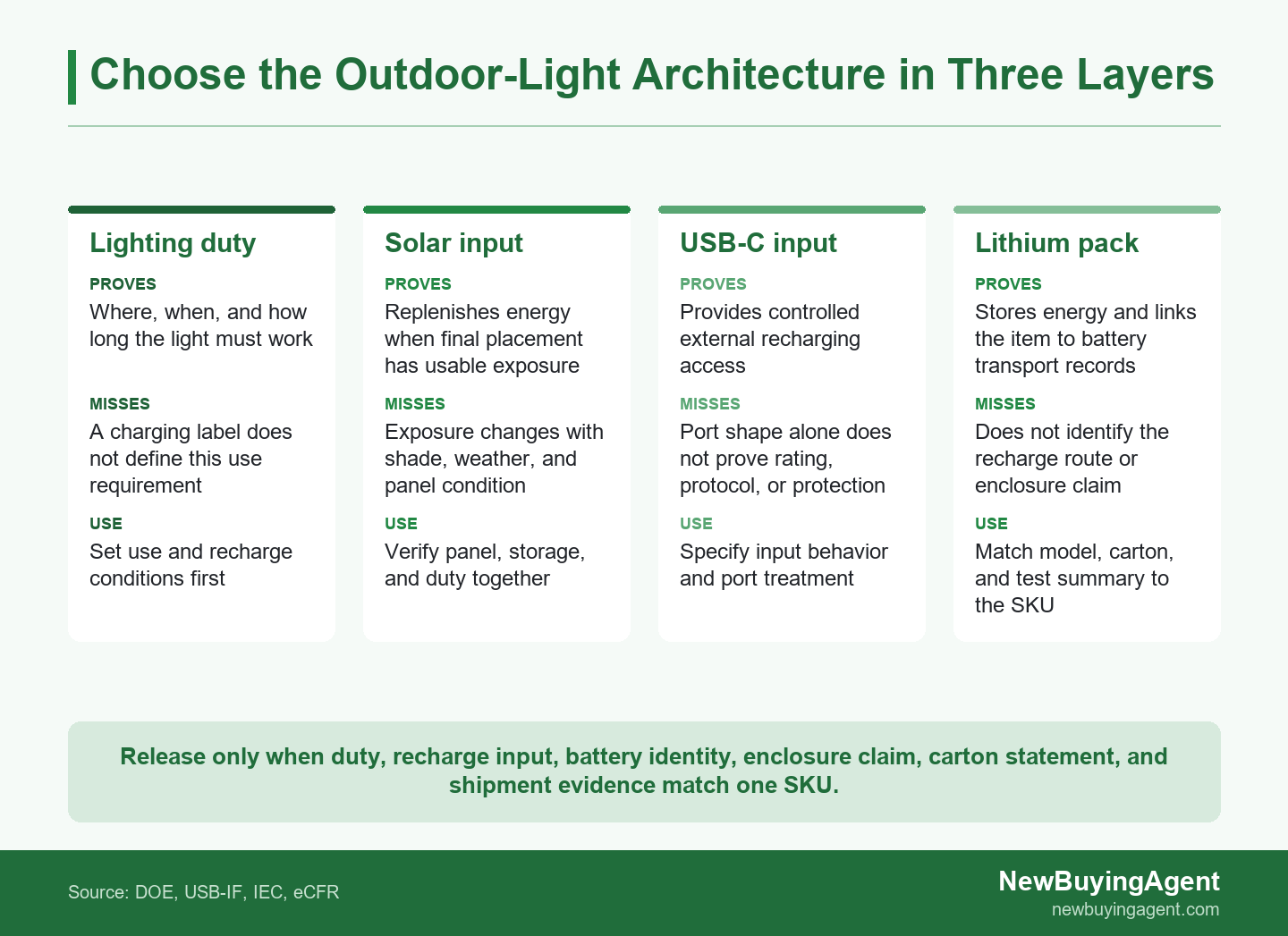
Outdoor-light sourcing cards comparing lighting duty, solar input, USB-C input, and lithium battery evidence before release
- Define the duty: placement, lighting mode, expected use window, mounting, and recharge opportunity.
- Select the input route: solar, USB-C, or a deliberately specified hybrid, with no assumed charging behavior.
- Identify storage and exposure: battery model, watt-hour rating, port cover, enclosure claim, and the tested finished configuration.
- Reconcile release records: sample, product specification, carton, battery evidence, and logistics plan must name the same SKU.
The check supports a conditional decision: choose solar when placement can support the stated duty; choose USB-C when controlled recharge access and its actual specification fit the product; choose a hybrid only when both inputs are part of the approved design. In every case, lithium remains the stored-energy and shipment-evidence layer.
For category and execution context, buyers can review NewBuyingAgent sourcing cases for category and execution context.
Prepare an Outdoor-Lighting Brief Before Requesting a Quote
A buyer brief for outdoor lighting should specify use case, illumination duty, charging inputs, battery identification, exposure expectation, packout, destination market, and shipment timing before a China sourcing quote is prepared. That gives the supplier a controlled basis for offering the correct configuration rather than guessing from a title such as “solar lithium outdoor lamp.”
Include the product category and intended placement; required operating mode; solar, USB-C, or hybrid input; approved input rating and charging behavior; battery chemistry, model, and watt-hour rating; port-cover and enclosure expectation; sample and test evidence; carton configuration; destination market; and required delivery window. Mark unknown fields as open decisions rather than allowing a catalog default to become a requirement.
Before the request is released, compare the brief with the physical sample and record every configuration-sensitive detail: panel position, port cover status, battery label, carton wording, accessory cable, mounting hardware, and product model. If one item is still provisional, mark it as an open decision and prevent an earlier sample or catalogue page from standing in for approval. This creates a clean handoff for a quotation, sample review, packaging check, and shipment discussion without asking any party to infer a missing feature.
When the brief is ready, buyers can send the outdoor-light product brief to NewBuyingAgent.
Frequently Asked Questions About Outdoor Lighting Sourcing
Is USB-C better than solar for outdoor lights?
USB-C is better when a product can rely on controlled recharging access, while solar is better when the final placement can provide the specified exposure for the required lighting duty. Neither choice removes the need to identify the lithium pack, enclosure condition, and finished-SKU evidence. A hybrid can be suitable when both recharge paths are deliberately specified and tested. The buyer should compare the exact use pattern, not a catalogue preference: a lantern stored beside a charging point has a different replenishment condition from a garden marker that remains outdoors all week. The released specification should say which condition applies, who tests it, and which sample represents the production version.
Does a USB-C port mean an outdoor light supports fast charging?
A USB-C charging port is useful only when its actual input rating, charging behavior, enclosure treatment, and battery documentation fit the outdoor product's intended use. USB-IF's protocol resource distinguishes protocol capability from the connector alone. Do not use the port shape as evidence of a particular charging speed, battery capacity, or weather resistance. Confirm the charger condition used for the test, the indicator behavior, the time required under that stated condition, and how the port is protected in the released outdoor configuration. Keep the sample photograph and the product label with that test record.
Which lithium-battery document should an importer request first?
Request that test summary first, then reconcile its model, watt-hour rating, and product association with the actual goods and packing plan. Review it alongside the purchase specification, finished sample, battery label, and carton record. If one document names a battery family while another names a specific product model, record the unresolved association before logistics are confirmed. The record is not a universal approval for shipment: transport mode, destination, packing method, quantity, and carrier instructions still matter for the actual movement. Keep a version date on the packing plan so a late carton change is visible.
Is an IP rating enough to prove an outdoor light will last?
No. An IP Code addresses specified enclosure-protection conditions, so the buyer should also verify the finished port cover, seals, mounting, materials, intended operating duty, and model-specific test basis. An IP claim should follow the released configuration rather than an earlier sample or a generic housing statement. The buyer should also ask whether the panel interface, switch, port cover, and mounting method on the tested model are the same as on the production version. A change to one of those parts can change the evidence that belongs with the SKU. Record the configuration shown in the test file before approving mass production.
NewBuyingAgent
Related Resources



Get Started Today
Let's Turn Your Sourcing Goals into RealityWeChat:+86 15157124615
WhatsApp:+86 15157124615
Address:Building 10 #39 Xiangyuan Road, Hangzhou, China