
Introduction
The email said matte black, soft touch, similar to the one attached. The sample arrives in a black that reads slightly blue under shop lighting, with a coating that marks when you hold it. The factory did exactly what it was asked. The instruction contained three words that meant something specific to you and nothing specific to anybody else.
Most quality arguments are documentation arguments wearing different clothes. A supplier builds what the paperwork describes, and where the paperwork is silent it builds whatever is normal for that plant. Getting the package right before the first quote costs a few days and removes a large share of the disputes that follow.
Key Takeaways
• An ODM brief describes an outcome, while an OEM package must define the product completely.
• Tolerances belong on every critical dimension, since an unstated tolerance becomes whatever the factory normally runs.
• Send a physical reference sample whenever one exists, and state which attributes it governs.
• Colour, texture and finish need a physical standard rather than a description or a screen image.
• Attach the approved specification to every purchase order with a version number and a date.
What Changes Between OEM and ODM
The two arrangements demand completely different packages, and sending the wrong one produces either a stalled conversation or a quote for something you did not ask for.
ODM: you send a brief
Under an ODM (original design manufacturer — the factory sells a design it already owns) arrangement you are selecting rather than defining. Send the function you need, the target price, the quantity, your market and the changes you want to an existing item. Branding, packaging, colour and minor material swaps are usually available. The base engineering is not, and asking for it produces an OEM quotation by another name.
OEM: you send a definition
Under an OEM (original equipment manufacturer — the factory builds to your design) arrangement the factory builds only what the documents describe. Everything absent from the package is a decision you have handed over. That includes things nobody thinks of as decisions, such as which side a seam falls on or how a moulded part is gated, and those choices become permanent once tooling exists.
A useful test is to hand your package to someone in your own company who has never seen the product and ask what they would build. Whatever they guess at is what the factory will decide for you. The exercise takes twenty minutes and consistently finds three or four gaps that felt obvious to the person who wrote the document.
Expert Tip: Write a single page stating which parts of the product are fixed, which are open to the factory's judgement, and which you want a recommendation on. Suppliers rarely receive this and respond to it well, because it tells them where they may use their own experience without risking a rejection. It also exposes, before any money moves, how much of your product is genuinely defined.
Building a Spec Sheet a Factory Can Quote From
A specification is a document a stranger could build from without calling you. Most first attempts are a description of the product written for someone who already understands it.
The sections that need to exist
Five sections cover almost every physical product, whatever the category.
• Dimensions and tolerances are stated for every measurement that matters functionally.
• Materials are named by grade or composition rather than by a general description.
• Construction notes explain how parts join, what fasteners are used and where seams or gates fall.
• Performance requirements state what the product must withstand and how that will be tested.
• Packaging and labelling are described down to carton quantity and label placement.
Tolerances, and where over-specifying costs money
A tolerance that is tighter than the product needs adds cost to every unit forever. Tight where it matters, generous everywhere else, is the rule. Let's be honest: many buyers copy tolerances from an unrelated drawing because the numbers look professional, then pay for that decision on every order for years.
Mark which dimensions are critical rather than treating the drawing as uniformly important. Factories inspect against what you flag, and a drawing with forty equally weighted measurements gets checked with the same effort as one with four. Highlighting the handful that decide fit or function focuses the inspection where failure actually hurts you.
Common Mistake to Avoid: Sending photographs instead of drawings for a moulded or machined part. Photographs carry no dimensions, no wall thicknesses and no indication of which features are critical. Factories asked to quote from images either add margin to cover the unknowns or guess, and both outcomes reach you as a problem later. Through 2026 most plants accept 3D files directly into their production workflow, so sending a model alongside a dimensioned drawing shortens quoting noticeably.
Reference Samples: What to Send and How
A physical object communicates in minutes what a document struggles to convey in pages. It also creates ambiguity of its own unless you say what it is for.
Say what the sample governs
Send the reference with a written note stating which attributes it controls and which it does not. A competitor's product sent as a quality benchmark will otherwise be copied in every respect, including features you did not want. Labelling the sample as a reference for finish and weight only, for instance, prevents a factory from replicating a shape you have no right to use.
Getting samples there without losing two weeks
Declare samples honestly with a low but realistic value and mark them as samples rather than commercial goods. Powders, liquids, batteries and cosmetics carry restrictions that delay couriers. Build ten days into the plan for the first exchange, and send two identical units so that the factory can cut one apart without losing your only reference.
Ask for the counter sample back as well. A counter sample is the unit the factory produces to match your reference, and holding it beside the original is how you judge whether the match is close enough. Suppliers sometimes keep both, which leaves you approving a production run against a memory rather than an object.
Expert Tip: Photograph and weigh every sample before it leaves your desk, then photograph it again on arrival at the factory. Samples get damaged in transit and get compared against whatever condition they arrived in. Two sets of photographs and a recorded weight settle any question about whether a defect existed before shipping, and the whole exercise takes five minutes per unit.
Colour, Material and Finish Standards
These three attributes generate more rejected production than any other part of a specification, because all three are described in words that feel precise and are not.
Why a colour name is not a specification
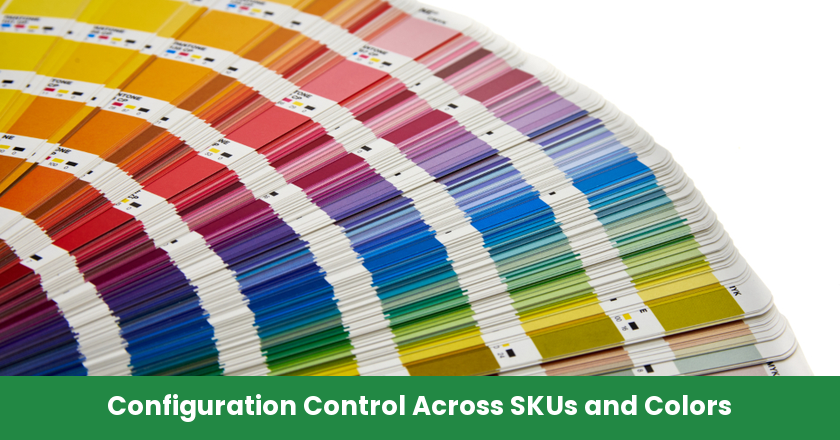
Screens differ, lighting differs and printed references fade. Use a recognised colour system reference where your category has one, and back it with a physical chip or an approved production sample. State the light source under which colour will be judged, since a match under daylight can fail under warm indoor lighting and both parties will be certain they are right.
Physical standards and approval records
For textiles, ask for lab dips before bulk dyeing, which are small swatches dyed to your reference for approval. For coatings and finishes, ask for a plaque or a finished part rather than a description. Approve in writing, keep one copy of everything approved, and make sure the factory keeps a matching copy with the same date on it.
Agree an acceptable variation band at the same time. No dyeing or coating process reproduces a reference exactly across a full run, and a standard with no stated tolerance invites an argument at inspection. Stating how much drift is acceptable, and in which direction, turns a subjective disagreement into a measurable one.
Expert Tip: Approve colour and finish on the actual material and the actual process, never on a substitute. The same reference applied to injection-moulded plastic, painted metal and printed card produces three visibly different results, and a chip approved on paper tells you very little about a moulded part. Ask for the approval sample to come off the production process that will make your goods.
Artwork, Packaging and Label Files
Packaging is where buyers send the least and expect the most, and it is also where errors are most expensive because they reprint in full.
What a factory needs from you
Send vector artwork with fonts converted, a dieline showing the cut and fold lines at actual size, the colour references for printing, and a clear statement of which surfaces carry which artwork. Include barcode files at the correct size rather than as an image pulled from a document, since a rescaled barcode frequently fails to scan.
The details that cause reprints
Mandatory market information, importer details, material and origin statements all belong on the file you send rather than in a follow-up message. Confirm carton markings separately, including the quantity per carton, the gross and net weights and any handling marks. Ask for a printed proof before the full run, not a digital preview. Keep the approved proof, since it is the reference for every reprint that follows.
Common Mistake to Avoid: Approving packaging artwork on screen. Print colour behaves differently from screen colour, coatings change how ink reads, and an area that looks generous on a monitor can be cramped on the actual box. A printed proof costs a few days and a small fee. A container of boxes with the wrong shade or an unreadable barcode costs the shipment and sometimes the launch window.
Approvals, Versions and What Travels With the Order
The package you built is worth very little if the factory is working from an earlier version of it, which happens more often than buyers imagine.
Version control in practice
Put a version number and a date on every document and use them in conversation. Ask the factory to confirm which version it is building from at the start of each order. Development conversations scatter across messages, and a plant working from a drawing superseded six weeks ago will build exactly what that drawing says.
What goes with the purchase order
Attach the approved specification, the artwork files, the packing instruction and a reference to the approved physical sample by its label and date. A purchase order carrying a price, a quantity and a delivery date alone is an agreement about commerce rather than about product, and only one of those two is usually in dispute later.
Expert Tip: Keep one sealed approved sample per version, labelled and dated, at your own premises rather than only at the factory. When production differs from expectation two years later, that object is the reference both sides agreed to, and it survives staff changes on either side. Factories lose samples, reorganise storage and change quality managers, and your copy is the one that will still exist.
Getting Specifications Across the Gap With NewBuyingAgent
An OEM or ODM specification only works when the factory understands exactly what the buyer wants to produce. Language, location, time-zone and communication differences can make that process more difficult, particularly when specifications involve materials, dimensions, finishes or other product details.
NewBuyingAgent works from the buyer's product requirements and communicates them with the relevant factories in China. Its 20,000+ product development and QC experts provide product and quality support, helping translate product requirements into practical specifications that factories can follow during development and production.
Access to the right factory matters as well. NewBuyingAgent works with 50,000+ partner factories across China, giving buyers a broader supplier base to consider for OEM and ODM products rather than limiting the search to factories they can reach independently.
For OEM and ODM sourcing, the value is therefore not simply translating an email. It is connecting the buyer's specifications, the right manufacturing source and factory-level execution so that what is developed and produced stays aligned with what was originally approved. Contact now.
Frequently Asked Questions
What is the minimum I need to send for an oem and odm service quotation?
For ODM, a clear description of function, target price, quantity and market is usually enough to start. For OEM, a dimensioned drawing, a material specification and a target quantity are the floor. Anything less and the number you receive is a placeholder that will move once the factory understands what it agreed to build.
Should I send a competitor's product as a reference?
It is common practice and useful for communicating quality level, provided you state which attributes the sample governs. Asking a factory to copy a protected design is a different matter and creates exposure for you rather than for the supplier. Reference the feel, the weight or the finish, and design the rest yourself.
How detailed should tolerances be on a first order?
Specify tightly only where a dimension affects fit, function or safety, and leave the rest to standard practice for the process. Ask the factory what tolerance it normally holds on that process and whether your requirement sits inside it. A requirement outside a plant's normal capability is a cost increase and sometimes a rejection rate you will fund. Asking the question early also tells you whether the factory understands its own process.
Can NewBuyingAgent manage this documentation work?
Specification and approval work is precisely the back-and-forth that consumes a buyer's week. Save Time for Local Market Growth: NewBuyingAgent handles all factory communication—perfect for multi-category buyers. The commercial side of that arrangement rests on supplier selection rather than on fees. Even with its margin included, NewBuyingAgent cuts your costs by 5%-10%.
Conclusion
Build the package once and reuse it for every supplier you approach: a defined specification with real tolerances, a labelled reference sample, physical colour and finish standards, print-ready artwork with a dieline, and a versioned approval record attached to the order. Suppliers quote faster and more accurately against it, and the arguments that usually surface at inspection mostly stop happening. If you would rather have that translation handled at the factory end, NewBuyingAgent is worth a conversation.
Partial Sources
1. CE Marking: Manufacturers – European Commission — https://single-market-economy.ec.europa.eu/single-market/goods/ce-marking/manufacturers_en
2. Basic Importing and Exporting – U.S. Customs and Border Protection — https://www.cbp.gov/trade/basic-import-export
NewBuyingAgent
Related Resources

Get Started Today
Let's Turn Your Sourcing Goals into RealityWeChat:+86 15157124615
WhatsApp:+86 15157124615
Address:Building 10 #39 Xiangyuan Road, Hangzhou, China