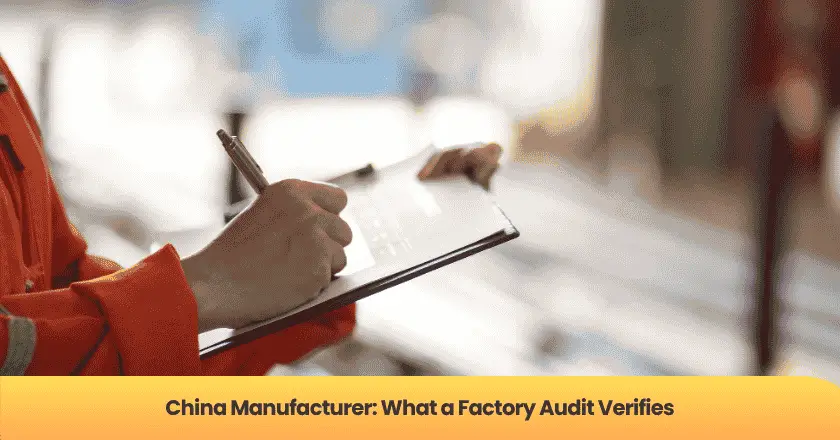
A buyer commissions an audit, receives a favourable report, and places a first order with confidence. The goods arrive with a plating defect traced to a workshop two streets from the plant he audited. Nothing in the report was wrong. It confirmed the company exists, owns the equipment described, employs the people counted and operates a documented quality system. It did not say who does the plating, because he never asked and the auditor was not briefed to find out.
An audit is a snapshot of an organisation against defined criteria. Knowing which criteria were applied, and which questions were never on the list, is what turns a report from reassurance into information.
Key Takeaways
• An audit assesses an organisation against stated criteria, and the criteria decide what the report can tell you.
• Capability audits verify equipment, headcount and capacity, while system audits verify documented processes.
• Social compliance audits cover working conditions at a named site on a named date and do not travel to subcontractors.
• A certification is not the same as an audit report, since certification confirms a system rather than your product.
• No audit predicts whether your specific batch will be good, which is what inspection exists to do.
What an Audit Is
The word covers several different exercises, and buyers frequently commission one while expecting another.
Criteria, Evidence and Findings
An audit is a systematic, independent and documented process for obtaining evidence and evaluating it against agreed criteria.ISO 19011, the international guideline for auditing management systems, sets out the principles involved, how to manage an audit programme, how to conduct audits and how to evaluate auditor competence.
The practical consequence is that an audit answers the questions it was asked. A capability audit and a social compliance audit visiting the same factory on the same day produce entirely different reports, both accurate. Define the criteria before commissioning one, since the scope is the product you are buying.
Audit, Certification and Inspection
Certification is an independent body confirming that a management system meets a certifiable standard, which is a statement about process rather than about your goods. An audit report is a described assessment for your own use.Inspection is different again, checking a specific batch against a sampling standard such asISO 2859-1.
Buyers often hold a certificate and assume it substitutes for the other two. It does not. A certified factory can still ship a bad batch, and an inspection can pass goods from a factory with poor labour conditions. The three exercises answer three separate questions.
Who performs the audit matters as much as what it covers. A third-party firm working to your brief is independent of both you and the factory. A certification body assesses against a certifiable standard and issues a certificate rather than a report. Your own staff or agent produce the most tailored assessment and the least independent one, which is fine provided you know which you have.
Expert Tip:Write the audit brief yourself rather than accepting a provider's standard template. Add the questions specific to your risk: which processes are subcontracted and to whom, whether the site has produced this product category before, what happens to your tooling when it is not running. Standard templates cover standard ground well and cannot know what worries you. I add four or five product-specific questions to every brief, and those are reliably the most useful lines in the report.
The Main Audit Types
Four types cover most commissions, and each has a defined scope with defined blind spots.
Capability and Capacity
This is the audit most importers actually want. It verifies the legal entity, the site address, floor area, headcount, the equipment list, the process flow and an estimate of monthly capacity. Done properly it also records which processes happen in-house and which are subcontracted.
The entity check is worth doing carefully.A registered company can be confirmed on theNational Enterprise Credit Information Publicity System, and an audit that names the registered Chinese company and its credit code is considerably more useful than one naming an English trading style.
Quality System, Social Compliance and Security
A quality system audit examines documented procedures: incoming material control, in-process checks, calibration records, non-conforming product handling and corrective action. It tells you whether a system exists and is followed, not whether your product is good.
Social compliance audits cover working hours, wages, age verification, health and safety and facility conditions at a named site on a named date. Security audits assess controls on cargo and premises, which some buyers require for customs programmes. Each is a snapshot, each expires, and none of them travel to a subcontractor the factory uses next season.
Environmental audits appear in some supply chains and are worth naming separately. They cover permits, discharge handling and waste management, and they matter most in processes such as plating, dyeing and finishing where local enforcement can halt a line without warning. Buyers in those categories sometimes discover the issue when production stops rather than when they audited.
Common Mistake to Avoid:Treating an audit report as a guarantee of the goods is the error underneath most disappointment in this area. An audit assesses an organisation and a system. It cannot tell you that the batch produced three months later will match your sample, that the factory will prioritise your order in a busy month, or that the process you care about will still be performed in-house. Commission the audit for what it answers, then commission inspection separately for the batch, and treat anyone selling one as a substitute for the other with appropriate caution.
Reading the Report You Receive
Reports vary enormously in usefulness, and the differences are visible on a first read.
What a Good Report Contains
Named registered entity and credit code, site address and photographs including the front gate with signage, floor area, headcount broken down by function, an equipment list with quantities and condition, a process flow marking in-house against subcontracted steps, and a capacity estimate with the assumptions behind it.
It should also record what could not be verified. An auditor unable to see a production line because it was idle, or unable to obtain a document, should say so. Reports with no caveats at all usually reflect an auditor filling in a template rather than one looking carefully.
Capacity figures deserve particular scrutiny, since they are the most frequently overstated number in any report. Ask how the estimate was derived: machine count multiplied by cycle time and shift pattern is a calculation, while a figure supplied by the factory and repeated by the auditor is a claim. A good report distinguishes the two clearly.
Announced, Unannounced and What Changes
Announced audits see a prepared factory. That is not deception, since any business tidies before a customer visits, and a prepared site still reveals equipment, scale and documentation. Unannounced or semi-announced audits see ordinary operating conditions and cost more to arrange.
Use announced audits for capability and capacity, where the facts do not change with notice, and consider unannounced ones where working conditions or actual output are the concern. Where budget allows only one, an announced capability audit early plus an unannounced check after volume grows is a reasonable sequence.
Expert Tip:Ask for the auditor's photographs as a separate file rather than only as images embedded in a report. Full-resolution pictures of the production floor, the warehouse, the equipment plates and the front gate tell you things the written summary compresses away. I have spotted a machine brand inconsistent with the claimed capability, and on another occasion a floor far emptier than the headcount implied, both from photographs rather than from text. Auditors provide them readily when asked in the brief.
Using Audits Sensibly
The value comes from matching the exercise to the decision and repeating it at the right intervals.
When an Audit Is Worth Commissioning
Before a first substantial order, before committing tooling to a site, when moving production between factories, and when a customer or regulator requires documented supply chain diligence. For a small trial order, a public register check and a video walkthrough usually cover the risk at a fraction of the cost.
Scale the effort to the money at stake. Buyers who audit every candidate spend heavily on companies a ten-minute search would have removed, and buyers who never audit discover their supply chain during a problem rather than before one.
Re-auditing and What to Watch Between Visits
Factories change. Ownership moves, lines get reallocated, key staff leave and processes get subcontracted when capacity tightens. An audit from three years ago describes a company that may no longer exist in the same form.
Between audits, watch the signals that come free: a longer than usual lead time, a new account manager, a sudden price movement, a batch that differs from the last. Any of these is a reasonable trigger to ask what has changed at the site, and asking early is considerably cheaper than auditing after a failure.
Expert Tip:Ask which factory produced each batch, routinely, and record it. Where a supplier names the site every time, you have continuity you can verify against your audit. Where the name changes or the answer becomes vague, production has moved and your audit no longer describes what is happening. This costs one line in an email per order and it is the most reliable early warning available between formal visits.
Audits Across a Wider Supply Base
NewBuyingAgent is your perfect partner for global sourcing from China, backed by 30 years of expertise in trade, manufacturing and quality control. Its mission is to make China sourcing effortless and profitable for global buyers.
An audit tells you about one site on one day. What happens on the line during your production run is a separate question and needs people present rather than a report.
20,000+ product development & QC experts ensure your products match market needs and stay high-quality.
Assessment also only helps where there are enough candidates to choose between in the first place.
Only less than 5% of China's factories are within your reach. NewBuyingAgent gives you 100% Access to China's Factories through its 50,000+ cooperated partner factories—no language/region/time zone barriers. Its local reputation gets you full factory cooperation.
Frequently Asked Questions
What does a factory audit actually check?
It depends on the type commissioned. A capability audit verifies the legal entity, site, equipment, headcount, process flow and capacity. A quality system audit examines documented procedures and records. A social compliance audit covers working conditions at that site on that date. Define the criteria before commissioning, since the scope determines what the report can tell you.
Is ISO 9001 certification enough on its own?
No. Certification confirms that a quality management system exists and meets a standard, which is a statement about process rather than about your product. Treat it as a hygiene factor and rely on your own written specification, an agreed sampling standard and inspection at defined stages for actual quality assurance.
Should the audit be announced or unannounced?
Announced works well for capability and capacity, since equipment, floor area and documentation do not change with notice. Unannounced is more informative where working conditions or genuine operating output are the concern, and it costs more to arrange. Many buyers use an announced audit first and an unannounced check once volumes grow.
How often should I re-audit a supplier?
Commonly every one to two years for active suppliers, and sooner where something visible changes such as ownership, a new account manager or an unexplained shift in lead time or quality. Between audits, ask which site produced each batch and record the answer, since a change there is the earliest warning you will get.
How much does a factory audit cost relative to the risk?
Far less than a container of unusable goods, which is the comparison that matters. Costs vary by scope, location and whether the visit is announced. For a first substantial order or before committing tooling, the expense is generally trivial against the deposit at stake. For a small trial order, a register check and a video walkthrough usually cover the risk adequately.
Conclusion
An audit answers the questions it was asked about one site on one day. Write the brief yourself, add the questions specific to your product, insist that subcontracted processes are identified, read the photographs as well as the text, and commission inspection separately for the goods. Used that way it is one of the cheaper pieces of diligence available. Used as a guarantee it disappoints.For buyers who want assessment and production oversight handled together, NewBuyingAgent covers factory selection, quality control and delivery from China.
Partial Sources
1. International Organization for Standardization — ISO 19011:2018, Guidelines for auditing management systems, covering audit principles, programme management and auditor competence —https://www.iso.org/standard/70017.html— Accessed 31 August 2026
2. International Organization for Standardization — ISO 2859-1:2026, Sampling procedures for inspection by attributes, Part 1 —https://www.iso.org/standard/85464.html— Accessed 31 August 2026
3. State Administration for Market Regulation — National Enterprise Credit Information Publicity System, the public register of Chinese business entities —https://www.gsxt.gov.cn/— Accessed 31 August 2026
NewBuyingAgent
Related Resources
Get Started Today
Let's Turn Your Sourcing Goals into RealityWeChat:+86 15157124615
WhatsApp:+86 15157124615
Address:Building 10 #39 Xiangyuan Road, Hangzhou, China