A supplier lessons learned library is a collection of evidence-backed records that helps a team avoid repeating known problems and judge what to do differently. Across Chinese suppliers, its value depends on preserving the conditions behind each lesson, not simply circulating a corrective-action report. Keep the original event and its evidence separate from the decision to use the lesson at another factory. That makes learning searchable without pretending that the same fix suits every product or production line.
Build a library that changes the next order
Build the library around decisions that recur in your orders: a tooling check before production, a packaging requirement before shipment, or a product revision before quotation. A useful entry states what happened, what is known about the cause, what action worked, and where reuse may fail. Each receiving factory then needs its own applicability decision and record of implementation; closing the original incident does not complete that work.
- Definition: Store a concise lesson linked to evidence, rather than duplicate the entire incident folder.
- Risk: Match materials, process, failure mechanism, and checking method before copying a remedy.
- How it works: Keep a separate adoption record for each receiving factory.
- Decision: Measure whether lessons change current work, and revise them when new evidence appears.
Choose lessons people can find and act on
Choose entries that another person can retrieve, understand, and use in a specific decision. NASA’s public lessons system describes reviewed lessons containing the original driving event and recommendations, indexed to support retrieval. The useful design principle is the connection between context and action. This is an institutional knowledge-management example, not a NASA supplier requirement or a reason to import aerospace procedures into an ordinary consumer-product order.
An incident folder answers what happened to a particular order; a reusable lesson explains what another team should notice or change. Keep photos, test reports, correspondence, and the full investigation in their controlled source location. The library entry should point to that material and state its practical consequence. A proven improvement can be worth recording even when it prevented a complaint, while a dramatic failure with no dependable conclusion may belong in an investigation queue.
Give an entry a title people would search for, such as “Check boring-jig wear when cabinet joints loosen,” rather than “Supplier A complaint closed.” Add a small set of consistent tags for product family, material, manufacturing step, failure symptom, and mechanism. An adoption record is the receiving factory’s record of how it assessed and used that lesson. Link these records to the source entry so supplier-specific results remain visible without duplicating the underlying lesson.
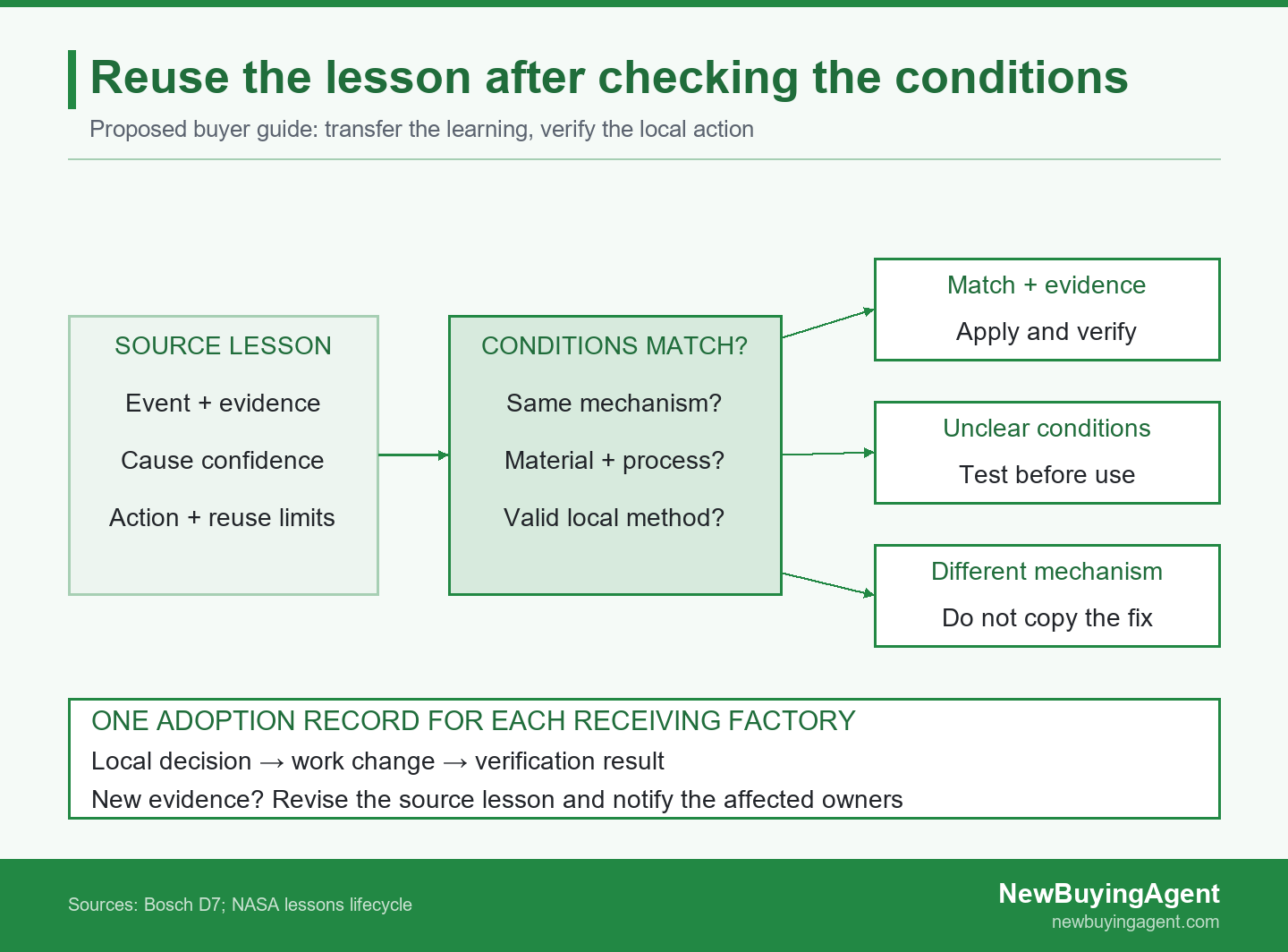
A source lesson leads to different supplier actions after checking conditions, with a separate adoption and verification record for each factory.
Capture the evidence, the action, and its limits
Capture enough evidence and context for a colleague to judge the lesson without reconstructing every email. NASA’s lessons lifecycle distinguishes recording and dissemination from application, where learning changes processes, checklists, or other practice. For a sourcing team, saving a report and sending it to factories are therefore intermediate steps; the record also needs to show what the recipient should assess or change, and what evidence will establish local use.
Use the following proposed entry template as a starting point. The final column is a prompt for completion, not a mandatory data standard. Use links to approved source records and actual document revisions; avoid copying restricted drawings or large attachments into every entry.
| Entry field | What to preserve | Fill-in prompt |
|---|---|---|
| Identity and status | Stable lesson ID, useful title, owner, revision and review state | ID ___; title ___; owner ___; status ___ |
| Original context | Product revision, material, process, factory and affected production scope | Product/process ___; scope ___ |
| Event and consequence | Observed defect or successful intervention and why it mattered | Observation ___; effect on order ___ |
| Evidence and confidence | Source record, confirmed findings, hypotheses and unresolved questions | Evidence link ___; confidence/unknowns ___ |
| Action and verification | Implemented change and what demonstrated its effectiveness locally | Action ___; verification ___ |
| Reuse conditions and limits | Conditions necessary for the lesson to be relevant; exceptions | Applies when ___; reassess when ___ |
| Work-document link | Specification, setup check, instruction or checklist affected | Document/revision ___; required change ___ |
| Receiving-factory use | Link to each separate applicability and adoption record | Factory ___; adoption record ___ |
| Sharing and review | Access restriction, approved shareable summary, next review trigger | Permission ___; review trigger ___ |
The entry should distinguish observation, explanation, and proof. “The joint was loose” is an observation; “a worn jig caused the oversized bore” needs supporting investigation. If the cause is unresolved, retain the warning with that limitation instead of approving a remedy for general reuse. Likewise, a revised instruction is an implemented action only when it reaches the relevant workstation; its existence alone does not show that the defect mechanism was removed.
Check the conditions before reusing a factory lesson
Check applicability—the conditions that must match—before assigning a lesson to another supplier. Bosch’s D7 guidance addresses comparable problems in other processes and products through preventive action and updates to documentation. It supports looking beyond the original incident, but does not establish that every similar-looking defect has the same cause. The receiving factory must assess whether the mechanism and the conditions behind the original lesson are relevant to its own product and process.
Use these questions to make the transfer decision explicit. A matching product category is a useful search cue, not a sufficient technical conclusion:
- Requirement: Is the same function or acceptance characteristic at risk, under the applicable product revision?
- Mechanism: Could the same physical or process failure occur here, rather than merely produce a similar symptom?
- Conditions: What changes in material, tooling, equipment, handling, or operating environment could alter the result?
- Local action: Which specification, setup check, maintenance task, or instruction should change at this factory?
- Verification: Who will assess the action and what evidence will support its local effectiveness?
The checking method also needs attention. NIST’s gauge R&R guidance addresses instrument and measurement-system performance, including repeatability, reproducibility, stability, bias, and resolution. When a lesson depends on a dimension, a result from another factory’s instrument is not enough to establish that the local measurement is suitable. Record the method and relevant setup, and have the responsible technical team assess it. This instrument guidance should not be presented as proof that a visual appearance judgment is reliable.
One cabinet problem, different actions at different factories
Transfer the risk question before transferring a production setting. A lesson about worn boring equipment may be relevant to several furniture factories, while the corrective setup remains specific to a material, joint, and process. The example below shows how a source lesson can lead to different local actions. It is illustrative, not a NewBuyingAgent customer case, a tested engineering recommendation, or evidence that every loose cabinet joint has the same cause.
Illustrative example: capture the jig problem at Factory A
Consider an illustrative order of 1,200 flat-pack cabinets made by Factory A in China. After an investigation, the importer and factory identify oversized bores associated with a worn boring jig. The factory corrects the setup, checks the relevant joint feature against the approved product requirements, and retains evidence of the corrected output. For this example, assume the investigation and local effectiveness checks support the stated cause and correction; the library entry must link to those records.
The review covers 1 source factory and 2 possible receiving factories. Factory B performs a similar boring operation, but its jig design and maintenance arrangements differ. Factory C uses a different material and joint design. The observation to transfer is that tooling condition can matter to the specific joint feature, together with the confirmed conditions at Factory A. Sending Factory A’s setup instruction unchanged would conceal the differences that the recipients need to evaluate.
The buyer records the source lesson and asks each receiving factory for a separate applicability decision. Factory B checks its own tooling condition and, where relevant, revises a local setup or maintenance control; its responsible team verifies trial output and follow-up production against its approved requirements. Factory C first assesses whether the identified mechanism can occur in its different design. It does not copy a boring setting merely to mark the lesson complete. These are illustrative decisions: actual controls, scope, and verification need product-specific technical assessment.
Decide what Factories B and C should do differently
Factory B’s adoption record should name the evidence reviewed, the relevant local difference, the document changed, and the result of verification. If the jig is sound but another source of variation remains, record that finding instead of forcing Factory A’s explanation onto the new situation. Factory C may record “not applicable to this design,” with a specific reason and a trigger for reassessment if the design changes. A reasoned non-application is more useful than a signature falsely implying that the same correction was implemented everywhere. Link both outcomes to the source lesson’s current revision.
Use the library during real purchasing and factory work
Make retrieval part of an existing decision, such as product review, production preparation, a tooling change, or an inspection-plan update. NIST’s Baldrige commentary emphasizes embedding improvement and learning in work processes. For a buyer team, this suggests asking which relevant lessons were considered before the order advances, then recording the resulting change. A separate library meeting can help, but cannot substitute for a requirement reaching the people who perform or check the work.
Keep a short adoption record beside each source lesson: receiving factory and product revision; applicability decision and reason; local action owner; affected work document and revision; implementation evidence; verification result; unresolved issue and next review trigger. Use explicit states such as awaiting assessment, testing, implemented but unverified, verified locally, or not applicable with reasons. This keeps “email sent” and “action effective” from becoming the same status. The receiving factory’s owner supplies evidence; the buyer’s responsible reviewer evaluates the result.
For a buyer keeping its existing Chinese cabinet suppliers, the practical gap is often local follow-up after an instruction has been agreed. NewBuyingAgent’s existing-factory management service includes production follow-up, staged QC, reporting, and logistics. Its product and quality-control capability can support the wider factory-management scope while the buyer carries confirmed requirements into the order. Agree the relevant activities and reporting needs; do not assume this service includes hosting a lessons database, validating every engineering remedy, or distributing another factory’s restricted records.
Control sharing, revisions, and proof of use
Treat permission to share as a separate decision from technical usefulness. WIPO’s trade-secret guidance identifies reasonable secrecy measures, including confidentiality agreements, in explaining trade-secret protection. For a multi-supplier library, keep original evidence under appropriate access controls and prepare a shareable version only within the rights and agreements that apply. Removing a supplier’s name does not by itself establish permission to disclose its drawings, process detail, prices, or other restricted information.
Give each entry a named owner and preserve superseded versions. Review it when a relevant specification, material, method, or process changes, when new evidence challenges the cause, or when a receiving factory reports recurrence. Link the replacement entry and notify affected adoption owners so obsolete instructions are not silently reused. Track use with a small set of practical measures: relevant reviews completed, work changes implemented, local verification pending, and recurring defects after adoption. Document uploads alone cannot show that the library influenced production.
When assessing a sourcing partner for future purchases, ask how its stated resources relate to the product and process risks in your own records. NewBuyingAgent’s factory-resource and product-QC background describes local China factory resources and development/QC capability. That background can inform the sourcing discussion; it is not evidence of a proprietary cross-supplier database or permission to exchange confidential factory information. Keep the approved lesson summary focused on the product requirement the next sourcing decision needs to address.
Start with a focused set of recurring problems
Start with a focused product family and a manageable set of recurring problems, then test the library during an actual order review. Ask a colleague to find a relevant entry, explain its limits, and identify the local document or check that should change. If that requires reconstructing an investigation or consulting only the original author, improve the entry and its tags before expanding the repository. Assign ownership for both maintaining the lesson and following through at receiving factories.
For a new China product purchase, include the confirmed risk and acceptance requirements alongside the specification, quantity, target price, destination, and timing, then request a China product-supply quote. NewBuyingAgent uses local factory resources and product/QC capability to quote and supply products around the purchasing need. The useful input is the approved product lesson and its limits, rather than an instruction to repeat another factory’s setting. That carries learning into the supplied product offer without promising a ready-made library implementation service.
Questions about maintaining a supplier lessons library
What software should we use for a supplier lessons library?
Choose software that lets the team retrieve relevant lessons, control revisions, and reach the supporting evidence without relying on one person. A shared tool may be enough for a pilot if ownership and access are clear. Test it using a real search and an adoption review before buying a larger system. If it cannot distinguish a current approved entry from an obsolete attachment, solve that problem before treating the software rollout as completion.
Can we record a lesson before the root cause is confirmed?
Yes, but record it as an unresolved warning or investigation rather than a verified remedy that other factories should copy. State the observation, the supporting records, what remains uncertain, and who owns the next investigation step. Such an entry can prompt another team to check for exposure while preserving the uncertainty. When the cause is later confirmed or rejected, revise the entry and review the receiving-factory decisions that relied on it.
Should lesson records be written in Chinese or English?
Use the languages the receiving teams need, while keeping product references, revision identifiers, and technical acceptance meaning aligned across both language versions. A short bilingual action summary can help the buyer and factory communicate, but ambiguous technical wording needs review by a competent owner. Retain the approved source revision and identify which version governs the agreed instruction. Do not let a translated summary silently change a limit, material, test method, or exception.
What should happen if the same defect returns after adoption?
Reopen the adoption assessment and the local implementation evidence instead of deleting the old lesson or assuming that an operator ignored it. Check whether the conditions changed, the action was maintained, the measurement was suitable, or the original cause explanation was incomplete. Preserve the earlier evidence and record the new finding. Revise the source lesson when justified, then identify other adoption owners who need to reassess their own decisions.
NewBuyingAgent
Related Resources
Get Started Today
Let's Turn Your Sourcing Goals into RealityWeChat:+86 15157124615
WhatsApp:+86 15157124615
Address:Building 10 #39 Xiangyuan Road, Hangzhou, China