

AI-powered market insight is useful when it converts several imperfect signals into a product opportunity that a buyer can validate; it is not a machine-generated promise that a trending item will sell. The useful question is not “What is hot today?” It is whether a particular buyer, in a particular market, has enough evidence to test one product concept with clear learning goals and defined limits.
That distinction matters in China sourcing. A highly visible product can still miss the buyer’s price position, intended use, product requirements, or destination-market constraints. The recommendation becomes valuable only when it narrows uncertainty before the buyer commits inventory, samples, packaging, and launch resources.
A Better Standard for Product Recommendations
A credible AI product recommendation separates signal discovery, cross-signal corroboration, product-risk screening, and a defined validation action before China sourcing begins. It should make uncertainty visible instead of hiding it behind a score, a viral post, or a category ranking.
- Discovery: identify a specific buyer problem or use case, not a vague product category.
- Corroboration: look for a second, independent signal that supports the same market and time window.
- Risk screen: surface the safety, naming, and product questions that could change the concept.
- Action: decide whether to validate, revise, or stop before issuing a supply request.
AI Finds Patterns; It Does Not Prove Demand
Google Trends presents search interest, so it can show what people are searching for but does not itself provide a sales, margin, or product-quality conclusion. The Google Trends exploration view is therefore a starting point, not a product verdict. A signal is an observed indicator that may suggest attention or demand but cannot prove a buying outcome. AI can read many such signals quickly; it cannot remove the difference between attention and a product decision.
Pinterest and TikTok expose platform-specific search, pattern, and creative-trend signals, but those signals describe activity within their own environments rather than a buyer's complete market. The Pinterest trends tool and TikTok Creative Center make those platform views easier to inspect. A creator format may inspire a feature direction; it does not establish the price a retailer can support, the product quality buyers will accept, or the repeatability of the demand.
A sound market-insight process records what each signal actually observes. Search can indicate language and curiosity. Commerce data can indicate product clusters or listing activity. Social activity can reveal visual styles, moments, and emerging vocabulary. Customer reviews, own-site queries, returns, and repeat purchase records can add closer-to-buyer evidence when available. The point of AI is to compare these inputs consistently and expose disagreements early.
Corroborate a Product Idea Across Different Signals
A product idea deserves a buyer-facing opportunity brief only after at least two independent signal types agree on a concrete use case, market, and time window. Here, corroboration means checking whether a second independent signal supports the same idea. It is stronger than seeing the same claim repeated across dashboards that draw on similar activity.
Keyword Planner can show search-frequency change and bid estimates for planning, so it can add commercial context to a query without establishing product profitability by itself. Its keyword planning resources are most useful after the buyer sets geography, language, and phrase family. Then the question becomes practical: does the growing language describe the same use case as the product concept, or merely a broad interest that several unrelated products could satisfy?
Commerce reporting can distinguish a product cluster from a single listing: Google's Merchant API describes best-seller clusters as groupings of offers and variants that represent the same product. The Merchant API reporting reference is helpful because an isolated high-performing listing can reflect an unusual promotion, an established brand, or a bundle. A product opportunity needs a use-case explanation that remains meaningful when the listing, variant, and seller are removed.
After that comparison, a buyer who wants product-specific market analysis can review the Bestseller Market Analysis Report. The useful discussion is not a promise that a product will win; it is a record of the product concept, the observed signal, the market context, and the evidence that remains open.
Use Search Language to Define the Buyer Problem
Google's Search Analytics API can query a website's search traffic using custom filters and dimensions, but its documentation notes that internal limits can return only top data rows. That makes a buyer's own search patterns useful directionally, not a complete market record. The Search Analytics reference describes the coverage boundary.
For example, “small kitchen counter storage” and “magnetic kitchen organizer” are not interchangeable. The first can point to a space constraint and a use setting; the second points to a feature hypothesis. AI can group phrases and customer comments, but the buyer should decide which wording describes a real product need, which wording is seasonal, and which wording belongs to a different product family. That discipline makes the later sample brief much more specific.
Give the Signal a Commercial Meaning
A commercial signal is useful only when the buyer can connect a product cluster or search pattern to a plausible price position, use case, and target market rather than treating a ranking as a margin forecast. The buyer should ask: who needs this product, what job does it do, what existing alternative does it replace, and what feature would justify the proposed price?
This is where AI is particularly good at comparison, not prediction. It can summarize recurring feature language, group review complaints, and identify style differences across a large set of examples. The buyer still needs to reject false matches. A compact organizer for renters, a premium countertop accessory, and a low-cost impulse item may share a search term while demanding very different materials, packaging, retail price, and test quantity.
Turn Signals Into a Product Opportunity Brief
The useful output is a short product-opportunity brief that states the buyer segment, market, product use, observable signal, price hypothesis, differentiating feature, and the exact evidence still needed. This gives the buyer a product opportunity to challenge, rather than a pile of unranked ideas or an unexplained AI conclusion.
| Brief field | Decision it supports | Question still open |
|---|---|---|
| Buyer and market | Clarifies whose demand is being tested | Which country, channel, and buyer segment matter first? |
| Use case and product boundary | Stops adjacent products being mixed together | Which feature is essential, optional, or excluded? |
| Signal record | Shows why the concept deserves attention | Which second source supports the same idea? |
| Price and test hypothesis | Frames the commercial question | What would the buyer learn from a controlled sample or test? |
| Open risks | Prevents hidden assumptions from entering sourcing | Which safety, claim, naming, or packaging questions need resolution? |
The brief should name uncertainty plainly. “Need to confirm whether the removable divider changes the product-risk route” is a better instruction than “trending organizer.” It tells the buyer and the sourcing partner what information would change the decision, while keeping the product concept narrow enough to test.
Before turning the brief into a detailed request, buyers can compare product-supply service options for a defined opportunity. The meaningful handoff is the one that preserves the market, product boundary, and evidence gaps already identified.
Screen the Idea Before It Becomes an Inventory Decision
Before a concept becomes a sourcing request, the buyer should screen category safety alerts and potential naming conflicts for the intended market; those checks identify questions to resolve, not compliance or trademark clearance. The European Commission’s Safety Gate records dangerous non-food products, their risks, and the measures taken. That makes it a practical early-warning source for a product type or feature planned for EU markets.
A name or visible design cue can also create a commercial handoff question. The USPTO trademark toolkit directs users to its trademark database; a preliminary search may reveal a reason to pause, rename, or seek qualified advice. It does not clear a mark. The same restraint applies to product claims, materials, child use, electrical features, and packaging statements: identify the question before it becomes an unplanned production assumption.
Translate a Validated Idea Into a China Sourcing Brief
China-side product feasibility starts after the opportunity is defined: the item must be expressible as a product brief with a target market, feature boundary, quantity range, price context, and validation sample. At this point, the goal is not to make an AI observation sound more certain. It is to make the proposed product specific enough to quote, sample, compare against the intended use, and revise if the evidence changes.
For a new product, the buyer can state the market, core use, dimensions or capacity range, feature priorities, allowed substitutions, target retail and target purchase context, destination, and timing. NewBuyingAgent then uses its local China factory resources, product development and quality-control capability, and category knowledge inside the product-supply process. Buyers can see how a defined product brief becomes a China supply request once the market-fit work has produced requirements that can be quoted and supplied.
The brief also creates a clean pause point. If a sample cannot demonstrate the proposed feature, a package cannot support the intended claim, or the price hypothesis changes after product construction is known, the buyer revises the opportunity rather than treating the original trend signal as a reason to continue.
Illustrative Scenario: A Trend Becomes a Controlled Seasonal Test
An opportunity should pause when an emerging feature raises a market or product-risk question that cannot be answered from the current signal set or validation sample. The following is illustrative; it shows a decision pattern, not a client result or a prediction.
For broader context on how NewBuyingAgent applies category and execution experience, buyers can review NewBuyingAgent sourcing case examples. The lesson in this scenario is narrower: the next purchase decision should reflect what the test actually revealed.
The Evidence That Changed the Next Order
A 600-unit seasonal test should not be converted into a broader order merely because social attention rises; the buyer needs a second signal, a defined price position, and a validated product specification. In this scenario, a home-organization retailer sells into 2 English-language destination markets and sees repeated creator posts about modular countertop storage. The retailer considers a 600-unit seasonal test, not a full category rollout, because the attention signal is promising but the product feature and market-risk record are incomplete.
The first review finds four mismatches. Creative activity is concentrated in one region. Search interest is moving, but that alone does not establish absolute demand. The retailer’s own customer language supports small-kitchen storage, not the proposed magnetic feature. The magnetic feature would also require a new carton statement and a target-market risk question. The attention signal therefore supports a product hypothesis, not a wider order.
Define a 600-unit seasonal validation sample only after a second market signal supports the use case and the feature is screened for its intended market. The buyer therefore holds the wider commitment and revises the concept to a compact countertop organizer with a removable, non-magnetic divider. The revised brief gives the product a clearer use case, a price context tied to the retailer’s existing category, and a second-signal requirement. The decision is not “AI was wrong.” It is that the available evidence changed the scope of the test before inventory made that correction expensive.
Before considering another order, the buyer compares the approved sample, destination-market questions, sales feedback, and return feedback with the revised brief. If the evidence supports the same use case and product boundary, the next test can be designed deliberately. If it does not, the buyer revises again or stops. This is an illustrative scenario only; it does not report a client result, forecast sales, or state a compliance conclusion.
Use a Four-Question Validation Decision
The repeatable decision is not 'AI says buy'; it is 'the idea has enough matched demand, commercial, risk, and product evidence to justify a defined validation action.' A buyer can use four questions to make that choice explicit:
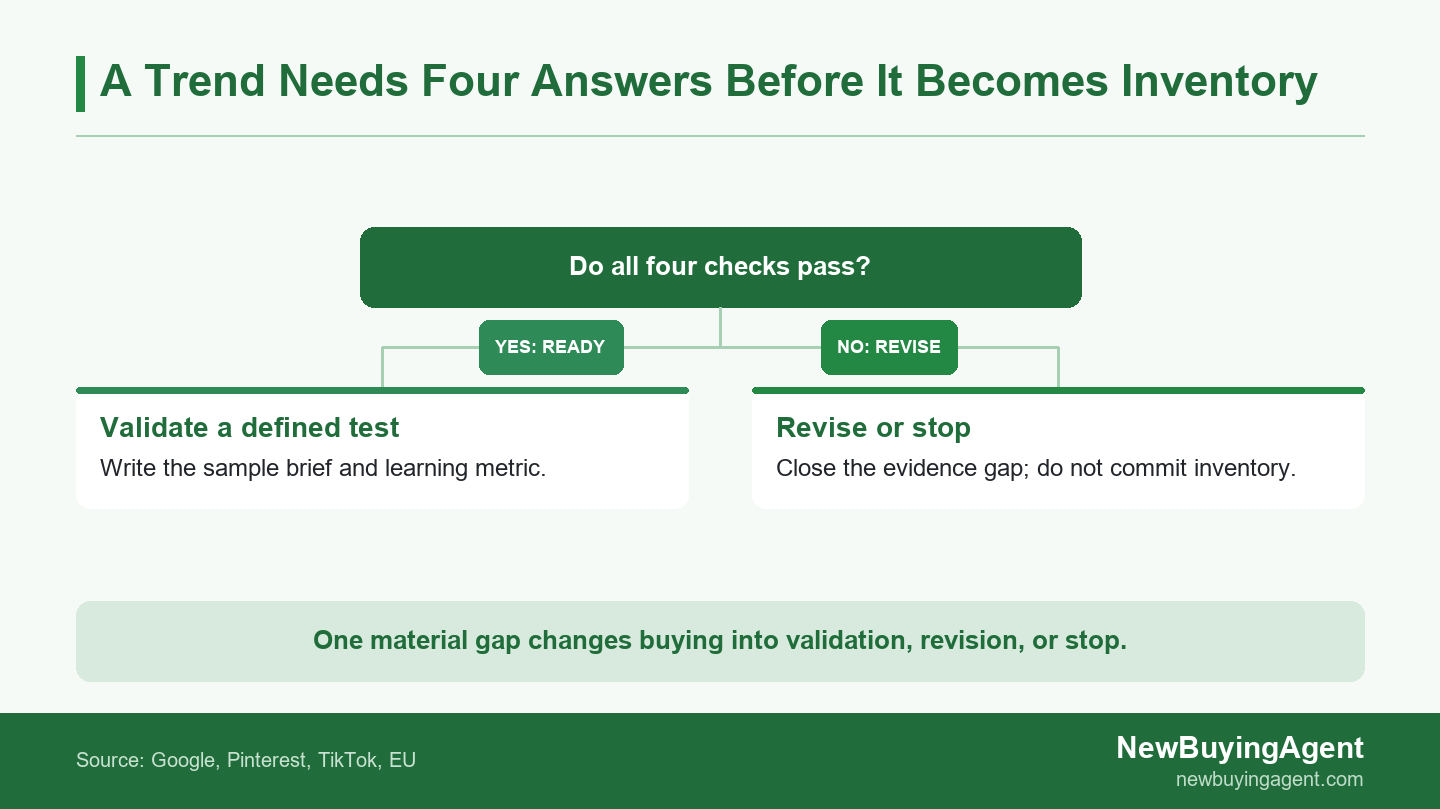
Four-question product validation flow from signals to a China sourcing brief
- Demand: Does a second independent signal support the same buyer problem, market, and time window?
- Commercial fit: Can the buyer state the intended segment, use case, and price hypothesis without relying on a single ranking?
- Product risk: Are the relevant safety, naming, claim, packaging, and material questions visible enough to test or escalate?
- Sourcing readiness: Can the opportunity be written as a feature-bounded product brief with quantity, destination, timing, and a validation sample?
If all four answers are clear, validate with a named sample or controlled test and record what will count as learning. If one is incomplete but resolvable, revise the brief and close the gap. If the core use case, market, or product boundary cannot be supported, stop. This approach avoids treating trend monitoring as an automatic inventory trigger.
Where a Product Opportunity Becomes a Supply Request
For a China sourcing request, NewBuyingAgent can use the buyer's approved product opportunity, target market, specification, quantity, target price, destination, and timing to prepare a quoted product-supply path. Its market-fit sourcing work is strongest when the buyer brings a clear opportunity brief rather than an undifferentiated request for whatever is trending.
NewBuyingAgent is a one-stop China sourcing agent service provider for global buyers. It combines local China factory resources with product development and quality-control capability to turn a defined requirement into a supplied product.
Before contacting a sourcing partner, prepare the target market, buyer segment, use case, required and excluded features, price context, quantity range, destination, timing, and the validation sample needed. With those inputs stated, a buyer can request a China sourcing discussion for this defined product opportunity.
Frequently Asked Questions
Can AI identify a trending product before competitors do?
Google Trends is a search-interest exploration tool, so its output needs corroboration before it informs a product validation decision. The Google Trends exploration view can surface early patterns faster than manual browsing, but it cannot establish that a product will convert before buyers validate the market, product, and risk conditions. The timing advantage comes from recognizing a useful question earlier, then testing it with a defined product brief.
What should an AI product opportunity brief include?
A useful brief names the buyer segment, destination market, use case, product hypothesis, evidence observed, price context, and open questions before a sourcing request. It should also identify the feature boundary, quantity range, timing, and validation sample. The brief is successful when a reader can see what has been supported, what remains uncertain, and what new evidence would change the decision.
Does a social-media trend prove product demand?
No, social activity can reveal interest or creative momentum, but it does not prove demand, margin, product quality, or repeatable sales in a specific market. It is useful when it suggests a product use, visual feature, or buyer language that can be checked against search, commerce, first-party, and product-risk evidence. A trend should produce a question to test, not an unqualified commitment.
When is a trending idea ready for China sourcing?
A trending idea is ready for China sourcing when the buyer can state the destination market, product use, required features, quantity range, price context, and the validation sample needed. It should have enough independent evidence to explain why the idea is being tested and enough product detail to make a quoted supply request meaningful. If a material risk or feature question remains unresolved, revise the opportunity first.
NewBuyingAgent
Related Resources



Get Started Today
Let's Turn Your Sourcing Goals into RealityWeChat:+86 15157124615
WhatsApp:+86 15157124615
Address:Building 10 #39 Xiangyuan Road, Hangzhou, China