
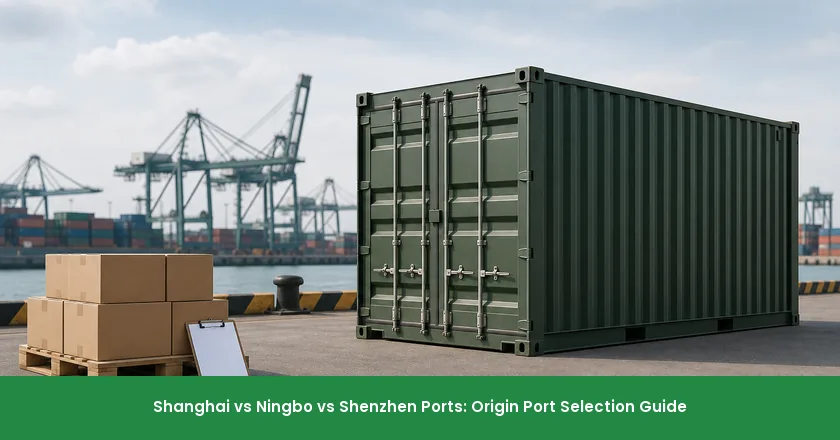
The useful origin-port decision is not a contest between three famous names. It is a release decision: can the finished cartons, the booked carrier service, the terminal instruction, the empty-container plan, and the shipping record all describe the same handover? A city that is close to a factory can still be the wrong gateway if the confirmed equipment, terminal acceptance, or deadline belongs to another route.
That distinction matters most when the shipment is close to pickup. A quotation may say “FOB Ningbo” or “Shanghai port” months before the forwarder issues a booking. The booking then adds operational facts that a city label cannot supply: carrier, voyage or service, terminal or accepted port area, empty release, cargo cut-off, document deadline, and verified gross mass timing. Select the port after those facts line up, not before.
Choose the Port With the Lowest Total Handover Risk
- Start with the physical origin. A port is only a viable candidate if the factory or consolidation point can hand over the actual cargo on the booking’s timetable.
- Let the booking outrank reputation. Carrier service, terminal or port area, equipment release, and cut-offs are shipment-specific facts.
- Keep the record geographically precise. The sales term, forwarder instruction, factory dispatch sheet, and shipping documents must not point to different handover points.
- Stop on a mismatch. Reconcile a conflict before pickup; a truck dispatched under an assumed port name does not solve the booking conflict.
Choose the origin port by the complete handover path: cargo origin, booked terminal, cut-off, and the written delivery record. ICC guidance says the named port, place, or point in an Incoterms® rule should be as geographically specific as possible, while carrier instructions make the booking and cut-off record operationally important. ICC’s Incoterms® Q&A provides the commercial-rule boundary.
A port's scale can be impressive and still be the wrong reason to route a particular container. Throughput describes a port system’s past activity, not a promise of carrier space, equipment availability, terminal acceptance, trucking capacity, or a particular cut-off. Use scale to understand the context; use the live booking to decide the handover.
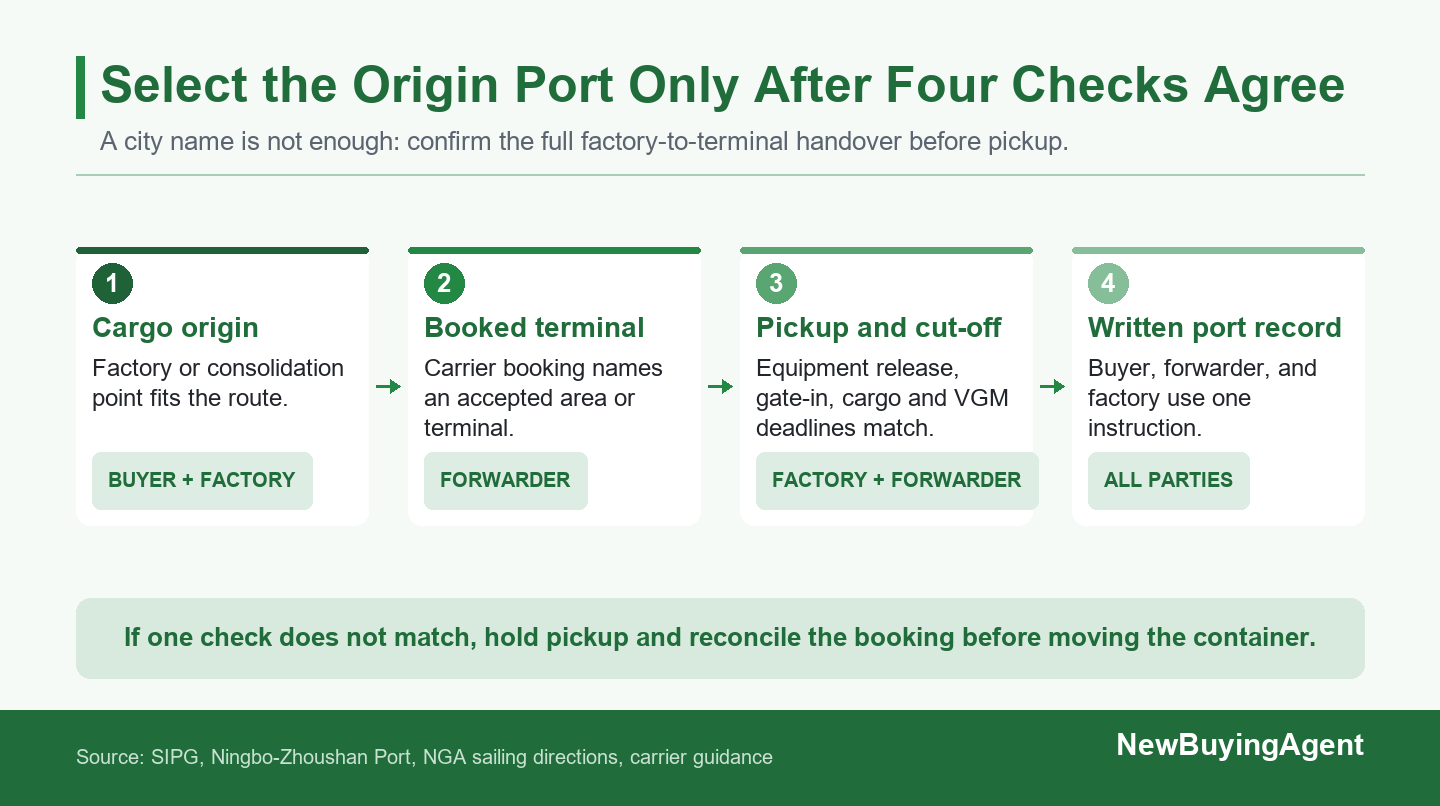
Release pickup only after the factory route, booked terminal, deadlines, and written port record agree.
Three Port Systems, Not Three Interchangeable Labels
Shanghai, Ningbo-Zhoushan, and Shenzhen are port-system contexts, not interchangeable terminal instructions. Each can offer a large operating network, yet the buyer still has to translate the city-level name into the actual factory route and carrier instruction. The comparison below therefore avoids unsupported claims about universal “best” transit time, congestion, or cost.
Shanghai: Scale Does Not Replace a Booking Check
SIPG reported Shanghai Port container throughput of 51.506 million TEUs in 2024. That scale may make Shanghai a credible candidate when the factory, consolidation plan, carrier service, and named terminal genuinely align. It is not a reason to redirect cargo that is already booked through a different route. SIPG’s 2024 data supports the volume figure, not a shipment-specific recommendation.
For a Shanghai-area factory, ask the forwarder for the booking confirmation before issuing a pickup instruction. Check whether the factory can receive or collect the right equipment, whether the terminal or acceptance point is named, and whether the cargo-ready date leaves room for gate-in and documentation. If the booking says Shanghai but a supplier sheet says only “China port,” the instruction is incomplete rather than close enough.
Ningbo-Zhoushan: Strong Network, Still a Route-Specific Choice
Ningbo-Zhoushan handled 39.3 million TEUs in 2024 and reported more than 300 container routes. Those facts make it an important network context for eastern China, but they do not establish that Ningbo is automatically cheaper or safer for every Zhejiang-origin shipment. The 2024 Ningbo-Zhoushan report provides the figures and route count.
A Zhejiang factory may make Ningbo a practical candidate, especially where the consolidation point, available carrier service, and pickup plan point there. But “near Ningbo” is not a substitute for a confirmed release. A Shaoxing factory, for example, may have a truck plan that is reasonable for either Ningbo or Shanghai; the safer choice is the one that matches the actually booked terminal, the equipment release, and the cut-off that the forwarder can confirm in writing.
Shenzhen: Name the Port Area and Terminal
U.S. National Geospatial-Intelligence Agency sailing directions describe Shenzhen as geographically divided into eastern and western port areas. For a buyer, the practical lesson is simple: “Shenzhen” alone is often too broad for a dispatch instruction. The NGA sailing directions support the geographic distinction.
When goods are made in Guangdong or consolidated in South China, ask for the carrier’s actual terminal or accepted port-area instruction, not a generic city name. Then compare the trucking path, empty release, appointment or gate-in requirements where relevant, and cargo-ready date. The article does not rank eastern versus western Shenzhen areas; a buyer should use the booking and forwarder’s accepted routing rather than treating a port-area label as a default answer.
Shanghai vs Ningbo vs Shenzhen: What to Compare
Compare the same four handover fields for every route before comparing price. A freight quotation without a stated terminal, pickup window, and cargo-ready assumption is not yet a final origin-port decision.
| Check | Shanghai candidate | Ningbo candidate | Shenzhen candidate |
|---|---|---|---|
| Cargo origin | Can the factory or consolidation point meet the confirmed pickup plan? | Can the eastern-China route meet the confirmed pickup plan? | Can the South-China route meet the confirmed pickup plan? |
| Booked service | Carrier, booking, terminal, and service are named | Carrier, booking, terminal, and service are named | Carrier, booking, port area or terminal, and service are named |
| Timing | Equipment release and gate-in fit goods readiness | Equipment release and gate-in fit goods readiness | Equipment release and gate-in fit goods readiness |
| Written record | Factory, forwarder, and commercial terms match | Factory, forwarder, and commercial terms match | Factory, forwarder, and commercial terms match |
The comparison is deliberately conditional. A buyer should not award a port “winner” based on a map, a historical throughput figure, or a general freight quote. For a China product order, NewBuyingAgent can use the buyer’s product, destination, and delivery requirements to keep factory readiness and the actual handover plan aligned before a port label is treated as final. The strongest candidate is the route that clears all four checks with the least unsupported assumption.
Validate the Booking Before You Release the Container
An export empty-container pickup window can be tied to the FCL cut-off at the origin port, and equipment availability can change. That makes an empty-release notice a route-control document, not a routine administrative detail. Hapag-Lloyd’s China export notice describes that relationship.
Carrier and terminal VGM cut-offs can vary, so the booking confirmation should supply the shipment's cargo cut-off and VGM deadline. Confirm what the forwarder is using for this particular booking rather than carrying a deadline over from a previous shipment. Maersk’s VGM guide states that these timing requirements can vary by port and terminal.
The IMO states that verified gross mass is a condition for loading a packed container onto a ship. The shipper must provide it to the master or representative and terminal representative sufficiently in advance for stowage planning; that is a compliance and safety boundary, not a port-selection shortcut. IMO’s VGM guidance states the loading condition.
Before pickup, ask the forwarder for one written release package: the booking reference, carrier, accepted port or terminal, equipment-release instruction, cargo cut-off, VGM deadline, document deadline if applicable, and a contact who can confirm a change. Then have the factory or warehouse acknowledge the same plan. This small control is more useful than a generic list of port strengths because it identifies the exact route that must be executed.
When the Factory Sheet and Booking Name Different Ports
The buyer held pickup until the booking, terminal, and factory instruction described the same route. This is the correct response to a port-label conflict because a truck instruction must execute the booked handover, not merely repeat the port name that appeared first in a supplier email.
Illustrative Zhejiang Consolidation Scenario
Hold pickup until the booking, terminal, factory instruction, and release-sheet fields describe the same route.
A home-goods buyer is consolidating finished cartons from two Zhejiang factories for one 40HQ shipment to Europe. The buyer has one order but two different factory dispatch contacts and wants the cartons collected as soon as packing is complete.
The combined order is 1,080 cartons: 640 from a Ningbo-area factory and 440 from a Shaoxing-area factory. The scale is large enough that an unplanned detour or missed cut-off would affect the whole consolidated movement.
Both factories report goods packed. The forwarder’s booking names Ningbo and gives a five-day empty-pickup window, but one supplier’s dispatch sheet still says Shanghai and does not show a terminal or booking reference.
First observation: the packing lists are ready, yet the two instructions cannot both be correct because one dispatch sheet names Shanghai while the booking names Ningbo.
Second observation: the booked equipment release and cargo cut-off are tied to the Ningbo booking, while the Shanghai reference offers no evidence of a replacement booking or accepted terminal path.
The question is not which port has more sailings. The missing evidence is a single executable route: truck pickup, empty release, terminal acceptance, VGM responsibility, and documents must all point to one booking. A port name in a factory template cannot override those facts.
The buyer pauses pickup. The forwarder reconfirms the Ningbo booking and accepted terminal, and the Shanghai reference is removed from the factory instruction rather than treated as a harmless wording difference.
A single release sheet is issued with the carrier booking, named port and terminal, empty-depot release, cargo cut-off, VGM owner, factory pickup contact, and escalation contact. Both factories receive the same version.
The forwarder checks the revised plan against the booking confirmation. Each factory acknowledges the same terminal and deadline before the truck is dispatched, so the buyer has evidence that the documents and physical movement describe one handover.
This is an illustrative operational scenario, not a live freight-rate comparison and not a guarantee that Ningbo is the best port for every Zhejiang shipment.
Put the Exact Port and Handover Point Into the Record
ICC advises parties to be as geographically specific as possible when naming the port, place, or point in the chosen Incoterms® 2020 rule. That instruction should travel into the commercial and operational record: do not leave the factory to infer whether a city name, a terminal, and a carrier booking refer to the same place. ICC’s geographic-specificity guidance is the reason to resolve ambiguity early.
Use the contractual named port or place exactly as agreed, but do not assume that it is a complete dispatch instruction. The release sheet may need a more precise carrier, terminal, depot, and deadline record. The commercial term allocates responsibilities; the live booking gives the operational details required to deliver the container on the selected route.
When China-Side Coordination Changes the Port Decision
NewBuyingAgent can coordinate product supply, production follow-up, quality control, and logistics when the port handover has to align with factory readiness. For a new product request, buyers can coordinate product supply and China-side logistics from the same brief; buyers working with existing China factories can use China-side factory-management support for the handover plan.
The relevant decision is not whether someone can name a preferred port. It is whether product readiness, packing information, factory communication, pickup timing, and the forwarding instruction can be reconciled before the cargo moves. Buyers evaluating that China-side coordination context can review NewBuyingAgent's China sourcing background.
Build an Origin-Port Release Sheet Before Pickup
Issue one release sheet that names the specific handover point, booking, deadlines, and VGM owner before pickup. A practical sheet should also record the factory or warehouse address, container type, equipment-release location, pickup contact, cargo-ready status, document owner, and escalation contact. It should be revised whenever the booking or readiness date changes rather than treated as a static template.
- Factory or consolidation address and the cargo-ready date.
- Carrier, booking reference, service, and named origin terminal or accepted port area.
- Equipment release, pickup window, cargo gate-in, VGM, and document deadlines.
- Commercial named port or place, plus the party responsible for VGM and booking changes.
- One version-controlled instruction acknowledged by the factory, forwarder, and buyer-side release owner.
When a project needs that comparison tied back to the actual product, factory readiness, and destination, buyers can send the factory and shipment details for an origin-port review to NewBuyingAgent.
Frequently Asked Questions
Reconfirm the live booking and named handover point whenever the route or readiness date changes. A city ranking cannot substitute for the carrier and terminal instructions that apply to the container now being released.
Is Ningbo always cheaper than Shanghai for Zhejiang factories?
Ningbo is not automatically cheaper for Zhejiang factories because the practical comparison includes the booked carrier, terminal, pickup plan, and timing exposure. A factory’s location can make Ningbo a sensible candidate, but a lower quoted ocean rate can be outweighed by a route that cannot meet the actual cut-off or requires a late booking change. Ask for comparable route assumptions before deciding which total handover path is commercially stronger.
How specific should a Shenzhen origin port instruction be?
It should be specific enough for the factory and forwarder to execute the booked route without interpretation. At a minimum, use the carrier booking, the actual terminal or accepted port area, the equipment-release instruction, and the relevant deadlines. “Shenzhen” may be useful for a high-level discussion, but it is not enough when a truck, container, or VGM submission must meet a particular carrier and terminal process.
Can the origin port change after goods are packed?
Sometimes, but treat the change as a new handover decision rather than a label edit. Recheck carrier space, equipment release, terminal or port-area acceptance, truck routing, cargo cut-off, VGM timing, documents, and any commercial instruction that names the port. Do not release pickup until the factory, forwarder, and written record have been updated to the same confirmed route.
Who owns VGM and cut-off confirmation before pickup?
The shipper remains responsible for providing verified gross mass under the IMO-described SOLAS requirement, but the project should name the operational owner who gathers the information, submits it, and confirms acceptance. The release sheet should also show who confirms the carrier’s cargo and VGM cut-offs. Clear ownership avoids a common failure: everyone assumes another party has checked the deadline while the container is already moving toward the terminal.
NewBuyingAgent
Related Resources


Get Started Today
Let's Turn Your Sourcing Goals into RealityWeChat:+86 15157124615
WhatsApp:+86 15157124615
Address:Building 10 #39 Xiangyuan Road, Hangzhou, China