
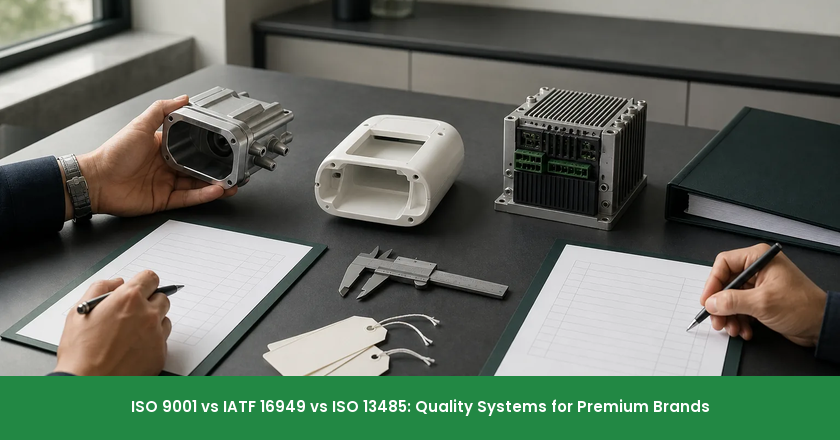
A supplier certificate can be a useful buying signal. It is not a shortcut to “approved supplier” or “approved product.” ISO 9001, IATF 16949, and ISO 13485 describe different quality-management-system contexts. The practical buyer question is whether the certificate covers the named site and process for the exact product program—and whether the product records meet the customer and destination requirements that sit outside the certificate.
What should a buyer decide before treating a certificate as evidence?
- ISO 9001 is a broad quality-management-system baseline; it does not certify a particular SKU.
- IATF 16949 is relevant when an actual automotive supply-chain role and customer requirements connect to the program.
- ISO 13485 is relevant in a medical-device quality-system context; product classification and destination-market evidence remain separate.
- For any route, ask for the certificate scope, named site, actual process, controlled product revision, and acceptance records together.
A quality certificate is a route signal, not a product passport
Premium brands often see a specialised certificate and assume that it is simply “better” than a general one. That framing creates a blind spot. A certificate can describe a supplier’s management system while leaving open whether the final assembly, the quoted product revision, the customer-specific requirement, or the destination evidence belongs to the order in front of you. Start with the product route, then test the certificate against the program.
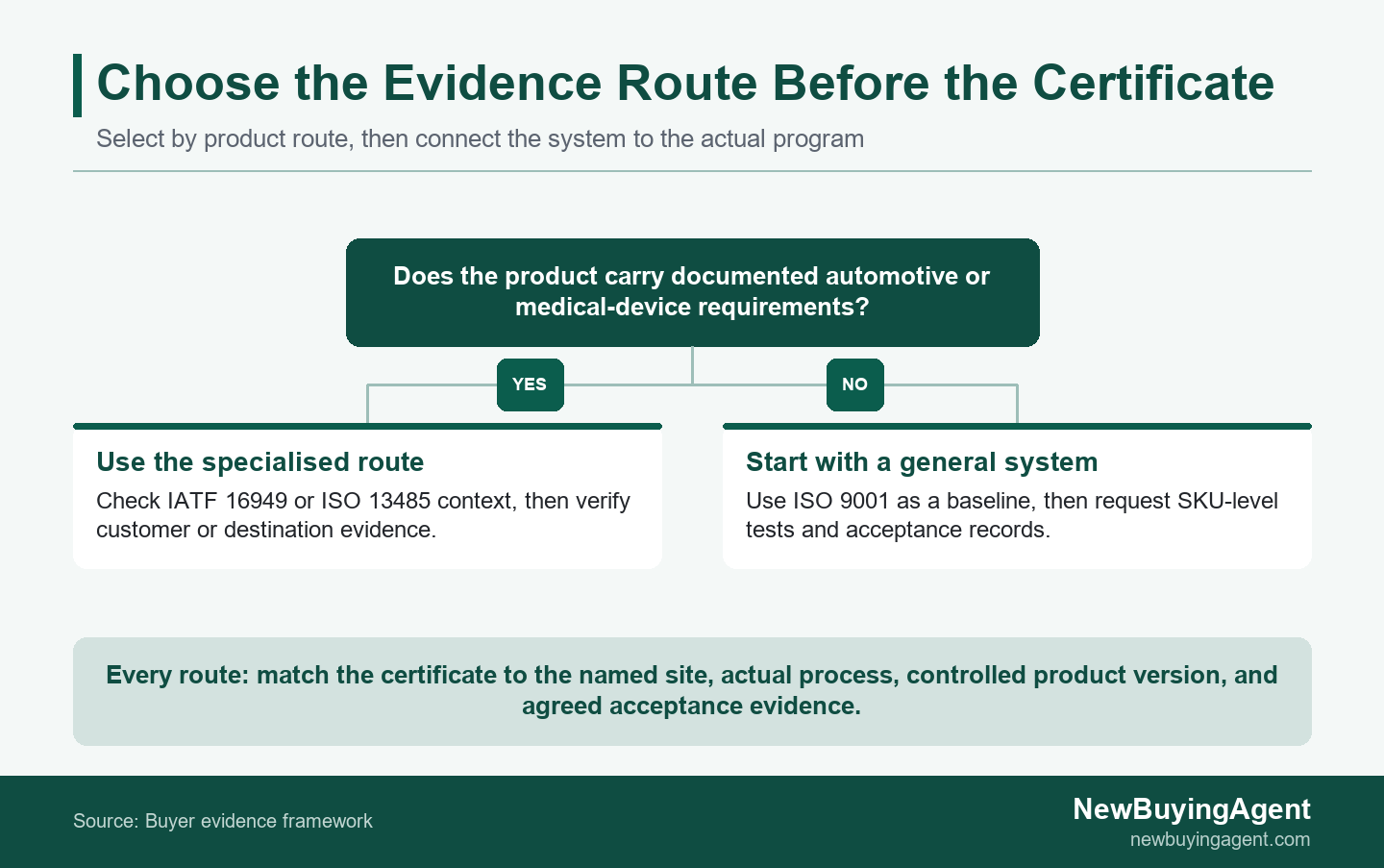
Choose the product route first. A specialised certificate can be relevant only when the site, process, and program connect; every route still needs product evidence.
Compare the systems by the product route they govern
ISO 9001:2015 is a broad quality-management-system requirements standard. A current ISO 9001 overview describes its general quality-management purpose across sectors. For a buyer, that makes it a useful starting point for assessing how a supplier controls work—not proof that one product meets a particular specification or market rule.
IATF 16949 is an automotive quality-system context with customer-specific requirements. Here, customer-specific requirements means requirements set by the relevant automotive customer or program. Automotive certification references describe its use in the automotive supply chain and its connection to those requirements; see Intertek’s IATF 16949 outline and this IATF 16949 explanation. That relevance is powerful when the supplier’s role, site, process, and customer program actually match. It is not a transferable badge for unrelated consumer or industrial SKUs.
ISO 13485 is a quality-management-system standard for medical-device and related-service contexts. An ISO 13485 overview explains the medical-device focus. Buyers should read that as a system-context signal: it can matter deeply for the right route, while still leaving product role, destination, and the required technical evidence to be checked separately.
The three systems are not interchangeable quality grades. A specialised system can be more relevant for a defined automotive or medical-device program, yet be less useful than a well-scoped general system for a different product route. This is why the certificate title should never be the final release decision.
| System | Primary context | Certificate scope to inspect | Buyer evidence to request | What it does not establish |
|---|---|---|---|---|
| ISO 9001 | General quality-management system | Named site, covered activities, and the process that touches the order | Product revision, acceptance criteria, inspection or test records, and traceability expectation | That a particular SKU is compliant, approved, or suitable for every market |
| IATF 16949 | Automotive supply-chain quality system | Actual automotive role, certified site, relevant process, and program connection | Customer-specific requirements, control plan, part or program records, and release evidence | That an unrelated product or customer program is automatically covered |
| ISO 13485 | Medical-device quality-management system | Named site, lifecycle activities, and the device-related process covered | Product role, destination route, controlled records, traceability, and applicable technical evidence | That a product has market authorization or the same obligations in every jurisdiction |
When a new China product is still being defined, a broader China manufacturing and product guide can help turn an early idea into a product brief. The quality-system comparison should then become one field in that brief, alongside the product version, destination, acceptance criteria, and production timing.
Use three buyer questions before choosing a route
Product route, external requirements, and program evidence form a buyer decision route. Question 1: What is the product route? Start with the product and customer, not the certificate. Is this a general industrial or consumer product? Is it a part or service in an automotive program with documented customer expectations? Or is it a medical-device or related-service route? The answer does not decide compliance by itself; it tells you which quality-system signal deserves closer scrutiny.
Question 2: Whose external requirements apply? For an automotive order, identify the customer program and any customer-specific requirements before treating IATF status as meaningful. For a medical-device context, identify the destination jurisdiction and product role before treating ISO 13485 as the end of the discussion. For a general product, set the buyer’s own specification, acceptance criteria, and relevant destination evidence instead of asking a generic certificate to do that work.
Question 3: What must follow this actual product? Ask which document or record links the certificate to the named site, final process, controlled product revision, lot or serial traceability expectation, and accepted result. That question is often more valuable than asking for one more logo.
ISO records an expected September 2026 replacement timing for ISO 9001:2015. ISO 9001 transition guidance notes the expected publication of the revised edition. A buyer does not need to pause every order for that change, but should ask a long-term supplier which certificate version it holds and how controlled procedures will transition. A defined evidence brief can be part of a new China product request. For a buyer-ready requirement, NewBuyingAgent can help turn a defined evidence brief into a China product-supply request.
Ask for evidence that reaches the actual product program
A certificate scope is the named site and activities covered by the certificate. Request the complete certificate, not only a cropped badge: named legal entity, site address, covered activities, issuing body, validity period, and any scope wording that limits the activity. Then map the quoted work. If final assembly, calibration, sterilisation, software activity, or a critical subcontract process is outside the named scope, the buyer has a clarification task—not necessarily an automatic rejection, but never an assumption.
FDA's QMSR became effective on 2 February 2026 and incorporates ISO 13485:2016 by reference. Medical-device routes make the distinction especially visible; see the FDA QMSR page and its implementation FAQ. That is quality-system context, not a statement that a supplier certificate alone authorizes a finished product for sale.
EU medical-device evidence is assessed within a destination framework separate from a supplier certificate. The European Commission’s medical-device standards information sits within that framework. In plain language, product-level evidence means records tied to the actual product version, acceptance requirement, test, inspection, or traceability expectation—not a general statement about the supplier’s system.
A management-system certificate is not by itself SKU-level product proof. Build a small evidence pack for the actual order: certificate scope; site and process map; controlled product revision; customer or destination requirement; control or inspection plan; agreed acceptance criteria; traceability rule; and the record the buyer expects before release. This is a purchasing method, not a substitute for the buyer’s technical, regulatory, or contractual review.
A worked certificate-scope conflict
This is an illustrative buyer decision exercise. It is an example, not a NewBuyingAgent client result, certification decision, product test, regulatory classification, or legal advice.
The 1,800-unit release that a certificate alone cannot clear
An illustrative premium-components buyer is preparing two China production programs with the same supplier: an automotive interior-module order and a general-industrial controller order. The automotive program covers 1800 modules in 3 variants, while the general-industrial program covers 600 controllers with a separate product brief and destination file. The supplier provides an IATF 16949 certificate, but its scope does not identify final electronics assembly. The quote does not connect the automotive modules to customer-specific requirements or a control plan.
First, the buyer cannot see whether final assembly occurs inside the named scope. Second, the supplier’s ISO 9001 certificate does not connect either product version to test criteria, acceptance records, or release documentation. This is a scope-to-program mismatch. IATF-related evidence may be relevant to the automotive route, but the certificate cannot settle program fit without the actual site, process, customer requirement, and part-level records.
A scope-to-program mismatch should be clarified before release. A certificate-to-process mismatch requires a program-specific hold or clarification, not a generic certification conclusion. The buyer should hold the 1800-unit automotive release until the missing connection is made. The 600-unit industrial program should be assessed on its own product specification and acceptance evidence rather than borrowing the automotive certificate claim.
The corrective request is specific: provide the full certificate scope and site list; map final assembly and critical processes; identify customer-specific requirements; and attach the applicable control plan, product revision, traceability expectation, and test or inspection evidence to each program.
Stage the release until scope, process, product version, and acceptance records align. In practice, the buyer should also confirm the named production site and document owner. This creates a documented decision without claiming that any one certificate can clear every production risk.
This illustrative example depends on the product, supplier role, customer program, and destination. The scenario simply shows why the buyer should separate a system signal from a release-ready product file.
When quality-system evidence changes a China sourcing brief
NewBuyingAgent can receive a buyer-defined China product requirement that includes evidence fields. If you already know the product route, the required records, quantity, destination, and timing, that input gives the supplier conversation a clearer starting point. The goal is not to promise a certificate outcome; it is to make the buyer’s request specific enough for meaningful comparison.
Keep the request focused on evidence, not a supplier label
For an existing factory, use the same brief to separate three questions that are often blurred together. First, what does the certificate scope cover at the named site? Second, which process creates, changes, or verifies the ordered item? Third, which record proves the agreed result before shipment or program release? The answers may sit with different people: a factory quality manager, a subcontract-process owner, a buyer’s technical approver, or a customer program contact. Naming the owner of each answer makes escalation simpler.
It also prevents a familiar failure mode: a broad audit document is sent to close a narrow product question. A supplier may genuinely run a controlled system and still need to show the buyer where a particular inspection step occurs, which revision governed the build, or how an outsourced process is controlled. Conversely, a buyer may have a good test report that does not show whether the same revision will govern the production order. The evidence brief is valuable because it makes those gaps visible early, while a scope clarification or document update can still change the release plan.
An evidence brief can support existing-factory coordination. Where a buyer already works with a China supplier, it can be useful to coordinate quality and delivery with an existing China factory around the named product revision, inspection point, release record, and commercial handoff. The buyer retains the product and approval decisions; the brief makes the requested evidence less ambiguous.
Before closing that loop, agree on the practical handoff: the buyer’s file version, the factory contact who owns the response, the deadline for a record, the language of any test or inspection summary, and the person who can approve a deviation. These details may seem administrative, but they keep a scope question from becoming a shipment-day dispute. A short written release rule also helps the commercial team understand whether a late document is an information gap or a reason to pause the order.
Turn the comparison into a buyer-ready brief
A concise evidence brief makes buyer questions traceable. Before awarding or releasing a China order, put these fields in one controlled request:
- Product name, application, controlled revision, quantity, and target timing.
- Destination market and the known customer, product, or documentation requirements.
- Requested system context: general ISO 9001 baseline, automotive IATF route, medical-device ISO 13485 route, or a documented reason another route applies.
- Certificate scope, named legal entity, site address, covered processes, and validity details.
- Product-level evidence: drawings or specifications, control or inspection plan, acceptance criteria, traceability expectation, and required records.
- Release rule: who checks the evidence, what blocks release, and what version of the product file applies.
A clear brief gives both sides a better starting point than a request for “the best certificate.” If China-side support is the remaining gap, you can send an evidence brief to NewBuyingAgent.
Frequently asked questions
Certificate answers remain conditional to product, supplier role, and destination.
Is IATF 16949 a better choice than ISO 9001?
IATF 16949 is not better as a universal ranking; it is more specific to an automotive supply-chain context. ISO 9001 is a broad quality-management-system standard. The buyer should first confirm the actual automotive program, supplier role, certified site, and customer requirements, then request the program records that connect those facts. For a general consumer or industrial order, an IATF certificate can be interesting background but may not change the evidence request.
Can an ISO 9001 certificate prove my product is compliant?
No. An ISO 9001 certificate can be a useful system signal, but it does not replace a controlled product version, agreed acceptance criteria, destination-specific assessment, or relevant test and inspection records. Ask how the supplier’s named system covers the work, then verify the product evidence separately. If the final process or inspection is outside the stated scope, ask for the relevant process mapping before using the certificate as a release input.
Does ISO 13485 certification mean a product can be sold as a medical device?
No. ISO 13485 concerns a medical-device quality-management-system context rather than a stand-alone permission to sell. Product classification, destination requirements, technical documentation, and market evidence remain separate questions. Confirm the specific route with appropriate qualified resources for the product and destination. A supplier’s certificate may help frame the quality-system conversation, but it cannot replace the destination review for the finished item.
What should I request from a China supplier besides a certificate?
Request the complete certificate scope, named site, relevant processes, controlled product revision, acceptance criteria, traceability expectation, and the product records that apply to the actual program. If a process is subcontracted or the scope wording is unclear, ask for the mapping before you treat the certificate as a release input.
NewBuyingAgent
Related Resources
Get Started Today
Let's Turn Your Sourcing Goals into RealityWeChat:+86 15157124615
WhatsApp:+86 15157124615
Address:Building 10 #39 Xiangyuan Road, Hangzhou, China