

Supplier cybersecurity evaluation for product files is an assessment of how the intended recipients protect drawings, specifications, bills of materials and related information from unauthorized access, alteration or loss. For a buyer sourcing from China, the practical question is whether the proposed people and systems can handle this particular package safely enough for its intended use. Start with the file path, not a supplier’s general assurance.
A secure transfer link does not by itself establish safe downloaded-file handling or authorized onward sharing. A drawing can arrive securely and then be copied to a personal laptop or forwarded to an unapproved workshop. Evaluate what happens after receipt, as well as how the buyer sends it, before approving detailed design access.
Approve a File Package, Not a General Security Claim
Approve a specified file package for named recipients and systems only when proportionate evidence supports the proposed access; restrict or hold unsupported exposure. Record the purpose, allowed copies, permission limits and conditions for reassessment alongside the approval. This approach lets purchasing and supplier-quality teams distinguish a usable manufacturing handoff from an open-ended disclosure, while recognizing that an assessment cannot guarantee that a compromise will never occur.
- Decision: Match the evidence to the actual files, users, storage and onward recipients
- Common mistake: Treating a certificate or encrypted link as proof of every later copy’s protection
- How it works: Verify controls with harmless files and redacted records before releasing controlled designs
- Risk: Recheck access when the people, systems, subcontractors or project scope change
The Product File Sharing Framework
The Product File Sharing Framework connects file scope, evidence quality, authorized handling, and recovery and recheck. It is a descriptive buyer synthesis, not a proprietary method or security certification. Use its four dimensions to decide what the supplier must demonstrate for the proposed disclosure, then record the unresolved gap and its consequence for access. A strong answer in one dimension cannot compensate for an unapproved recipient or an unknown copy location.
File Scope: Identify What Will Be Exposed
Record the package, purpose, approved revision, sensitivity, supplier site, named users, systems, subcontractors and copy destinations before assessing control evidence. Identify whether the files are for an estimate, tooling, a prototype or production, because those tasks need different detail. Trace the intended route from the buyer’s transfer location to the supplier account, working device and storage, then to any external workshop or retained archive. Ask who owns that route.
NIST SP 1305, the CSF 2.0 supply-chain quick-start guide links supplier criticality to factors such as data sensitivity and system access and recommends communicating supplier requirements and verification expectations. Its technology-supply focus does not create a universal factory mandate. The useful lesson for product files is proportionality: a public product photo and a confidential tooling drawing should not receive an identical evidence request simply because they go to the same supplier.
A bill of materials, or BOM, lists a product’s parts and materials; it can also reveal commercially important component choices. Separate ordinary commercial sensitivity from information needing special approval, such as customer personal data or restricted technical detail. The China sourcing guide offers broader sourcing context for deciding what manufacturing information belongs in the purchasing brief. Keep unnecessary customer records and unrelated designs out of the package; removing them reduces exposure without preventing the supplier from answering the actual product question.
Evidence Quality: Separate Claims, Scope and Demonstration
Supplier self-claims identify questions to verify, scoped documents show intended coverage, and observable demonstrations support whether controls operate on the actual proposed file path. Ask for a named control owner, a current policy or relevant certificate, and redacted evidence of the key settings. “We use secure cloud storage” leaves important questions unanswered: which service, which accounts, what permissions, what devices and whether the proposed subcontractor uses the same environment.
ISO/IEC 27001:2022 specifies requirements for an information security management system: the organization’s way of managing information-security risks, policies and controls. Certification is optional. A certificate offers management-system assurance, but does not by itself prove that a particular folder, device or drawing is safe. Ask whether its declared scope actually includes the entity, site and services handling the buyer’s files; treat that match as a separate buyer check.
ISO’s certification guidance explains that ISO does not perform certification or issue certificates. Accredited certification can be checked through the relevant verification routes or certification and accreditation bodies. Obtain the certificate number, issuer, status and scope, then verify rather than rely on a logo in a presentation. An absent search result alone does not establish that a certificate is false; contact the relevant issuer to resolve the uncertainty.
Check whether certificate scope and redacted control evidence cover the supplier entity, site, service, systems and current assessment period; a gap should lead to more specific proof rather than automatic approval. Evidence from a headquarters office may not describe the workshop laptop receiving the CAD file. Give the supplier a focused request for the missing environment, and record what remains unverified. A dated policy describing intended behavior is useful, but different from observing that behavior.
Authorized Handling: Check the Actual File Path
Use named accounts, appropriate additional identity checks, minimum necessary permissions, protected transfer and storage, and maintained devices for the proposed product-file environment. Named accounts identify the person using access. Multi-factor authentication, or MFA, adds another identity check beyond a password. Minimum permissions mean that a tooling engineer can access the needed drawing without gaining the buyer’s entire project archive; separate viewing, downloading, editing and onward-sharing permissions where the platform supports them.
NIST SP 1300’s practical protection guidance recommends MFA, needed-only access, removal of unnecessary access, software patching, laptop and tablet full-disk encryption, and tested backups. These are suggested actions, not a compulsory factory audit. Use these concrete actions to ask the supplier administrator how the relevant accounts and devices are configured, and whether the controls also apply to people working away from the main office.
Encryption protects data through cryptographic controls, but an authorized user may still open or copy files. Ask how files are protected while moving between systems and while stored, where readable working copies exist, and who controls encryption keys. Do not request keys, passwords or account secrets as evidence. A protected upload can coexist with an unprotected local copy, so the supplier’s answer needs to follow the actual drawing to the device used for manufacturing work.
Recovery and Recheck: Prove the File Can Be Trusted Again
Agree who reports suspected product-file exposure or alteration, how access can be contained, which records are preserved and how the buyer-approved revision is restored and confirmed. The supplier’s response contact should be reachable through an alternative channel if normal email is affected. Define what the buyer needs to know: affected files, recipients, systems, known facts, containment action and the next update. Set notification expectations by agreement and applicable rules, rather than inventing a universal reporting deadline.
NIST CSF 2.0 includes defined and reviewed permissions; protection for stored, transmitted and in-use data; protected, maintained and tested backups; supplier involvement in incident response; and provisions after a relationship ends. The framework is non-prescriptive. For this purchasing decision, translate those outcomes into file-specific questions about containment, restoration and residual copies, rather than declaring a supplier compliant because its questionnaire mentions each framework heading.
Demonstrate restoration with harmless files and compare the restored copy with the buyer-approved reference; a backup existing is different from a usable, trustworthy recovery. File integrity means the information has not been improperly altered. A recorded revision and, where appropriate, a file checksum can help detect a difference; a checksum is a digital fingerprint, not proof of who created or authorized the file. Confirm the correct reference with the buyer’s product owner before manufacturing resumes.
Use The Product File Sharing Framework to identify the unsupported part of the intended environment; missing evidence should narrow access or delay disclosure rather than disappear into an overall supplier rating. The supplier may be suitable for an initial product discussion while detailed tooling files remain on hold. Record that distinction explicitly, so purchasing urgency does not silently expand the approval to new people, systems or copies.
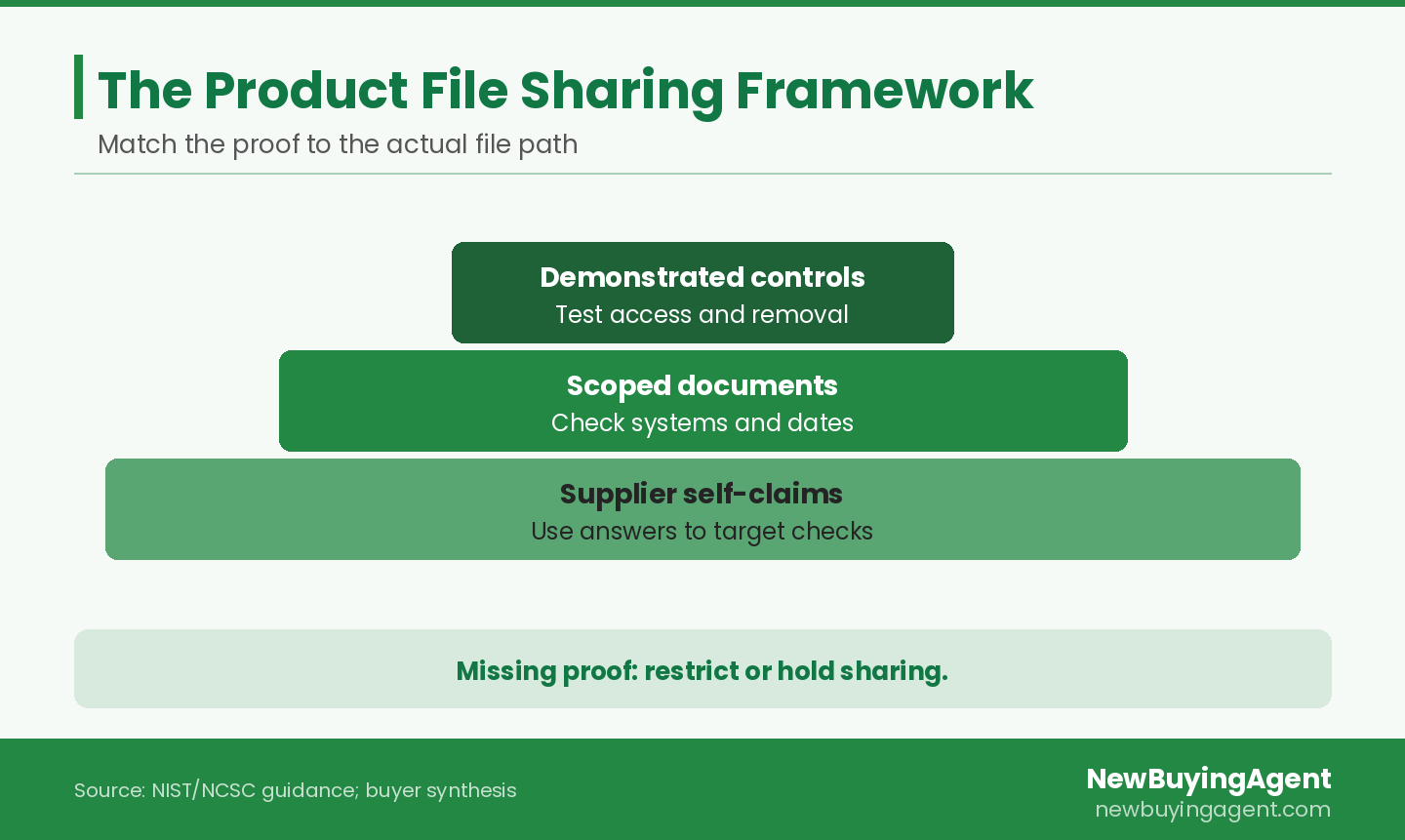
Product file sharing approval separates supplier claims, scoped documents and demonstrated controls
Verify Controls Without Exposing Live Designs
Verify control claims through agreed redacted evidence and a harmless test package in the proposed environment, without live designs, credentials or intrusive security testing. The demonstration should answer the buyer’s specific unresolved question, such as whether a forwarded link gives another person access. Agree the scope with the supplier’s authorized administrator before the check. Purchasing staff can observe the result; a technical specialist should interpret configuration gaps when the risk exceeds their expertise.
An authorized supplier administrator can show that approved test users can open only the intended folder, another user cannot obtain access through forwarding, and removal ends the intended account permissions. Use an empty sample drawing or invented specification carrying no confidential information. Check both the shared link and any separate folder membership or direct permission. If the supplier cannot demonstrate the planned restriction, change the handling arrangement or keep the controlled package withheld.
Record the environment, administrator, test date, observed result and limits; screenshots and a walkthrough are point-in-time evidence, not proof of absence of compromise. Redact unrelated customer names and security secrets. Ask for enough context to identify the relevant account or setting without collecting the supplier’s whole system configuration. Avoid unauthorized vulnerability scans, password tests or production disruption. For high-sensitivity designs, involve the buyer’s security owner before accepting an exception or relying on a simplified demonstration.
For a new prototype or customized product, buyers may need manufacturing capability before they need to disclose every design file. NewBuyingAgent’s product-supply service combines local China factory resources with product development and quality-control capability to quote and supply China products. Put the product objective, material and performance needs, quantity and delivery constraints in the purchasing brief. Agree the file-sharing scope before releasing controlled detail, so the sourcing discussion can progress with the information appropriate to that stage.
Follow Downloads and Subcontractor Copies
Follow the file after download to supplier devices, shared drives, removable storage, prints and external workshops; a protected transfer does not automatically protect those copies. Ask which working copies are necessary, how they are stored and who can access them. If downloads are permitted, document the endpoint and retention arrangements. If viewing only is proposed, confirm that the supplier can still perform its manufacturing task, while recognizing that viewing restrictions do not prevent every screenshot or manual reproduction.
Microsoft’s OneDrive and SharePoint link documentation distinguishes transferable, unauthenticated Anyone links from named, authenticated Specific people links. It also explains that expiry affects only the link: users with other permissions may retain access. These are Microsoft 365 behaviors, so test the supplier’s actual platform rather than assume identical settings elsewhere. Removing portal permission does not retrieve a previously downloaded drawing; that separate copy needs an agreed handling and disposition process.
Authorize subcontractor recipients and the minimum necessary files explicitly; assess their actual handling environment and removal arrangements rather than infer approval from the main supplier. A workshop needing a dimensioned tooling drawing may not need the complete BOM or customer presentation. Record whether onward sharing is permitted, by whom and for which purpose. Ask the supplier to obtain approval before adding another workshop, consultant or cloud destination, and make the supplier’s contact responsible for tracking the agreed handoff.
Choose Share, Restrict or Hold for This Package
Record share, restrict or hold for the stated package, named recipients, environment and purpose, with conditions, approval owner and recheck trigger; avoid treating this as an unqualified supplier-wide approval. The decision should identify which evidence supports the permitted exposure and which uncertainty remains. A restriction is useful only when it can actually be enforced and still allows the agreed task, while a blocking gap should be closed before the affected disclosure occurs.
| Decision | Evidence condition | Permitted action |
|---|---|---|
| Share | Relevant controls demonstrated; recipients and copies authorized | Release the recorded package under its agreed conditions |
| Restrict | A workable lower-exposure route is verified; remaining gap owned | Allow only that narrower task and file access |
| Hold | Unknown recipient, uncontrolled copies or failed required check | Withhold affected files until closing evidence is accepted |
A decision record identifies evidence gaps, their consequence for disclosure, accountable repair and closing proof; a deadline or supplier promise alone does not close the gap. Keep the current file list, approved revision, user list, storage route, demonstration result and owner together. Separate the buyer’s product approval from its information-sharing approval. Purchasing can explain the commercial need, while the designated information owner accepts the remaining exposure according to the buyer’s own authority rules.
Illustrative Example: A Prototype File With an Unapproved Recipient
Situation and problem: In this illustrative example, an importer commissions 60 prototype desk-lamp housings and prepares 8 controlled files for 3 approved supplier users. The supplier requests access for 2 external tooling-workshop users and refers to revision B instead of the buyer-approved revision C. Original supplier account controls were demonstrated, but the workshop’s environment was not assessed. These are assumed quantities and records, not a NewBuyingAgent customer case.
Action: Hold new workshop disclosure while retaining the original supplier users’ approved access. The buyer confirms the workshop’s role, required files, named accounts, storage and removal process; the supplier resolves the obsolete revision request. After the required evidence and recipient permission are accepted, the product owner authorizes revision C for the agreed workshop task. The original secure link is not used as proof that the new recipient is safe.
Result: In the assumed test, named workshop access works, forwarding fails to give another user access, and removing permission ends the tested access. The workshop acknowledges the current revision before controlled transfer. This illustrative example closes the stated recipient and revision gaps; it is not a NewBuyingAgent customer case or measured security outcome, and does not prove absence of compromise. If the demonstration fails or the workshop needs additional copies, the affected release stays on hold until the buyer evaluates the changed conditions.
Keep File Approval Current After the First Transfer
Reassess when users, devices, storage, subcontractors, file sensitivity or the relationship change, and after a relevant incident; withdraw superseded permissions and distinguish retained copies from live access. A first-transfer approval should have an owner and a review trigger, not become permanent permission for every future package. Ask the supplier to report material changes before using the new environment, so the buyer can evaluate exposure before another controlled design leaves its custody.
NCSC’s supplier-assurance guidance combines proportionate evidence methods, treatment of noncompliance and ongoing review. A one-off assessment is insufficient for its recommended lifecycle approach. Use that lesson to maintain the buyer’s file-sharing record: recheck changed controls and track unresolved actions rather than repeat a complete questionnaire for an unchanged low-risk handoff. The guide supports a risk-based approach; the specific event triggers and share/restrict/hold decisions here are buyer recommendations.
At project closure, confirm removed accounts and links, agreed retained records, local and subcontractor copy disposition, backup retention and the owner of remaining obligations. Some records may need to remain for an agreed business or legal purpose, so distinguish that retention from continued production access. Obtain a clear supplier acknowledgement of the agreed disposition. A deletion statement cannot prove that every unknown copy vanished; preserve that limit when deciding whether the arrangement was sufficient for sensitive designs.
For an existing China supplier, product revisions and workshop handoffs also affect what gets manufactured. NewBuyingAgent’s factory-management service supports agreed supplier communication, production progress and quality management. Buyers can specify the approved product references, people who may use them and the communication scope alongside the order requirements. That local follow-up connects file use to production and quality needs, while the buyer retains the decision on controlled-file recipients and acceptable information exposure.
Implement the Supplier File-Sharing Checklist
Complete the package inventory, recipient map, scoped evidence, safe control checks, sharing decision, incident contacts and access-removal/recheck ownership before releasing controlled product files. Name both the buyer approver and supplier control owner, and give each open action a closing-evidence requirement. Keep the checklist proportionate to the information and intended use. A checked box is useful only when its record explains what was verified and what the supplier is allowed to receive.
- Identify file names, current revisions, purpose and sensitivity
- Map named users, accounts, sites, devices, storage and onward recipients
- Check policy or certificate scope, status and control owner
- Verify relevant identity, permissions, transfer/storage and device protections safely
- Confirm working-copy, subcontractor, restoration and incident arrangements
- Record share, restrict or hold, with its exact package and conditions
- Assign removal, retained-copy disposition and change-trigger responsibilities
Start a quote-to-supply conversation: send purchasing requirements to NewBuyingAgent with a high-level product brief, quantity, target price, destination, delivery timing and file-sharing constraints. NewBuyingAgent can use those purchasing requirements to discuss quoted China product supply around the actual product and quality need. Describe sensitive-file constraints at first contact, then agree the handling scope before releasing detailed controlled drawings or specifications.
Frequently Asked Questions
Does an NDA replace supplier cybersecurity checks?
An NDA does not replace technical file-handling controls. Confidentiality and permitted-use agreements address responsibilities between parties; accounts, permissions and copy handling address how information is actually exposed. Keep the legal agreement review separate from the control checks. Obtain qualified advice on contract terms rather than assume that a signed document prevents unauthorized access or repairs a compromised file.
Is a buyer-owned portal enough to approve supplier handling?
A buyer-owned portal does not by itself control every downloaded copy. Its settings may help the buyer manage named access, but supplier devices, local archives, printing and workshop copies can remain outside that boundary. Confirm what the supplier needs to do with the files and test the relevant permissions; use technical specialists where the required restrictions are difficult to demonstrate.
Do public product drawings need the same controls?
Public product drawings can have lower confidentiality needs while still requiring correct revision handling. A freely available drawing can still be altered, replaced with an obsolete version or confused with a buyer-approved manufacturing reference. Match protection to the real consequence of those errors, and check whether a package also contains nonpublic specifications or customer details before treating everything in it as public.
What if product files include personal or restricted information?
Personal or restricted information needs a separate applicable-rule review before sharing. Remove unnecessary personal data from ordinary manufacturing files. If export controls, sector rules, contractual restrictions or cross-border privacy obligations may apply, ask the buyer’s qualified legal or compliance owner to determine the actual requirements before any affected information is released.
NewBuyingAgent
Related Resources



Get Started Today
Let's Turn Your Sourcing Goals into RealityWeChat:+86 15157124615
WhatsApp:+86 15157124615
Address:Building 10 #39 Xiangyuan Road, Hangzhou, China