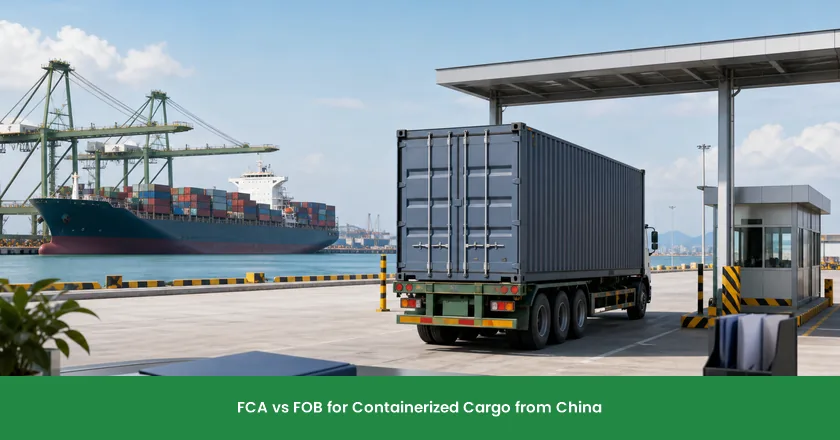
FCA (Free Carrier) is an Incoterms 2020 rule where the seller delivers when the buyer's nominated carrier receives the goods at the named place; FOB (Free On Board) is a sea-only rule where delivery occurs when the goods are on board the buyer-nominated vessel at the named port.
For a container leaving China, the practical question is not simply whether the voyage is by sea. It is whether the seller is actually delivering the sealed container to a carrier or terminal before vessel loading, or is genuinely responsible for putting the goods on board. That distinction sets the delivery event, the risk-transfer point, and the evidence the buyer should request.
The container handoff is the real FCA-versus-FOB test
The container handoff—not the port name—is the first FCA-versus-FOB test. A port can appear on both an FCA and an FOB quotation, but the terms make different promises about the point of delivery. For a container, ask the forwarder one question first: when will it issue, or arrange, the receipt showing that it has accepted the sealed unit?
- Decision point: If the carrier receives the container at a named terminal, depot, or gate before loading, test FCA first.
- Risk point: FCA transfers risk at the agreed delivery point; FOB transfers it only when goods are on board the nominated vessel.
- Control point: A seller may be able to deliver a container to a terminal while having no practical control over the later stowage sequence.
- Instruction point: Separate the Incoterm from freight charges, VGM ownership, insurance, payment documents, and carrier deadlines.
A terminal-control mismatch occurs when a contract keeps the seller responsible to an FOB on-board point even though the container has already been accepted into a carrier-controlled terminal. Compare the commercial wording with the actual sequence before cargo moves: factory release, carrier acceptance, terminal processing, and vessel loading. The contract and the relevant carrier, insurance, payment, and compliance parties remain the authority for a live transaction.
What FCA means when cargo enters a container terminal
FCA needs a precise named delivery point. Under FCA, the seller delivers to the buyer-nominated carrier or person at the agreed place. The International Chamber of Commerce's FCA-versus-FOB guidance identifies FCA as appropriate for containers and multimodal carriage; the UK government's Incoterms guidance also stresses that the delivery place must be specified. “FCA Shenzhen” may be too broad. “FCA, named terminal gate or depot, agreed receiving process, Incoterms 2020” gives the parties a point they can operationalize.
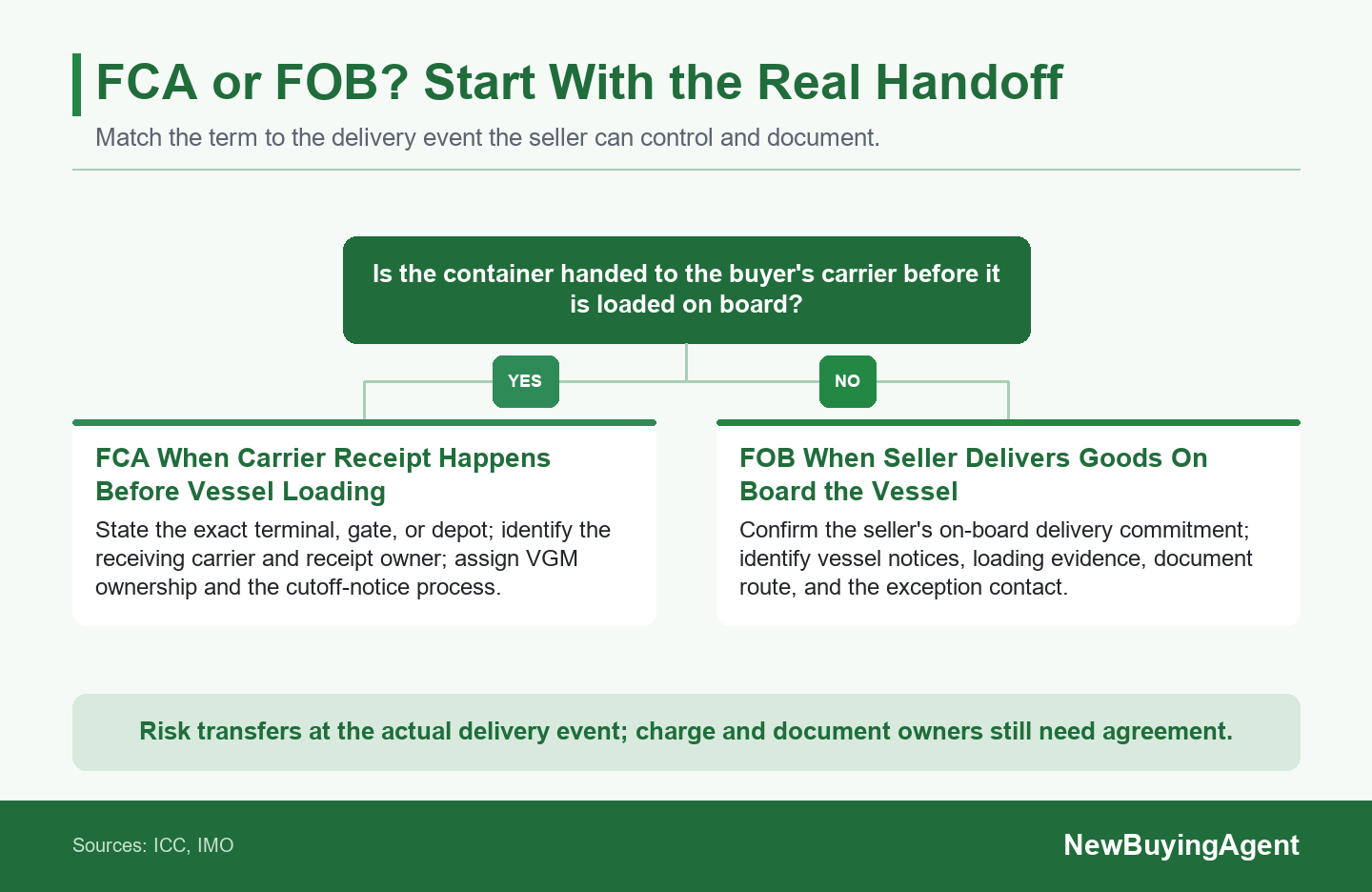
Choose the term by the real delivery event: pre-loading carrier handoff generally points to FCA; seller delivery on board can support FOB.
FCA's named delivery point must be specific enough for both parties to identify the actual handoff. The UK government's FCA definition distinguishes delivery at the seller's premises from delivery at another named place. That is why a terminal, depot, or gate should be identified with enough detail for the buyer, factory, and receiving carrier to recognize the same event.
That named point should answer four ordinary questions before the booking is approved: Who brings the packed container there? Who is authorized to receive it? What receipt or electronic acceptance will evidence delivery? What happens if the terminal refuses, rolls, or reschedules the unit? The answers do not all sit inside the three-letter rule. They belong in the sales contract, carrier booking instructions, and charge schedule.
FCA can accommodate an on-board bill-of-lading request when the parties arrange the carrier instruction. ICC explains that the Incoterms 2020 revision addressed the situation in which a buyer can instruct its carrier to issue an seller-facing on-board bill of lading under FCA after loading. That is useful when a payment instrument requires an on-board notation, but it is not automatic. Confirm the carrier's process, the contract wording, and the bank's documentary requirements rather than changing to FOB only to pursue a document.
FCA therefore suits a common container sequence: the buyer arranges main carriage, the seller completes the agreed pre-carriage and export-side handoff, and the carrier takes responsibility at a named place before the vessel-loading event. It does not make every charge or document the buyer's responsibility by default. It simply gives the parties a delivery event they can identify and evidence.
For buyers purchasing China-sourced products through NewBuyingAgent, the same distinction belongs in the early product and supplier brief: delivery assumptions affect how a factory quotation, packing plan, and buyer-nominated carriage will be coordinated. The service conversation works best when it begins with the complete purchase requirement rather than a request to interpret one isolated freight line.
What FOB means—and why the on-board point matters
FOB delivery and risk transfer occur on board the nominated vessel. The ICC's FOB explanatory note makes the container issue explicit, while the U.S. Trade Administration's overview places FOB in the sea and inland-waterway group. FOB is not appropriate when goods are handed to a carrier at a container terminal before they are on board. That is because the terminal interval can sit between the seller's physical handoff and the vessel-loading event that FOB uses for delivery and risk.
FOB is a sea or inland-waterway rule, while FCA can be used with any transport mode. The U.S. Trade Administration's mode overview makes that category distinction. For a China container shipment, the category is a starting check; the parties must still match the term to the actual receiving and loading sequence.
FOB can still be commercially coherent where the seller can truly deliver the goods on board the buyer-nominated vessel at the named port. That may be easier to observe with certain non-containerized cargo flows. It is not a shorthand for “the shipment travels by sea,” nor is it a pricing label that eliminates the need to define terminal handling, export formalities, notices, release orders, demurrage exposure, or document timing.
For a container shipment, an FOB line can obscure rather than solve a question: what is the seller expected to control after the terminal has received the container? If the answer is “nothing meaningful,” an FCA delivery point can give both sides a cleaner risk boundary. If the seller is genuinely responsible up to on-board delivery, then make sure the operational process, carrier access, and documentary evidence support that promise.
Choose the term by control, not by the port name
A carrier handoff at a container terminal before loading is an FCA signal. ICC's FOB explanatory note and its Incoterms 2020 buyer checklist direct attention to that distinction. The signal is not a mechanical rule. It tells the buyer to compare the contract with the real sequence—factory release, carrier acceptance, terminal receipt, and vessel loading—before accepting the quote wording.
| Decision point | FCA | FOB | Buyer check before approval |
|---|---|---|---|
| Delivery event | Carrier or buyer-nominated person receives cargo at the named place. | Goods are on board the buyer-nominated vessel. | Name the exact terminal, gate, depot, or vessel event. |
| Container-terminal fit | Usually aligns with a pre-loading handoff. | Requires a real on-board seller-delivery commitment. | Ask when the carrier first accepts the sealed unit. |
| Risk trigger | At the agreed FCA delivery point. | When goods are on board. | Do not confuse risk transfer with every freight charge. |
| Evidence to request | Carrier receipt or terminal acceptance tied to the named point. | Evidence of on-board delivery and the agreed document route. | State the record owner, format, and escalation route. |
| Transport-mode scope | Any mode; often useful for container flows. | Sea or inland-waterway use only. | Match the term to the actual carriage design. |
VGM is required before a packed container can be loaded and its responsibility must be assigned. The International Maritime Organization's VGM guidance states that the shipper named in the transport document must provide verified gross mass in time for stowage. FCA and FOB do not by themselves settle that operating responsibility. The buyer should identify the document shipper, VGM preparer, deadline, submission channel, and confirmation evidence.
NewBuyingAgent can be relevant once the purchasing path is clear: a buyer planning a new China-supplied product and a buyer coordinating an existing factory may need different support around product, supplier, quality, and delivery assumptions. Before the shipping term is fixed, buyers can compare NewBuyingAgent service options before the shipping term is locked. The objective is not to turn a sourcing discussion into freight advice; it is to make the purchase brief and the intended handoff visible early enough for the right parties to confirm them.
An illustrative terminal-handoff correction
The operating records must name an aligned delivery event. Consider an illustrative retailer buying 1,200 cartons of finished home goods from one China factory for a single 40-foot container to Europe. Its buyer-nominated forwarder plans to collect the sealed unit at a named terminal two days before vessel loading, while the factory quotation says “FOB Shenzhen.” This is a hypothetical decision exercise, not a NewBuyingAgent client result, freight quotation, or a universal procedure.
When the factory is already chosen, China-side follow-up may be the business issue rather than a new supplier search. In that context, a buyer can review factory management for an existing China supplier to understand the service path. The service decision should still be based on the full purchase and coordination need, not on a request to validate a single freight document.
The four records that must agree
An illustrative retailer is buying finished home goods from one China factory and appointing its own forwarder for a 40-foot container to Europe. The affected scope is 1 factory, 1 buyer-nominated forwarder, and 1 terminal handoff. The purchase is 1,200 cartons in one 40-foot container, with a factory pickup window five days before the vessel's cargo cutoff. The supplier quote says FOB Shenzhen, while the buyer's forwarder collects the sealed container at a named terminal two days before the vessel is loaded.
The factory can hand the sealed container to the carrier at the terminal, but it cannot control stowage or the actual vessel-loading time. The booking instruction names a terminal gate, but the sales contract names only the port and does not say who supplies VGM or terminal handoff proof. The commercial wording says FOB even though the observed operational delivery happens before on-board loading. That leaves the factory carrying a risk boundary it cannot directly control and leaves the buyer without a clear evidence request for the handoff.
Change the contract line to FCA with the precise agreed terminal handoff point, then align the forwarder instruction, VGM process, and receipt evidence to that point. Issue a revised order sheet naming the terminal, carrier handoff, cutoff instructions, VGM owner, and the receipt or terminal record expected after delivery. Release the container only after the contract, booking instruction, compliance handoff, and terminal receipt name the same commercial parties and delivery point. This is an illustrative buying scenario, not a NewBuyingAgent client case, a freight quotation, or legal advice.
The contract, booking, compliance handoff, and terminal receipt should align. First, the sales contract names the Incoterm, version, and delivery point. Second, the booking instruction identifies who tenders the unit, who receives it, and which notices matter. Third, the compliance handoff identifies the responsible party and timing without claiming that the term alone completes a regulatory task. Fourth, the carrier or terminal receipt shows the actual acceptance event. If one record still describes a different port-only or on-board event, correct it before relying on the sequence.
Write the shipping instruction before you approve the quote
A three-letter term is not a complete shipping instruction. A usable contract line begins with the Incoterm version and the exact named place or on-board event. It then identifies the carrier or receiving party, the delivery evidence, booking notices, charge exceptions, VGM process, document owner, and escalation contact. This is a commercial control list, not a substitute for legal review, insurance advice, or carrier-specific terms.
ICC's buyer checklist directs container users toward FCA instead of treating an FOB port label as decisive. Before approving the instruction, use the ICC buyer checklist to confirm that the selected rule matches the movement and then complete the transaction-specific records described below.
Use the following sequence when comparing a factory quotation, forwarder booking, and purchase order:
- State the rule and version. Write FCA or FOB with “Incoterms 2020,” rather than relying on a bare acronym copied from an old quotation.
- Name the delivery event precisely. For FCA, identify the address, terminal, depot, gate, or agreed receiving point. For FOB, identify the named port and the seller's actual on-board delivery commitment.
- Separate risk from price. List which party quotes and pays each agreed pre-carriage, terminal, documentation, inspection, and freight item; do not infer every charge from risk transfer.
- Set the evidence route. Define who receives the carrier receipt, booking status, VGM confirmation, and any on-board document, and when those records must be shared.
- Write the exception path. Note what happens if the terminal rejects cargo, the booking changes, the container misses a cutoff, or a document cannot be issued as expected.
For a new product purchase, the shipping term should be part of a complete request rather than an isolated line item. Product details, quantity, target price, destination, timing, packaging needs, and the intended handoff point give the supplier and buyer a shared operating baseline. Buyers who need China-sourced products can use NewBuyingAgent's product-supply service with a complete container-shipment brief when the product purchase itself needs to be quoted and supplied around those practical assumptions.
Keep a version-controlled instruction set instead of allowing the term to change across emails. The purchase order, pro forma invoice, booking request, packing list, and forwarder communication do not have to repeat every commercial clause, but they should not describe incompatible handoff events. A short confirmation call can be valuable when buyer-nominated carriage, a bank document, and an export terminal sequence overlap. Record the decision and the exception owner afterward.
Check the physical and information sequence as well as the contract line. A container can be packed, sealed, and accepted at a named point while the loading time remains outside the factory's control. A booking confirmation can name a cutoff without proving delivery. A receipt can prove acceptance without deciding which party pays a later exception charge. Treat each record as evidence of one part of the movement, then compare the records against the allocation that the parties actually agreed.
Public examples can help a buyer assess whether a service partner communicates scope and operating context clearly, but they do not determine the correct Incoterm for a new transaction. If that context would be useful, review NewBuyingAgent sourcing stories for buyer-context examples
Before the first container is released, perform one final alignment check. Read the Incoterm line aloud with the named point; compare it with the carrier's collection or delivery event; check whether the seller can actually control the promised milestone; and identify who owns the next record. Then compare the purchase order against the latest booking confirmation and confirm that the factory, buyer, and forwarder are working from the same version. If the booking is revised, update the instruction before a pickup or terminal appointment is treated as final. If a charge, document, or VGM responsibility is still unclear, assign it to the party that can answer it rather than leaving an assumption in the email thread.
If the container term is one unresolved part of a defined China purchasing request, prepare the full brief before asking for support. Include the product, quantity, destination, timing, current factory status, booking contact, and intended handoff point. That gives the conversation enough commercial context to determine whether product supply or existing-factory coordination is relevant. When that context is ready, share the container-shipment brief with NewBuyingAgent
Frequently Asked Questions
Residual FCA and VGM questions should be answered within the source boundaries already explained. These answers are general information; the sales contract, carrier procedure, payment instrument, insurance terms, and transaction-specific compliance requirements still need their own confirmation.
Is FCA always better than FOB for containerized cargo?
FCA is usually the better fit when the container is handed to a carrier at a terminal before vessel loading, but it is not automatically better in every contract. The delivery point, payment-document requirement, carrier process, and actual seller commitment must work together. FOB remains relevant where the seller is genuinely delivering on board the nominated vessel.
Does FCA mean the buyer pays every cost after pickup?
No. FCA transfers risk at the agreed delivery point, but the actual commercial allocation of charges must still be stated in the sales and freight arrangements. Confirm pre-carriage, terminal, documentation, loading, main-carriage, insurance, and exception charges instead of treating the term as a complete price schedule. Ask for the charge owner and trigger before comparing quotations.
Can a seller obtain an on-board bill of lading under FCA?
Yes, Incoterms 2020 FCA can accommodate an agreement for the buyer to instruct its carrier to provide an on-board bill of lading to the seller after loading. The carrier, contract, and bank or payment-instrument rules still need to support that route. Do not assume the document will be issued in the required form without checking the process.
Who submits VGM for a container shipment from China?
The shipper named in the transport document is responsible for providing verified gross mass in time for vessel stowage. Because the named shipper and submission method can depend on the transport arrangement, identify the responsible party, deadline, channel, and confirmation record in the operating instructions. Check that the carrier has accepted the submission before treating the loading condition as closed. FCA or FOB alone does not replace that assignment.
NewBuyingAgent
Related Resources
Get Started Today
Let's Turn Your Sourcing Goals into RealityWeChat:+86 15157124615
WhatsApp:+86 15157124615
Address:Building 10 #39 Xiangyuan Road, Hangzhou, China