
Dimensional weight engineering is the redesign of a packed product to reduce billable space under the applicable freight rules while preserving its protective functions. The useful target is a smaller, validated shipping pack that produces a defensible commercial benefit. A reduction in carton volume alone proves neither lower freight charges nor adequate product protection.
For buyers sourcing from China, the decision usually arrives as a supplier proposal: use a shorter carton, change the insert or rearrange the product. Before approving it, connect the proposal to measured shipping dimensions, the actual charging model and evidence that the revised pack still performs its job.
Optimize the billed pack, not just the empty box
A useful packaging reduction changes the billed pack without leaving its protective requirements unresolved. Confirm the charging model, measure the closed production pack and evaluate a justified redesign before approving the new specification. Then obtain a matched freight quotation: a lower dimensional weight can be commercially useful, but it does not establish a proportional reduction in the final invoice.
- Pricing: use the actual service, account and rate rules before calculating savings.
- Risk: distinguish removable void from cushioning, restraint, clearance and structural support.
- Decision: adopt the revised pack only when its protection evidence and commercial effect support the change.
Find out what actually determines your freight charge
Dimensional weight converts a package’s measured volume into a rating weight using a divisor. Billable weight is the weight used to rate the shipment under the applicable service rules, often determined by comparing dimensional and actual weight before applying the specified rounding. Establish those rules first, because a smaller carton can change one input while the same weight band, minimum charge or other billing condition still applies.
DHL Express UK’s weight-and-dimensions explanation illustrates centimetre length multiplied by width and height, divided by 5,000, yielding volumetric weight in kilograms. It compares actual and volumetric weight and charges on the greater figure. Use that as a scoped explanation of the mechanism, then confirm the terms for your shipment rather than applying the example to every transport service.
The UPS US dimensions-and-weight page lists a divisor of 139 for Daily Rates and 166 for Retail Rates for cubic-inch calculations yielding pounds. The difference shows why a divisor needs its units and rate context. Do not put centimetres into an inch-based formula, or select a divisor because it makes a proposed carton look cheaper.
Separate the China export movement from any later warehouse-to-consumer shipment. Each leg may use a different charging basis, shipping unit and account. A change that reduces parcel dimensional weight might improve storage or container utilization elsewhere, but those effects need their own calculation and quotation.
Record the service, route, account or rate type, divisor and units, dimension-rounding rule, weight-rounding rule, package-versus-shipment basis, applicable surcharges and quote validity. Ask the provider which of these changes under the proposed pack. This gives the packaging team a real target, such as a lower rated weight or the removal of an applicable size charge, rather than a general instruction to make everything smaller.
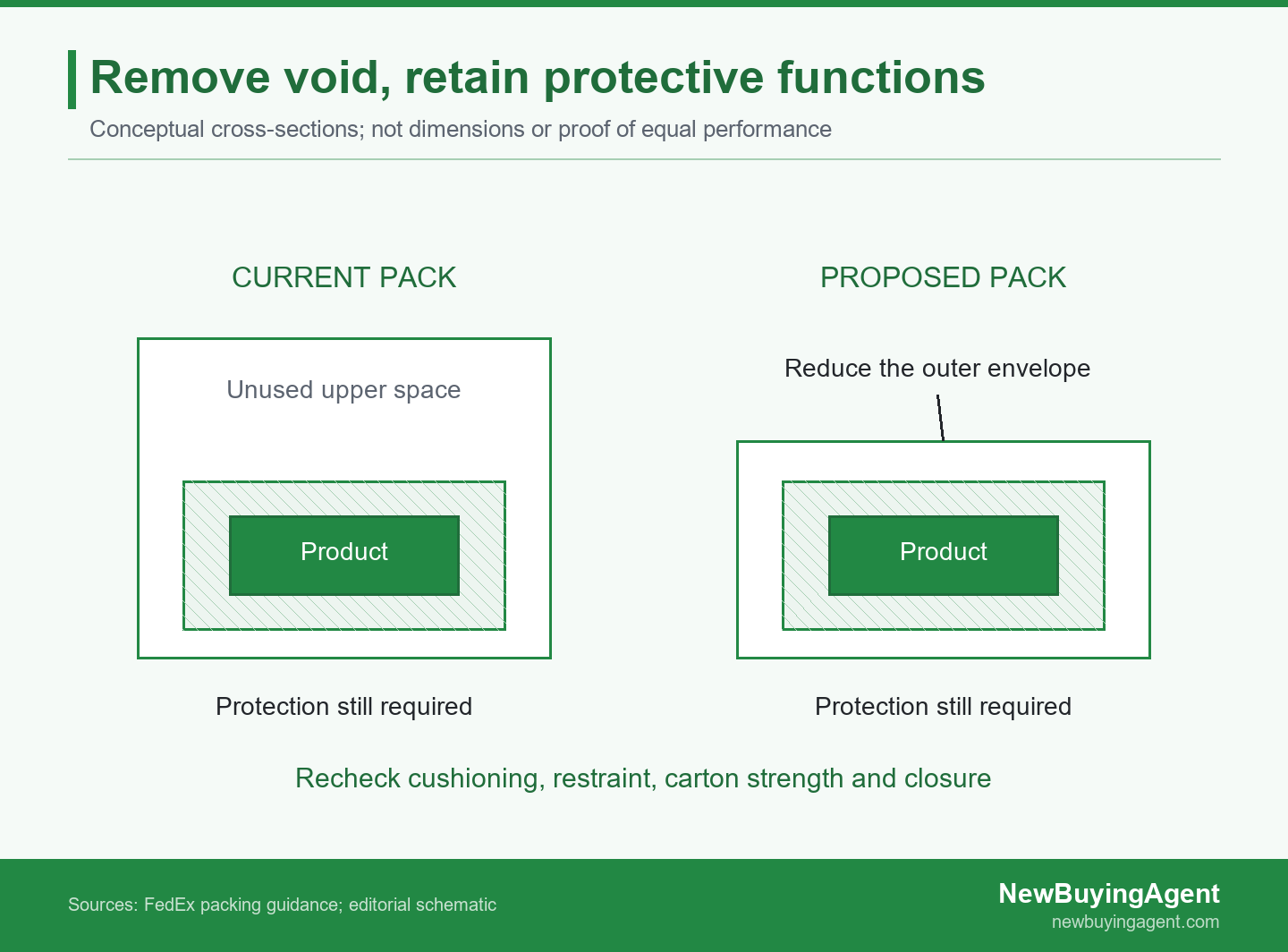
An illustrative carton redesign removes upper void space while keeping the product and protective zone; the complete revised pack still needs validation.
Measure the closed production pack before redesigning it
Measure the loaded, closed shipping pack at its extreme outside dimensions and record its actual gross weight. A carton drawing or internal box size does not capture the full shipping envelope, including bulges, closure effects or protruding protection. Identify the product, packing arrangement and sample revision alongside the readings, so the calculated benefit can be connected to something the factory can reproduce.
Use the same measurement approach on the current and proposed versions. Photograph the packed unit with the measurement positions visible, record the scale reading, and retain the unrounded dimensions as well as the rating inputs. Gross weight includes the product and all packaging, not just the product weight printed on the specification.
Rounding can erase a small physical reduction. The linked FedEx Hong Kong packing guide instructs shippers to round fractional centimetre or inch dimensions upward to the next whole unit before dimensional calculation. Confirm the rule that applies to your service and account; do not assume every carrier or contract uses the same sequence.
Measure representative production packs, not only a carefully assembled development sample. Record the range observed and investigate why a carton bulges or gains height. If a proposed benefit depends on an exact boundary, ask whether ordinary material and packing variation can keep the finished shipment within it. Allowing for real variation is part of designing the pack, not a reason to understate the dimensions.
Reduce unused volume while preserving the protective system
A smaller carton needs to retain the functions that protect its contents. FedEx’s breakables guidance calls for a sturdy box with room for cushioning and explains the importance of restricting product movement. For a redesign, distinguish genuinely unused space from material or clearance that absorbs impact, separates components, supports the product or keeps it away from the carton wall.
Change the product arrangement before cutting protection
Begin with product arrangement where the design permits it. Rotating an item, nesting suitable components or placing accessories in a controlled internal compartment may remove unused height without simply thinning the protective layer. Check that the new arrangement does not create contact between damage-sensitive surfaces, concentrate load on a weak feature or make the product difficult to unpack and assemble.
Make each proposed change visible in the pack drawing and bill of materials. State what the insert does, where it contacts the product and which movement it restrains. For a rigid product, a close-fitting insert may perform a different function from loose fill; they are not interchangeable merely because both occupy space.
Keep the current version as a reference and build the proposed pack with identified materials. A packaging specialist should evaluate whether the arrangement is suitable for the actual product and route. Do not apply a universal minimum clearance or compress every product until the carton closes.
Recheck the carton, inserts and closure as a system
Changing carton dimensions can change the way the complete pack carries load and responds to handling. Keeping the same board description does not prove that the new carton, inserts and closure perform like the old assembly. Recheck the finished construction, including joints, sealing, product support and any stacking arrangement that matters to the shipment.
When packaging is being developed with a China-sourced product, the product and carton decisions need to fit together. NewBuyingAgent describes local factory resources and product-development and QC capability relevant to integrating those requirements in a product purchase. That capability provides a practical sourcing context; product-specific packaging design and test evidence still need to be agreed for the order.
Keep appearance, protection and handling acceptance explicit. A pack that prevents breakage but marks the product, loses accessories or no longer meets the receiving channel’s requirements has not preserved the same useful result.
Work through a carton-height change before claiming savings
Consider an illustrative importer replenishing an ecommerce kitchen-organizer range from China, whose purchasing team can approve the product’s packaging specification. The supplier proposes a reduction in carton height, but no matched freight quotation or passing protection test has yet been supplied. The arithmetic can show whether the proposal changes the assumed billable weight; approval for this and later orders still depends on the commercial and protection evidence for the identified pack.
Illustrative example: calculate the new billable weight
An illustrative order of 800 cartons has actual gross weight of 12.8 kg per carton. Assume a divisor of 5,000 cm³/kg and round the higher of actual and dimensional weight up to the next whole kilogram. These are example assumptions, not a quotation or a complete rule set for a named carrier; the redesign remains proposed pending its quote and protection evidence.
Compare the two closed outside sizes using the same assumed gross weight and rating method. The example treats the stated dimensions as the rating inputs and assumes no packaging-weight change, surcharge, minimum-weight override or other charge adjustment.
| Example pack | Outside size | DIM calculation | Billable weight |
|---|---|---|---|
| Current | 50 × 40 × 40 cm | 80,000 ÷ 5,000 = 16 kg | 16 kg |
| Proposed | 50 × 40 × 35 cm | 70,000 ÷ 5,000 = 14 kg | 14 kg |
In this example, reducing outside dimensions from 50 × 40 × 40 cm to 50 × 40 × 35 cm changes dimensional weight from 16 kg to 14 kg; the rounded actual-weight floor is 13 kg. Both table results remain above that floor. Once actual weight determines the rating, further volume reduction alone cannot keep reducing billable weight under these assumptions.
Separate a lower weight from a lower freight invoice
The example reduces cube and billable weight by 12.5%, without establishing the same freight-price reduction. No applicable rate or passing protection test has been supplied. Obtain quotations for both identified pack versions on the same route, service, account, date basis and shipment quantity, with the relevant extra charges included.
Hold implementation until the identified redesigned pack meets agreed protection and channel criteria and a matched service/account quote establishes the commercial effect. Build and evaluate the revised pack with its actual product, inserts, carton and closure, then confirm the dimensions on representative production packs before releasing the revision.
This illustrative example is not a client result, a passed test or a verified freight saving. If the smaller version fails its acceptance criteria or the quote provides no useful benefit, revise or retain the current pack rather than approving the change from the dimensional calculation alone.
Validate the redesigned pack against its real distribution route
Validate the redesigned pack against the hazards and acceptance criteria relevant to its actual distribution route. Define unacceptable product damage, functional loss, missing components and packaging failures before evaluating representative packed units. Keep the tested configuration, method, conditioning and results tied to the proposed revision, so a report for a different insert or closure cannot silently become approval for this design.
The ISTA 3A overview describes parcel packaged-product evaluation and notes that its tests do not necessarily comply with carrier packaging regulations. The linked document is an overview, not an approval certificate or the complete procedure. Ask a qualified laboratory to confirm the current appropriate procedure and any separate carrier or receiving-channel requirements.
The public scope of ASTM D4169 describes laboratory evaluation through sequences of distribution hazards and identifies single-parcel testing as a separate method-selection consideration. Select an evaluation plan for the real shipping unit and route instead of choosing a standard because its name appears on an older report. A loose parcel, palletized unit and retail delivery pack may need different treatment.
Use an approval checklist that separates the questions:
- Protection: identified product and pack revision; agreed damage and functional criteria; applicable evaluation and results.
- Handling: closure, restraint, lifting or pallet arrangements, and any storage conditions included in the design.
- Channel acceptance: current receiving specifications, packaging configuration, labels and scannability where required.
- Billing: measured production dimensions and gross weight, applied rules and a matched quotation.
A successful physical evaluation does not answer labeling obligations or every channel rule. Equally, an accepted shipping label does not establish product protection. Close each applicable question using its own evidence and record the remaining limitations.
Carry the approved pack into the China purchase and production order
The approved packaging revision should become part of the product purchase and factory instructions. Freeze its drawing, bill of materials, packing method, acceptable packed-size range, gross-weight expectation and approval evidence before routine production uses it. Name who can authorize changes, because a factory substitution or inconsistent packing method can remove either the expected billing benefit or the protection established during development.
Include these fields in the purchasing attachment or revision record:
- Identity: product reference, pack revision, approved sample and responsible approver.
- Construction: carton and insert materials, dimensions, component arrangement, closure and pack quantity.
- Verification: measurement method, size tolerances, gross weight, protective acceptance evidence and unresolved exceptions.
- Commercial basis: service and account assumptions, relevant quote, cost of the changed pack and any new packing work.
- Production control: lot identification, inspection points, deviation reporting and approval required before substitution.
For buyers already working with a China factory, NewBuyingAgent’s existing-factory management service describes production follow-up, staged QC, reports and logistics coordination. In a packaging revision, that support can connect the approved product and pack requirements to factory execution and make deviations visible for disposition. Agree the actual scope, including how specialist testing and freight quotations will be obtained.
If your next China product order needs a costed packaging solution, prepare the product specification, quantity, target price, destination and delivery timing, together with the current and proposed pack, actual shipping service, route, quote assumptions and expected repeat-order schedule, to request a China product-supply offer from NewBuyingAgent. Its local factory resources and product/QC capability can support an offer incorporating the packaging requirements into the supplied product. Evaluate that offer against the approved protection criteria and the actual commercial basis.
Questions about dimensional weight and packaging changes
Can the same dimensional divisor be used for sea freight?
Use the sea-freight quotation basis rather than copying a parcel dimensional divisor. Reduced cube may change a volume-rated charge or help fit more product into a loading plan, but those are different calculations from parcel billable weight. If the same container is still booked at the same agreed price, a smaller carton does not by itself establish a lower freight invoice. Ask the forwarder to price the actual shipping unit and shipment arrangement.
Is vacuum packing a safe way to reduce every shipment?
Vacuum packing is suitable only when the product and packaging have been evaluated for compression and recovery. Check material behavior, recovery after unpacking, appearance, function and any storage or moisture issues relevant to the product. A technique suitable for one compressible textile product cannot be assumed suitable for rigid, delicate or mixed-component goods. Compare the complete revised pack and its packing process against agreed criteria before treating the smaller dimensions as an improvement.
How close should the carton be to a billing-size boundary?
Set a feasible packed-size tolerance and verify production variation against the actual rating rules. There is no universal clearance below a billing boundary that works for every carton, measuring system and production process. Retain the measured range, investigate bulging or inconsistent closures and confirm how the provider rounds its measurements. A hand-built sample just below a boundary does not prove that all production cartons will be rated the same way.
Does a successful pilot shipment prove the smaller pack is safe?
A successful pilot shipment supports only the units and conditions it actually covered. It can reveal operational problems with packing, handling or receiving, but it does not replace a defined packaging evaluation or establish performance on every later route. Keep the pilot pack revision and observations traceable, and review whether production materials and methods match them. Use the result alongside the agreed validation and inspection plan, rather than as a guarantee of future delivery outcomes.
NewBuyingAgent
Related Resources
Get Started Today
Let's Turn Your Sourcing Goals into RealityWeChat:+86 15157124615
WhatsApp:+86 15157124615
Address:Building 10 #39 Xiangyuan Road, Hangzhou, China