Containment is action to limit exposure to a defect. Rework is action on affected goods to bring them into conformity with their requirements. Corrective action is action to remove the cause to prevent recurrence. These distinctions combine Bosch’s containment guidance with the correction-versus-cause distinction in FDA’s CAPA training transcript; they describe different jobs, even when the factory performs them together.
For a buyer managing production in China, those different jobs need different approvals. A warehouse hold can protect the next shipment without fixing a single unit. Repacking can correct the current order while the same packing error remains possible on the next run. A process change can address the cause without proving that the goods already produced are acceptable. Keeping these decisions separate makes the supplier’s response easier to review.
Keep the Three Quality Decisions Separate
Treat containment, rework and corrective action as separate approvals with named owners and inspectable evidence. Start by controlling exposure to the problem. Then decide how the affected goods will be dispositioned and whether a proposed rework method is suitable. Investigate the cause in parallel where appropriate, and judge prevention by the results of the changed process.
- Containment: Identify and control the stock that could be affected, including its locations and movement.
- Rework: Approve the method and scope, then verify the goods against the agreed product requirements.
- Corrective action: Connect a verified cause to a change and check whether the change works under relevant conditions.
- Closeout: Record which approval is complete, which remains open, and who can authorize the next step.
Containment, Rework, and Corrective Action: Compare the Decisions
The comparison below covers routine factory nonconformities discovered during active production or before shipment. It compares the purpose, scope, authority and evidence of each buyer decision; it does not rank three competing services. The criteria are a buyer synthesis of the source definitions and problem-solving guidance. Product-specific tests and contractual acceptance requirements still need to be agreed for the order.
| Decision dimension | Containment | Rework | Corrective action |
|---|---|---|---|
| Main question | Where could the defect still reach people or the next process? | Can these goods be made to meet the requirements? | Why did the issue occur, and what prevents recurrence? |
| Affected scope | Suspect stock, locations, movements and production exposure. | The specifically authorized units and changed characteristics. | The cause pathway and relevant process or product family. |
| Typical action | Hold, identify, segregate, trace or sort. | Repack, replace an incorrect component or repeat an approved operation. | Change the verified cause and strengthen the relevant control. |
| Approval focus | Boundary of the hold and effectiveness of temporary controls. | Suitability of the method and verification of product conformity. | Evidence linking cause, action, implementation and effectiveness. |
| Evidence to request | Stock reconciliation, batch references, hold status and control results. | Work instruction, treated-unit records, test results and disposition. | Cause evidence, change record, acceptance criteria and follow-up results. |
| Completion means | The exposure covered by the control is managed. | The defined goods meet agreed requirements after the work. | The implemented action is effective against the verified cause. |
| What remains open | Product correction and the reason the defect occurred. | Recurrence risk and any unverified stock. | Current-lot disposition unless separately verified and authorized. |
Based on these differences, approve containment when exposure needs control, approve rework when a suitable method can restore the affected goods, and approve corrective action when cause removal and recurrence prevention need evidence. Several actions may run together; completion of one does not authorize the others.
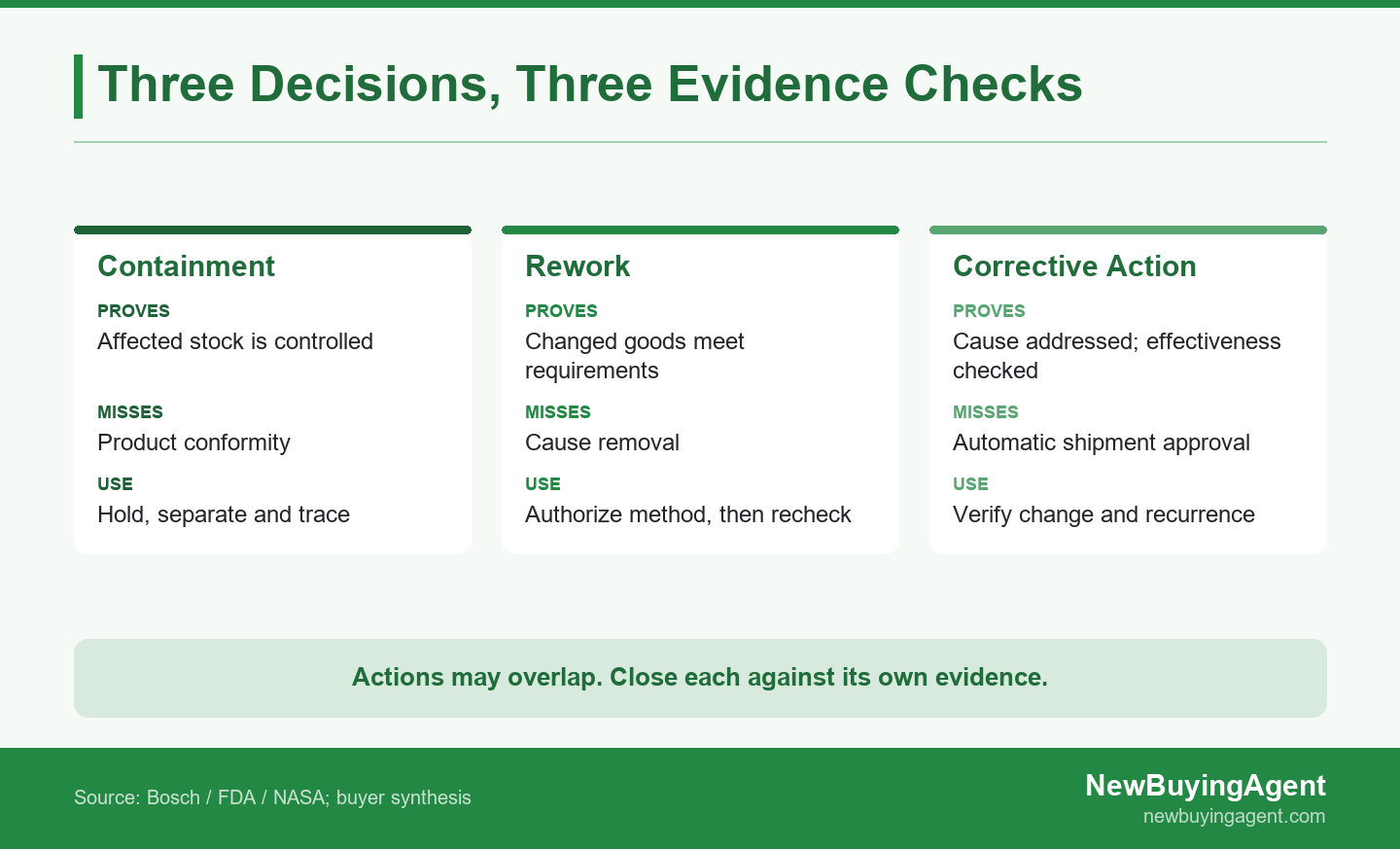
Containment controls exposure, rework checks current goods, and corrective action verifies prevention of recurrence.
For background on the manufacturing context behind these decisions, the China manufacturing and product guide provides a starting point. Use the actual product specification, drawings, approved samples and order conditions to turn that background into acceptance criteria for this factory.
Containment: Establish Which Goods Are Under Control
Containment starts with preventing further exposure: Bosch’s problem-solving booklet describes holding and sorting lots, and considering goods in transit, intermediate storage and at the customer. Its manufacturing problem-solving guidance calls for documented results and attention to unwanted side effects, so the buyer’s review includes where suspect goods are and whether the control actually covers them. The guidance describes a manufacturing response; its company procedures are not automatically requirements for every purchase order.
Ask for the batch references, production or packing period, quantity, storage locations and shipment status that define the affected boundary. Reconcile the quantities held, checked, rejected, treated and released so the same goods cannot appear in conflicting categories. Where records cannot distinguish the suspect run from other stock, broaden the hold pending evidence rather than accepting an unsupported narrow boundary.
A photograph of a marked pallet helps show identification, but it cannot establish that every relevant carton is on that pallet or that the hold also exists in the warehouse system. Request evidence suited to the failure: movement restrictions, a location list, packing references or observation of the proposed sorting check. A visual sort may separate a visible wrong label; it cannot establish the absence of a hidden material problem.
Name the person controlling stock and the next update time. If production continues, identify the additional temporary check and how its results will be reported. Keep production authorization, movement authorization and shipment authorization explicit. A control that works at one station may still leave an escape through a different warehouse, shift or shipping route.
For buyers whose existing China factory is difficult to follow up remotely, NewBuyingAgent’s local communication and quality-control capability can help connect supplier statements to inspection observations. Its service for buyers who need to manage production and quality at existing China factories includes production follow-up, staged inspections and reporting. That local support is useful when the buyer needs a clear account of the stock and factory response rather than another unspecific completion message.
Rework: Approve a Method and Recheck the Product
Rework is a product decision. In NASA’s quality-assurance terminology, rework brings nonconforming product into conformity with requirements, while repair makes it acceptable for its intended use. Those definitions come from NASA’s acquisition context; they are used here to clarify the distinction, not to impose aerospace approval procedures. For a buyer, a change that leaves a requirement unmet should not be described as conforming rework merely because the product still functions.
First decide whether the proposed operation can restore the actual requirement. A missing hardware packet may be added under a controlled repacking instruction. A wrong material, compromised coating or damaged load-bearing component may need a different technical assessment, replacement or rejection. The supplier’s familiarity with an operation is not enough to establish its suitability for the affected product.
Define the Rework Method Before Work Starts
Before rework starts, agree the instruction revision, the authorized scope and units covered, the operation sequence, the responsible team and the checks that will follow. Include how original identification is retained and how treated goods are distinguished from untouched or rejected goods. If cartons must be opened, the instruction should also address the packaging, labels and components that could be disturbed by the work.
Use a controlled initial trial when necessary to establish that the proposed method can achieve the requirements without creating another defect. Decide who evaluates that result before the factory extends the method to the authorized scope. The appropriate trial and inspection plan depend on the product and risk; there is no universal number of trial pieces that makes every rework method acceptable.
Record changes to the method as changes requiring review. If the factory discovers a different defect while repacking, the original instruction may no longer cover the work. Keep the revised scope visible so a practical adjustment does not silently become permission to substitute components, alter the specification or dispose of unrelated stock.
Verify the Changed Product Against Its Requirements
After rework, verify the characteristics affected by the original failure and by the operation itself. NASA’s product-verification guidance explains that a change to a nonconforming product may require verification to be planned and performed again. The transferable lesson is to reassess the checks for changed goods; the required tests for a commercial product come from its own requirements and risks.
The rework record should connect the original stock references, work performed, results and disposition. In a repacking task, checking for the newly added packet is only part of the picture: carton identification, component completeness and packaging condition may also matter. Keep failed, unchecked and approved units distinguishable until their dispositions are recorded.
Corrective Action: Remove the Cause and Check Recurrence
Corrective action turns from the current goods to the cause pathway. Siemens’ description of 8D problem solving separates the cause of occurrence from the cause of escape: why the issue happened and why the control failed to detect it. For a missing component packet, these could involve different facts. A packing omission explains the defect; an unsuitable check could explain why it passed through.
Ask the supplier to show the evidence behind the explanation before evaluating the proposed change. Records, observations and a technically appropriate controlled test can strengthen a cause claim. “The operator was careless” is not an adequate explanation if the method, materials or checking arrangement also allowed the omission. Choose the investigation depth according to the consequences, repeated failures and uncertainty in the evidence.
The MDSAP quality-system procedure published by FDA distinguishes implementation from effectiveness and notes that retraining or a revised procedure may not be adequate. This is an audit-program quality-system procedure, not a rule applied here to general consumer-goods factories. Its useful lesson is to ask what result will show that the chosen action has actually addressed the cause, and whether the change introduces another problem.
Define the effectiveness check before closing corrective action: the condition to observe, the relevant production scope or review period, the acceptance criteria, the owner and the retained record. Observe conditions relevant to the cause, such as a restart or changeover when that is where the omission occurred. A signed training sheet shows that training took place; it does not show effectiveness of the changed process.
A short successful trial may justify implementing a change while further monitoring continues. If another line or product uses the same failure-prone arrangement, assess whether the action should extend there. Avoid copying a control to unrelated processes just to make a wider action list; the extension should follow the actual cause and exposure.
See the Three Decisions in One Packing Error
The following illustrative packing example shows why stock control, rework and recurrence decisions can have different completion dates before any shipment approval. A missing hardware packet creates an immediate stock problem, but packing records and the proposed checks answer different questions about the affected run and later production. Reviewing the evidence separately helps the buyer identify what can be authorized now and what requires follow-up.
Illustrative Case: Missing Assembly Hardware
A retail brand has ordered 4800 flat-pack shelving units from a China factory. Before dispatch, checks find cartons without the assembly hardware packet. Packing records trace 1200 units to the affected run, although outer-carton weight checks were signed off. This is an illustrative scenario, not a NewBuyingAgent client case. The recorded run gives the buyer an initial stock boundary; the buyer still checks that the records cover all relevant cartons before excluding other stock.
The buyer holds the traceable run and asks the factory to reconcile its locations and quantities. Rework approval then covers controlled opening, confirmation of carton contents, addition of the correct packet and resealing under an agreed instruction. A successful initial trial supports extending that method to the authorized units. Afterward, the verifier records the agreed completeness and packaging checks, identifies failures and submits the results for product disposition.
In this illustrative scenario, retained packing records and a controlled trial support a missing packet-presence check as the cause pathway: the outer-weight check did not reliably distinguish the omission. The proposed corrective action adds a suitable packet-presence control and a restart check. The team verifies the control before adoption, records implementation and monitors the agreed follow-up production conditions. Completed repacking can support a current-product acceptance decision; the buyer keeps recurrence review open until its own evidence is available. No sample success in this example establishes a universal shipment or testing rule.
Close Each Approval Against Its Own Evidence
A passing inspection and an effective process change answer different questions. NIST’s acceptance-sampling explanation describes lot acceptance as a disposition decision, distinct from long-term quality control and from estimating the quality of the entire lot. Where sampling is appropriate, use the agreed plan for its actual purpose. Do not present a passing sample as proof that every unit is conforming or that the cause has been eliminated.
Closeout should reflect what has been demonstrated. The ISO 9001 Auditing Practices Group’s nonconformity guidance calls for objective evidence of implementation and effectiveness, and a review proportionate to whether the issue is systemic or accidental. This is educational audit guidance with an explicit non-endorsement disclaimer, not an additional ISO standard. It supports examining the substance of the response rather than demanding an elaborate investigation for every isolated defect.
A shipment decision can be reviewed against its current product evidence while recurrence monitoring remains open, if the product risk and customer requirements permit. Record the authorized disposition, the accepted evidence and the remaining work. Ending containment also needs a reason: if an ongoing temporary check is still needed to prevent escapes, current-lot acceptance alone does not justify removing it.
For a new product program, building these requirements into purchasing helps avoid improvising the response later. Buyers can ask NewBuyingAgent to supply products from China from purchasing requirements. Its local China factory network and product-development and quality-control capability support translating purchasing needs into product supply. Clear specifications, packaging requirements and defect-response expectations give that work a concrete starting point.
Send a Clear Decision Brief to the Factory
Send the factory a brief that separates the workstreams and names each owner and required evidence. Replace the bracketed fields below with the actual order information and agreed dates; assign responsibility for verification as well as for performing the work. Keep the next response specific to the open approval so the factory returns the relevant stock, product or process records.
- Problem: [Order, product, unmet requirement, photographs or test results, discovery point].
- Containment: [Stock controller, batch/location list, movement restrictions, quantity reconciliation, next update].
- Rework: [Authorized scope, instruction revision, method approval, work owner, verification criteria and results].
- Corrective action: [Cause evidence, change owner, implementation record, effectiveness check and follow-up date].
- Disposition: [Authorized decision maker, evidence reviewed, accepted/rejected/held quantities and remaining open work].
When local factory follow-up is needed, Contact NewBuyingAgent about existing factory management. Share the existing factory and product, the defect description, stock or shipment references, agreed requirements and timing. NewBuyingAgent can discuss support for supplier communication, production and quality management, and staged inspection reporting, so the buyer can agree a useful follow-up scope.
FAQ
Who should pay for rework?
Payment responsibility depends on the purchase contract and the agreed resolution. Keep cost allocation separate from product acceptance: record the authorized work, quotations, responsible parties and commercial agreement. Agreement to pay for rework does not establish that the goods are acceptable, and a supplier’s willingness to rework does not establish who covers inspection, delay or freight costs.
Does a replacement shipment count as corrective action?
A replacement shipment normally addresses the affected delivery rather than the reason the defect occurred. Verify the replacement goods against their own requirements. Ask separately whether the original cause has been identified and addressed before treating replacement as recurrence prevention. Replacement and corrective action can be part of the same response, but they need different supporting records.
What if the affected goods have already left the factory?
Extend the investigation to the actual shipment and customer locations. Use dispatch and receipt records to identify the goods involved, then coordinate with the responsible importer, customer and technical teams. A factory-only hold cannot control goods elsewhere. Safety concerns or market-specific reporting requirements need prompt assessment through the appropriate responsible parties. Determine the applicable response for the product and destination market.
What if the supplier will not share its full process records?
Agree with the supplier what evidence can be disclosed and how any restricted information will be verified. Traceable record extracts, suitable redaction or competent independent review may make the explanation inspectable without disclosing the entire process. Record any remaining gap and its effect on the approval. Confidentiality is a reason to agree a verification route, not evidence that the requested condition has been met.
NewBuyingAgent
Related Resources

Get Started Today
Let's Turn Your Sourcing Goals into RealityWeChat:+86 15157124615
WhatsApp:+86 15157124615
Address:Building 10 #39 Xiangyuan Road, Hangzhou, China